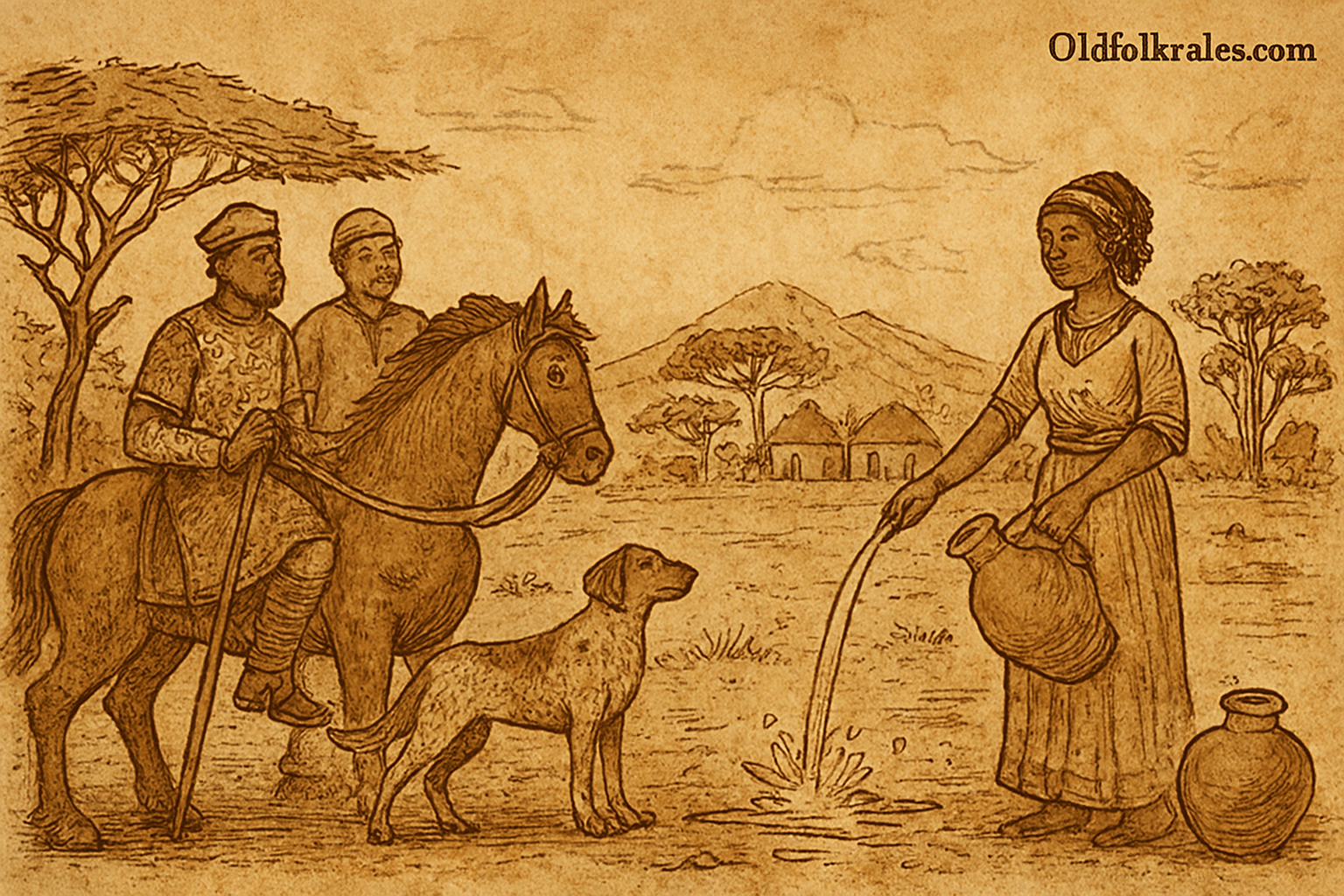
In an ancient African kingdom, where vast savannas stretch beyond the horizon and acacia trees stand like guardians over villages nestled near life-giving rivers, there lived a young prince named Vachagan whose courage in battle was matched only by his love for the hunt. On this particular day, as golden sunlight danced across the grasslands and vultures circled high above the ancient baobab trees, Prince Vachagan rode out with his most trusted companion, a loyal servant who had served his family for decades, and his beloved hunting dog, whose keen nose and swift legs had never failed him in the wild.
The morning hunt had been exhilarating, taking them deep into forests where ancient mahogany trees whispered secrets and clear streams sang their eternal songs. But as the sun climbed to its highest point in the brilliant blue sky, casting harsh shadows across the dusty terrain, both prince and servant found themselves parched and exhausted from their vigorous pursuit through the challenging African wilderness.
Their horses’ flanks heaved with effort as they approached a crystal-clear spring that bubbled up from the earth near a humble village nestled beside the river. The sight of cool, fresh water sparkling in the afternoon light was like discovering the most precious treasure, and Vachagan’s throat ached with desperate thirst from hours of riding under the relentless African sun.
Also read: Golden Brocade, Woven Hearts
As fate would have it, a young village girl was drawing water from the spring, her clay jar catching the sunlight as she worked. Prince Vachagan, his royal robes dusty from travel and his face flushed with heat and exertion, approached her with the natural expectation of immediate service that came with his noble birth.
“Girl,” he called out, his voice hoarse and urgent, “bring me water at once. I am dying of thirst.”
The village maiden, startled by the appearance of such an obviously important traveler, quickly moved to hand him her freshly filled jar. But just as Prince Vachagan reached eagerly for the vessel, another girl appeared as if from nowhere, a young woman whose intelligent eyes seemed to see far more than most people noticed, and whose movements carried a quiet confidence that immediately commanded attention.
This second girl, whose name was Anait, swiftly grabbed the water jar from her companion’s hands before the prince could take even a single sip. To Vachagan’s complete shock and growing irritation, she deliberately poured out every drop of the precious water onto the dusty ground, where it disappeared instantly into the thirsty earth.
Without a word of explanation, Anait calmly refilled the jar from the spring, only to pour it out again the moment Prince Vachagan reached for it. This bewildering ritual continued six times in succession—each time the prince growing more annoyed and confused, each time Anait’s actions becoming more deliberate and purposeful, and each time the precious water disappearing into the ground while his thirst grew more desperate.
“What madness is this?” Prince Vachagan finally exploded, his patience exhausted and his royal dignity thoroughly offended. “Are you mocking me, girl? I could have you punished for such insolence!”
But Anait remained completely calm, her wise eyes meeting his angry gaze without fear or apology. When she finally spoke, her voice carried the gentle authority of someone who understood truths that others missed.
“My lord,” she said respectfully but firmly, “your body is overheated from your long ride under the blazing sun. If you had drunk that ice-cold spring water immediately, the shock to your system would have caused you great harm, perhaps even serious illness. By making you wait while your body cooled naturally, I have protected your health and possibly saved your life.”
Prince Vachagan stared at her in amazement, his anger melting away like snow in spring sunlight. Here was a village girl who possessed not only beauty and courage, but wisdom that surpassed that of his own court advisors. When he finally drank the cool water, it tasted sweeter than the finest wine, and he knew that this remarkable young woman had indeed saved him from his own impulsive nature.
Throughout the long journey back to his father’s palace, Prince Vachagan could think of nothing but Anait’s intelligent eyes and the wisdom she had shown. By the time he reached the royal city with its towering mud-brick walls and magnificent gates, his mind was completely made up.
“I have found the woman I wish to marry,” he announced to his astonished court. “Send messengers immediately with a proposal of marriage to the girl named Anait in the valley village by the spring.”
The royal messengers, dressed in their finest ceremonial robes and carrying the prince’s official seal, rode swiftly to deliver this incredible honor to a simple village girl. But when they presented Prince Vachagan’s proposal with all the pomp and ceremony befitting such an occasion, Anait’s response shocked them to their very core.
“I am honored by His Royal Highness’s proposal,” she said with quiet dignity, “but I must respectfully decline. I will only marry a man who possesses a real trade, someone who can create something useful with his own hands and support himself through honest work, not merely through the accident of noble birth.”
When the stunned messengers returned with this unprecedented rejection, the entire court buzzed with amazement and outrage. Never in the kingdom’s history had anyone refused a royal marriage proposal, especially not a common village girl who should have been overwhelmed with gratitude for such an honor.
But Prince Vachagan, instead of being insulted, found himself even more impressed by Anait’s wisdom and principles. If she demanded that he learn a trade, then learn a trade he would. After careful consideration, he chose the ancient and honored craft of brocade weaving an art that required patience, skill, and dedication to master.
For one full year, Prince Vachagan devoted himself completely to learning this demanding craft. His royal hands, once soft and accustomed only to holding sword and reins, grew callused from working the intricate looms. His eyes strained over countless tiny threads, learning to create patterns of breathtaking beauty and complexity. Day after day, month after month, he practiced with the determination of a man whose heart’s desire depended on his success.
When the year was complete, Prince Vachagan had created a piece of brocade so magnificent that even the master weavers proclaimed it a work of art worthy of the gods themselves. Golden threads caught the light like captured sunbeams, and the intricate patterns told stories of love and dedication that spoke directly to the heart.
This time, when the royal messengers arrived at Anait’s village bearing both the marriage proposal and the prince’s own handiwork as proof of his newly acquired skill, her face lit up with joy and pride. She accepted immediately, recognizing not only the beauty of his craftsmanship but the depth of character it represented.
In time, as fate and wisdom would have it, Prince Vachagan and his beloved Anait became king and queen of their African kingdom, ruling with justice and compassion that made their realm prosperous and peaceful. Their subjects loved them for their wisdom, their fairness, and their understanding of both noble and common concerns.
One day, King Vachagan decided to travel throughout his kingdom dressed as a common merchant, wanting to see for himself how his people truly lived and what challenges they faced. Queen Anait remained behind as regent, governing the kingdom with the same wisdom she had always shown.
But disaster struck during this journey when the king was captured by a band of evil priests who had turned to robbery and kidnapping to fund their corrupt activities. These villains cared nothing for royal blood or noble birth—they would have killed their captive immediately except for one crucial detail that saved his life.
“What skills do you possess?” demanded their leader. “We have no use for useless prisoners.”
“I am a weaver of brocade,” replied the king truthfully, and this simple answer became his salvation.
The bandits locked King Vachagan in a dark, cramped dungeon along with other skilled craftsmen they had kidnapped, forcing all of them to work day and night creating valuable goods that the criminals could sell for profit. But the king’s clever mind was already working on a plan for escape.
Using golden threads and all his hard-won skill, King Vachagan wove a piece of brocade that appeared to be simply another beautiful cloth. But hidden within its intricate patterns was a secret message that only Queen Anait would be able to read, a code based on their shared memories and private understanding that no stranger could possibly decipher.
When the bandits took this golden brocade to market along with their other stolen goods, they eventually arrived at the royal palace, hoping to sell their finest pieces to the wealthy court. Queen Anait herself came to examine their wares, and the moment her eyes fell upon her husband’s secret message woven in gold, her heart leaped with understanding and determination.
Without revealing what she had discovered, Queen Anait quietly purchased the brocade and immediately called her most trusted military commanders to a secret meeting. Within hours, she was leading a rescue mission that followed the bandits’ trail back to their hidden stronghold in the mountains.
The rescue was swift and decisive. Queen Anait’s forces surrounded the criminals’ hideout, freed King Vachagan and all the other prisoners, and brought the evil priests to justice. As the royal couple embraced in the aftermath of this harrowing adventure, King Vachagan looked into his wife’s wise eyes with profound gratitude and love.
“My beloved Anait,” he said with deep emotion, “you have saved my life twice now. The first time was long ago by that spring, when you insisted I should learn a trade. Without that skill, these bandits would have killed me immediately instead of keeping me alive as their weaver.”
Queen Anait smiled with the same wisdom that had first captured his heart, and together they returned to their kingdom, more grateful than ever for the practical knowledge and deep love that had sustained them through every challenge.
The Moral Lesson
The story of Prince Vachagan and wise Anait teaches us that true wisdom lies in valuing practical skills and honest work alongside noble birth and privilege. Anait’s insistence that her future husband learns a trade saved not only his life but also demonstrated that real strength comes from the ability to create and contribute through one’s own efforts. The tale reminds us that wisdom often comes from unexpected sources, and that the most valuable knowledge is often the most practical skills that serve us in times of greatest need.
Knowledge Check
Q1: Who is Prince Vachagan and what happened when he first met Anait at the spring? A1: Prince Vachagan was an African prince who went hunting with his servant and dog. When he stopped at a spring for water, a village girl named Anait poured out the water jar six times before letting him drink, explaining that ice-cold water would harm his overheated body.
Q2: Why did Anait initially refuse Prince Vachagan’s marriage proposal? A2: Anait refused the royal marriage proposal because she would only marry a man who possessed a real trade, someone who could create useful things with his own hands and support himself through honest work, not merely through noble birth.
Q3: What trade did Prince Vachagan learn to win Anait’s hand in marriage? A3: Prince Vachagan chose to learn brocade weaving, an ancient and honored craft that required patience, skill, and dedication. He spent one full year mastering this demanding art until he could create magnificent woven cloth.
Q4: How did King Vachagan’s weaving skills save his life when he was captured by bandits? A4: When evil priests captured the king during his travels, they would have killed him immediately except he told them he was a weaver. They kept him alive to force him to create valuable brocades they could sell for profit.
Q5: What was special about the golden brocade King Vachagan wove in captivity? A5: The golden brocade contained a secret message woven into its patterns that only Queen Anait could read—a coded communication based on their shared memories that revealed his location and situation to his wife.
Q6: What does this African folktale teach about the value of practical skills? A6: The story demonstrates that practical skills and honest trades are just as valuable as noble birth and privilege. Vachagan’s weaving ability not only won him his wife’s respect and love but literally saved his life when he was captured, proving that wisdom lies in valuing useful knowledge and craftsmanship.
Source: African folktale, Africa