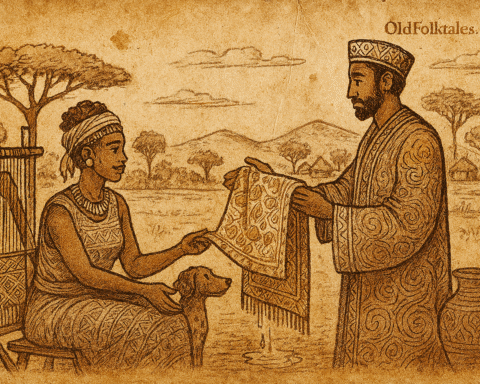
In a small African village where the red earth met the endless sky, there lived a little fly who took great pride in her home. Every morning, as the sun painted the horizon with shades of gold and amber, she would carefully gather fresh cow-dung from the village fields. With delicate precision, she would plaster the walls of her tiny dwelling, smoothing each layer until it gleamed like polished clay in the warm sunlight.
The fly had always been meticulous about her home, believing that a well-maintained dwelling reflected the character of its owner. She would work tirelessly, her tiny wings buzzing with satisfaction as she transformed the simple dung into smooth, protective walls. The other insects in the village often admired her handiwork, noting how her house stood as a testament to patience and care.
But on this particular day, something strange happened. As the fly stepped back to admire her freshly plastered walls, a peculiar fog seemed to settle over her mind. She looked around her familiar surroundings, the acacia trees swaying gently in the breeze, the children’s laughter echoing from the village center, the familiar scents of cooking fires yet something felt terribly wrong.
Also read: Ekanem and the River Spirit’s Daughter
She tried to recall who she was, but the knowledge seemed to slip away like water through cupped hands. Panic began to flutter in her chest like a second pair of wings. How could she have forgotten something so fundamental, so essential to her very being?
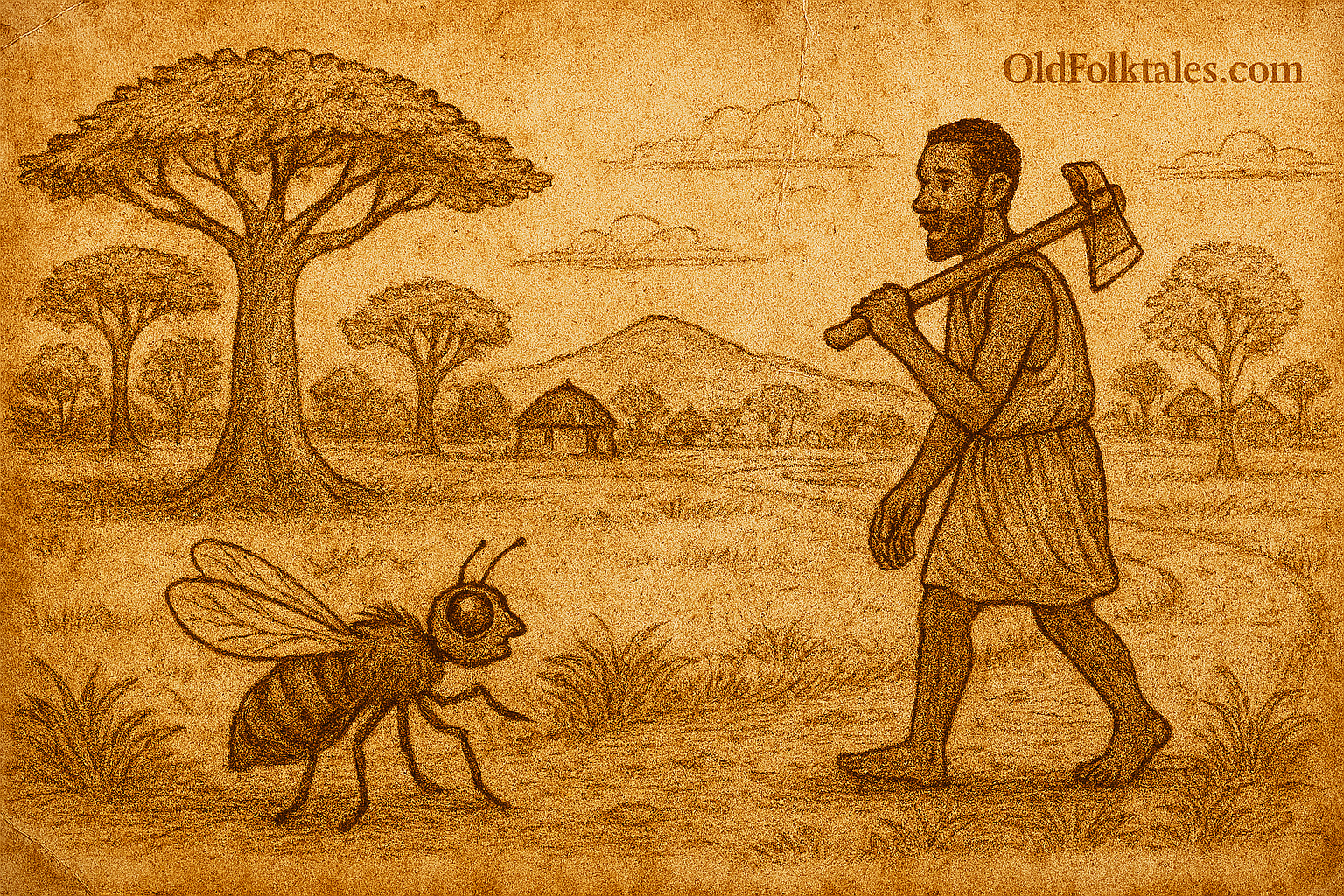
Just then, she spotted a wood-cutter walking along the dusty path, his well-worn axe gleaming on his shoulder. The man moved with the steady rhythm of someone who had spent countless days in the forest, his calloused hands gripping the tool that was both his livelihood and his companion.
“Oh wood-cutter, wood-cutter,” the fly called out desperately, her tiny voice carried on the warm African breeze, “what is my name?”
The wood-cutter paused, wiping the sweat from his brow as he looked around, puzzled by the small voice. “I do not know your name, little one,” he replied kindly. “Ask the axe which rests in my hand, it has cut through many things and seen much in this world.”
With growing urgency, the fly turned to the gleaming axe. “Oh axe, axe, what is my name?”
The axe, worn smooth by countless days of labor, seemed to consider the question. “I don’t know your name,” it finally responded. “But ask the tree which I am destined to fell. Trees are ancient and wise, perhaps it holds the answer you seek.”
The fly’s heart sank a little, but she pressed on, approaching a magnificent baobab tree whose massive trunk had witnessed generations of village life. “Oh tree, tree, what is my name?”
The ancient baobab’s leaves rustled in the wind, whispering secrets accumulated over decades. “Child, I know many names, but yours is not among them,” the tree replied with gentle regret. “Ask the bird who nests in my branches, she flies far and wide and knows many creatures.”
And so began the fly’s journey through an interconnected web of village life. The bird, preening its colorful feathers in the afternoon sun, directed her to the clear water it drank from each morning. The water, sparkling like diamonds in the dappled sunlight, suggested she ask the green moss that grew along its banks.
The moss, soft and vibrant, told her to inquire of the fish that fed upon its tender shoots. The fish, silver and quick in the flowing stream, directed her to the fisherman who cast his nets with practiced precision each dawn. The weathered fisherman, his hands stained with the honest work of feeding his community, suggested she speak to his wife, the fishwoman who sold the day’s catch in the bustling market.
The fishwoman, her voice ringing out over the colorful market stalls, recommended the cook who purchased the finest fish for the wealthy households. The cook, surrounded by aromatic spices and simmering pots, directed her to the maid who prepared elaborate meals with artistic care.
The maid, flour dusting her capable hands, told her to ask the master of the household who enjoyed the fruits of everyone’s labor. The master, reclining in the shade of his compound, suggested she speak to his prized horse, a magnificent animal whose intelligence was renowned throughout the village.
By now, the sun was beginning its descent toward the horizon, painting the sky in brilliant oranges and purples. The fly felt exhausted and discouraged, her small heart heavy with the weight of her forgotten identity.
But the horse, noble and patient, listened to her plea with deep, understanding eyes. After a moment of thoughtful silence, the horse turned to its own belly, where new life grew within.
“Ask my unborn foal,” the horse said gently. “Sometimes the youngest among us see most clearly what we have forgotten.”
The fly approached with trembling hope, and the foal, still nestled safely in its mother’s womb, spoke with the pure wisdom of innocence:
“Is not your name simply… fly?”
The words hit her like a gentle revelation. In surprise and sudden recognition, the fly touched her tiny hand to her nose—a gesture of amazement and relief that rippled through her entire being. Of course! How could she have forgotten something so simple, so fundamental?
With her identity restored and her spirit lightened, the fly buzzed contentedly back to her freshly plastered home, now understanding that sometimes we must journey far to rediscover what was always right before us.
Moral Lesson
Sometimes in life, we become so focused on complex solutions that we lose sight of simple truths. Our identity and worth are often simpler and more fundamental than we imagine. When we feel lost, the answer we seek may be right in front of us, requiring only a fresh perspective to see clearly again.
Knowledge Check
Q1: Why did the fly forget her name in this African folktale? A1: The story doesn’t explain why the fly forgot her name, but it happened after she finished plastering her house with cow-dung. This mysterious forgetting represents how we sometimes lose sight of our fundamental identity when focused on other tasks.
Q2: What does the chain of questioning represent in this folktale? A2: The chain represents the interconnectedness of village life and community. Each person and creature is linked to others, showing how African communities function as integrated systems where everyone depends on one another.
Q3: Who finally provides the answer to the fly’s question about her name? A3: The unborn foal in the horse’s belly provides the answer, suggesting that sometimes the youngest or most innocent perspective can see simple truths that others miss. The foal asks, “Is not your name simply… fly?”
Q4: What is the significance of the fly’s gesture at the end of the story? A4: When the fly puts her finger to her nose in surprise, it represents a moment of recognition and amazement. This gesture shows her relief and wonder at rediscovering something so simple that had seemed so elusive.
Q5: What role does community play in this African folktale? A5: The community plays a crucial role as each member, from wood-cutter to fisherman to cook,tries to help the fly, even though none can directly answer her question. This demonstrates the African value of collective support and interconnectedness.
Q6: What lesson does this folktale teach about problem-solving and identity? A6: The story teaches that sometimes we overcomplicate simple problems and that our true identity is often more straightforward than we think. It also shows that seeking help from others, while valuable, sometimes leads us back to truths we already knew.
Source: African folktale tradition