In the days when the world was younger and magic flowed as freely as water from mountain springs, there stood a kingdom where the golden dome of the royal palace caught the first rays of each dawn. Yet high above the bustling courtyards and flourishing gardens, in the tallest tower that scraped the very belly of the clouds, lived a princess whose beauty was matched only by her loneliness.
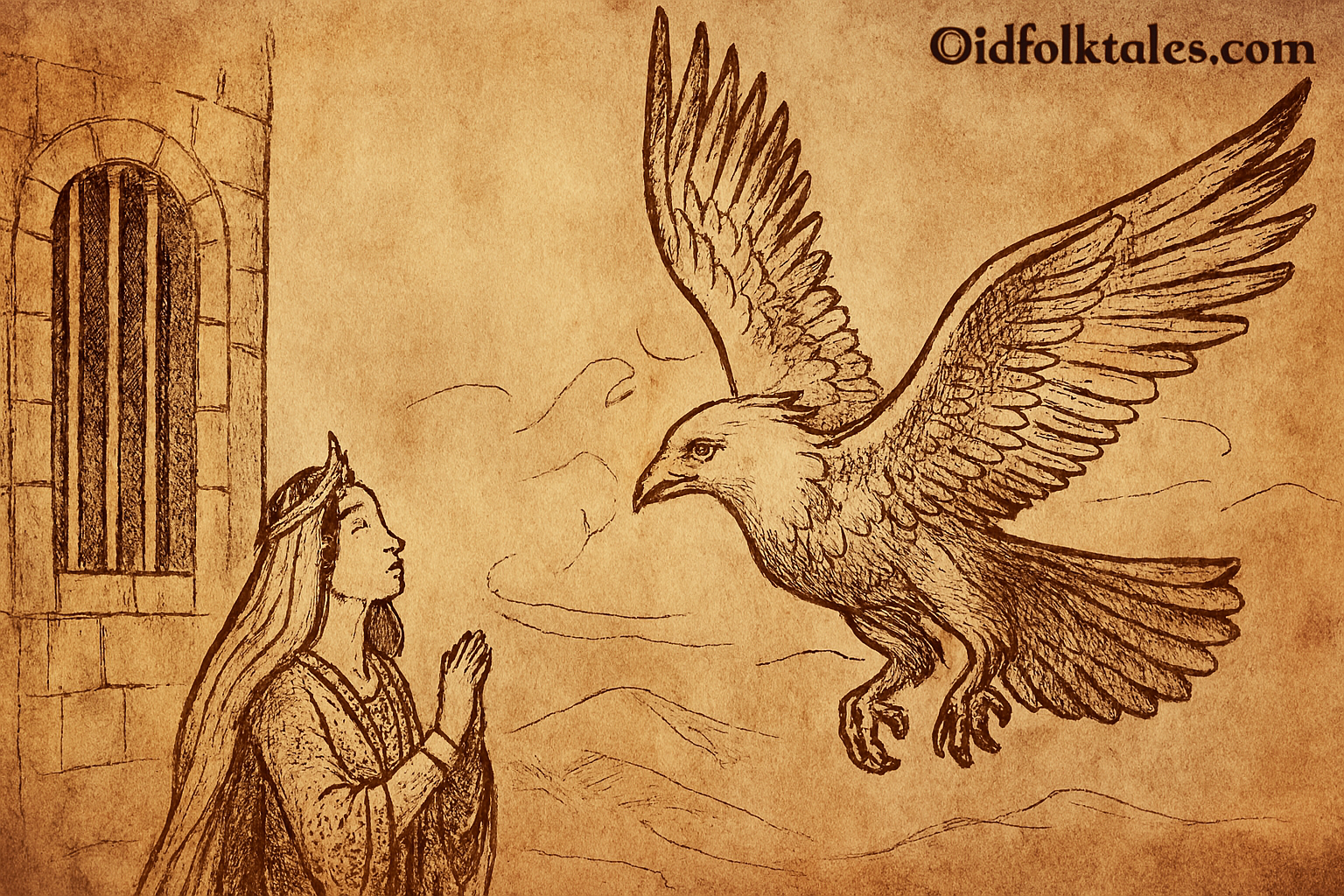
This tower had been her world for as long as memory served, a circular prison of smooth stone where no door existed, and no stairway led upward from the ground below. The walls rose impossibly high, their surface polished so smooth that not even the most skilled climber could find purchase. Windows dotted the tower’s circumference, each one barred with iron wrought so fine it seemed like delicate lacework, yet strong enough to withstand the mightiest storm.
The princess had grown from a child to a woman in this lofty solitude, her days filled with books and needlework, her meals carried to her in baskets by servants using pulleys and ropes. She knew the rhythm of the seasons by the changing colors of the distant mountains, and marked the passage of time by counting the caravans that appeared like lines of ants crossing the desert far below. Her father, the king, had placed her there for reasons wrapped in prophecy and fear, protection, he claimed, though from what danger she had never been told.
Also read: The Girl Who Saved Her Brother
But solitude, even gilded with royal comfort, could not cage the restless spirit that burned within her heart. Each day she would stand at her window, her dark hair streaming in the wind, watching the world spread out below like a vast tapestry of possibility. She longed to walk among the date palms in the palace gardens, to feel sand between her toes and hear the voices of people who were more than distant specks moving through the streets.
It was on such a day, when her yearning felt almost unbearable, that the great bird first appeared.
The creature materialized from the shimmering heat of the afternoon like a vision born from her desperate dreams. Its wings were broader than the sails of the largest ship, each feather gleaming with an iridescent beauty that shifted from deep blue to silver to gold as it caught the light. When it flew, the very air seemed to sing, and the sound of its wingbeats carried the power of desert storms and mountain gales combined. This was no ordinary bird, but a creature of the wind itself, one of those legendary beings that existed at the boundary between the mortal world and the realm of pure spirit.
The Wind Bird alighted on her windowsill with surprising gentleness for such a magnificent creature, its talons clicking against the iron bars as it settled. When it opened its beak, instead of a bird’s cry, there flowed forth the most beautiful songs the princess had ever heard, melodies that spoke of distant bazaars where spices perfumed the air, of oases hidden in trackless deserts where palm trees swayed to ancient rhythms, of cities built from white stone that gleamed like stars against purple twilights.
Day after day, the Wind Bird returned, and with each visit, the princess felt her world expanding beyond the confines of her tower. Through the bird’s songs, she traveled to lands she had only read about in books, experienced adventures that made her pulse quicken with excitement, and felt connections to a wider world that her tower could never contain. The melodies seemed to awaken something deep within her soul, a knowledge that she was meant for more than this beautiful prison, no matter how comfortable it might be.
As weeks turned to months, the princess found courage growing in her heart like a flame fed by each of the Wind Bird’s visits. The songs had shown her glimpses of freedom so vivid and compelling that she could no longer bear the thought of spending her entire life watching the world from behind iron bars. One day, as the Wind Bird perched on her windowsill singing of mountain peaks that touched the sky, she made a decision that would change her fate forever.
“Great bird,” she said, her voice trembling with both fear and determination, “I can no longer remain in this tower. If there is a way for me to leave this place, I beg you to show me.”
The Wind Bird ceased its song and fixed her with eyes that held the depth of storm clouds and the clarity of desert air. Without words, she understood that the choice was hers to make, but that the path to freedom would not be simple or safe.
Gathering her courage like armor around her heart, the princess descended the winding stairs within her tower, stairs she had been forbidden to use for so many years that dust lay thick upon each step. She emerged into the palace proper like a ghost returning to the world of the living, and made her way through corridors that seemed both familiar and strange to the throne room where her father held court.
The king, when he saw his daughter standing before him after so many years of separation, wept openly. His face showed the weight of a decision that had tormented him daily, the choice between protecting his beloved child and allowing her to live freely in a world he knew to be full of dangers.
“Father,” the princess said, her voice steady despite the rapid beating of her heart, “I must leave this place. The Wind Bird has shown me that there is a world beyond these walls that calls to my spirit. Grant me permission to follow where it leads.”
To the amazement of his entire court, the king looked into his daughter’s eyes and saw there a strength and determination that reminded him of the warrior queen who had been her mother. After a long moment of silence that seemed to stretch across eternity, he nodded slowly.
“My daughter,” he said, his voice heavy with both sorrow and pride, “if this is truly your choice, then you have my blessing. But know that the path you choose may lead through darkness before it reaches light.”
And so the princess, her heart soaring with newfound freedom, climbed once more to her tower where the Wind Bird waited. Without hesitation, she stepped onto the creature’s broad back, her arms encircling its powerful neck as they launched into the endless sky.
They flew across half the world, over deserts that stretched like golden seas, above forests so dense they seemed like carpets of emerald velvet, past cities that sparkled like jeweled necklaces scattered across the landscape. The journey was both exhilarating and exhausting, but the princess felt more alive than she ever had within the safety of her tower.
Eventually, they came to rest at a house that seemed to exist at the crossroads between worlds, a dwelling that was part palace, part storm cloud, where the very walls shifted and flowed like solidified wind. This was the home of the Wind Bird’s family, creatures of immense power whose moods could calm seas or raise tempests that reshaped coastlines.
But the princess soon discovered that power without wisdom or compassion breeds only corruption and cruelty. The Wind Bird’s mother and siblings were consumed by jealousy and malice, their hearts twisted by centuries of unchecked pride. They set the princess to work as a servant, forcing her to clean and cook while they lounged in luxury, plotting ways to use her royal blood for their own dark purposes.
Yet the long years in the tower had not been wasted. The princess had studied not only books of poetry and philosophy, but also ancient texts of wisdom and strategy. She had learned patience from her captivity, and her desperate yearning for freedom had forged her spirit into something unbreakable. With careful observation and quiet cunning, she learned the weaknesses of each evil family member, discovering the words that could bind them and the actions that could undo their malevolent power.
One by one, she confronted the corrupted members of the Wind Bird’s family, using their own cruelty against them until each was destroyed by the very malice they had cultivated in their hearts. When the last of the evil ones had fallen, the house itself seemed to sigh with relief, its walls settling into peace for the first time in centuries.
The Wind Bird, freed from the influence of its corrupted family, revealed its true nature, not a creature of storms and violence, but a being of pure freedom and joy. Together, the princess and her companion soared into the endless sky, no longer bound by towers or family obligations or the expectations of kingdoms, but free to explore all the wonders that the world contained.
They say that on clear nights, when the wind sings through mountain passes and across desert sands, you can still hear the sound of their laughter echoing through the sky, a reminder that true freedom comes not from the absence of challenges, but from the courage to face them with wisdom and an unwavering heart.
Moral Lesson
The tale of the Captive Princess and the Wind Bird teaches us that even the most restrictive circumstances cannot imprison a determined spirit forever. True freedom requires not only the courage to leave our comfort zones, but also the wisdom to overcome the obstacles we encounter along the way. Sometimes our greatest challenges come not from external barriers, but from the corrupted hearts of those around us, and only through cleverness, patience, and inner strength can we transform both ourselves and our circumstances.
Knowledge Check
Q1: What was unique about the princess’s tower prison and how did it symbolize her situation? A1: The tower had no doors or stairs accessible from outside, with smooth walls impossible to climb and barred windows. It symbolized how external protection can become internal captivity, and how comfort without freedom still constitutes a form of imprisonment.
Q2: What role did the Wind Bird play in the princess’s transformation and journey? A2: The Wind Bird served as both inspiration and guide, bringing songs of distant lands that awakened the princess’s desire for freedom, then carrying her across the world to face her destiny. It represented the call of adventure and possibility that stirs restless spirits.
Q3: How did the princess’s time in captivity prepare her for the challenges she faced later? A3: Her years of study and forced patience gave her wisdom, strategic thinking, and inner strength. The tower taught her to observe carefully and think deeply, skills she later used to defeat the Wind Bird’s evil family members through cunning rather than force.
Q4: What does the Wind Bird’s corrupted family represent in Middle Eastern storytelling tradition? A4: The evil family members represent how power without moral guidance leads to corruption and cruelty. In Middle Eastern folktales, such characters often symbolize the dangers of unchecked authority and the importance of wisdom tempering strength.
Q5: Why did the king surprisingly agree to let his daughter leave the tower? A5: The king recognized in his daughter’s eyes the same strength and determination that had belonged to her warrior queen mother. His decision shows that true parental love sometimes requires letting go, even when it means facing unknown dangers.
Q6: What is the deeper meaning behind the princess and Wind Bird flying away together at the story’s end? A6: Their flight represents the achievement of true freedom through mutual partnership and shared values. Unlike her tower imprisonment, this freedom is earned through courage and wisdom, symbolizing how authentic liberty requires both inner strength and worthy companions.
Source: Traditional Middle Eastern folktale