In the days when the great forests stretched unbroken across the land, and villages nestled like small islands of warmth in an ocean of ancient trees, there lived a woman whose heart had been broken by the cruelty of the man she had married. Her cottage, once filled with laughter, had become a place of fear and sorrow, where harsh words flew like arrows and kindness withered like flowers in winter frost.
This poor woman had been blessed with two children who were the light of her darkening world, a daughter whose eyes held wisdom far beyond her tender years, and a baby son whose innocent smile could still bring moments of joy even in their troubled home. As the months passed and her husband’s temper grew ever more violent, the woman realized that staying meant risking not only her own life, but the lives of the precious children who depended on her protection.
One moonless night, when the wind howled through the eaves and her husband lay in drunken slumber, the desperate mother gathered what few belongings she could carry and crept from the house with her children. The daughter, though barely old enough to understand the gravity of their situation, clutched her baby brother close while her mother led them into the dark embrace of the forest that bordered their village.
Also read: The Captured Princess and the Bird
The wilderness that received them was both sanctuary and peril, a realm where towering oaks and ancient pines created a cathedral of shadows, and where every rustling leaf might herald either salvation or doom. The forest floor was carpeted with centuries of fallen leaves that muffled their footsteps, while overhead, the canopy was so thick that even daylight filtered down in scattered golden coins of illumination.
For days, the small family pushed deeper into the woodland, living on wild berries and stream water, sleeping beneath makeshift shelters of branches and moss. The mother’s face grew gaunt with worry and exhaustion, but her children’s safety drove her forward with the fierce determination that only a parent’s love can provide.
But the forest, for all its beauty, was home to creatures that had never learned to distinguish between the innocent and the guilty. On the seventh night of their flight, as they huddled around a small fire that barely held back the pressing darkness, the wild beasts of the deep woods caught their scent.
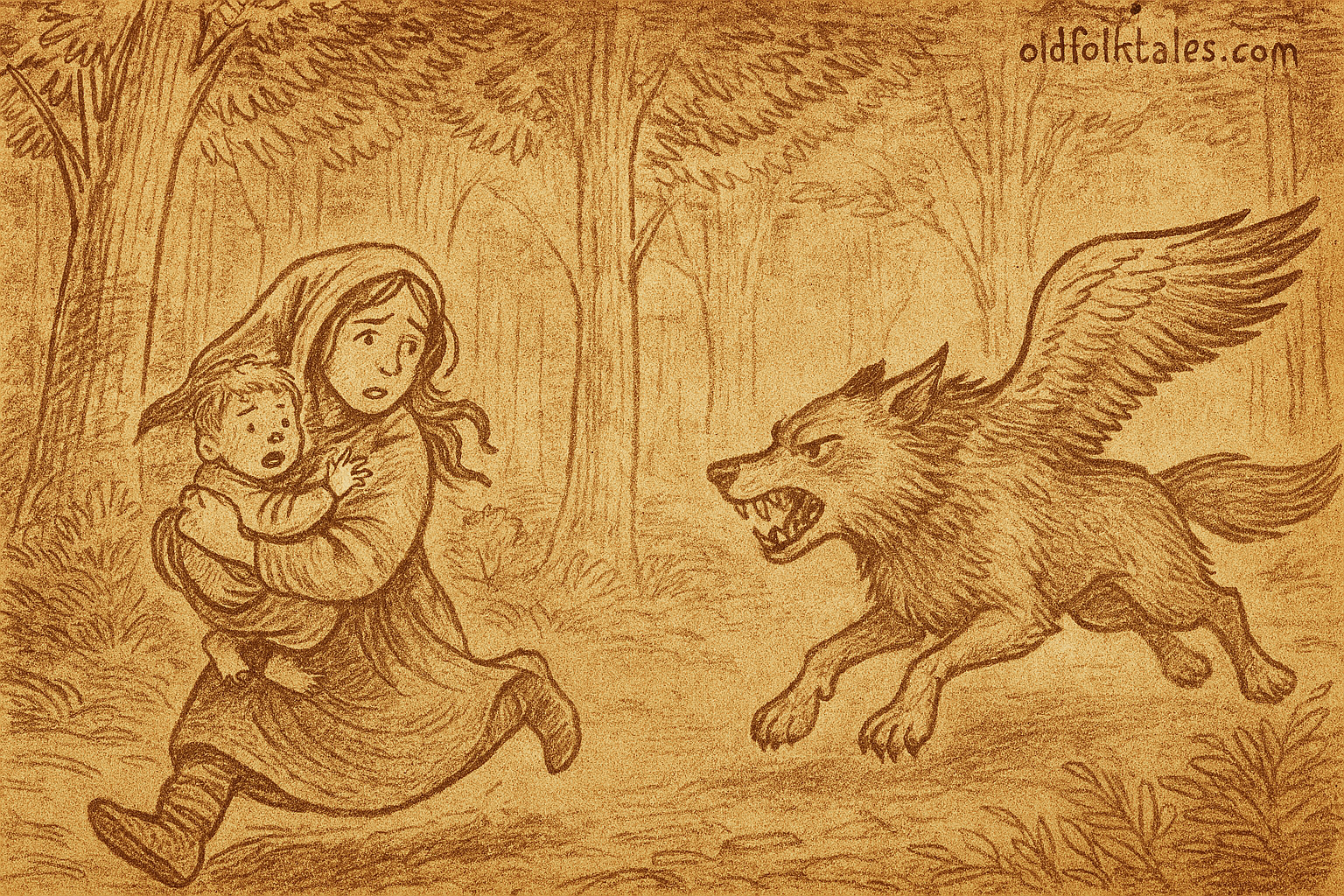
The attack came with terrifying swiftness, a pack of wolves, their eyes gleaming like yellow stars in the firelight, emerged from the shadows with silent, deadly grace. The mother, seeing death approaching on padded paws, did what mothers have done since the beginning of time: she placed herself between her children and danger, her arms spread wide as if she could shield them with nothing more than love and desperate courage.
The struggle was brief but fierce. When silence fell again over the forest clearing, the mother lay still beneath the ancient trees, her sacrifice complete. But her final act of love had given her daughter precious moments—enough time to snatch up the baby and flee deeper into the woods, beyond the reach of the sated predators.
And so began the girl’s true test, for she was now alone in the wilderness with a baby brother who depended entirely upon her for survival. She was young, perhaps no more than ten summers, yet necessity transformed her into something far beyond her years. With instincts that seemed to spring from the very depths of her soul, she learned to find food where others would see only leaves and bark, to locate clean water by following the flight of birds, and to create shelter that could protect them both from wind and rain.
Most remarkably, she learned to nurse her baby brother when he cried from hunger. Though she had no milk to give, she would chew wild roots and fruits until they were soft enough for him to swallow, feeding him drop by drop like a mother bird tending her nestling. Through cold nights when wolves howled in the distance, she would wrap him in her own thin cloak and sing the lullabies their mother had taught her, her young voice carrying all the love that had been lost when their mother fell.
Seasons turned like pages in a great book of survival. The girl grew taller and stronger, her hands becoming skilled at tasks that would have challenged adults. She learned which mushrooms were safe to eat and which would bring death, how to predict weather by the behavior of animals, and how to move through the forest like a shadow when danger threatened. All the while, her brother grew from helpless infant to curious toddler to sturdy young boy, his development a testament to his sister’s unwavering devotion.
By the time they finally emerged from the forest, drawn out by the smoke of cooking fires and the sound of church bells carrying across the valley, the brother had become a strong and healthy young man who remembered little of their years in the wilderness. To him, his sister was simply the woman who had always been there, her sacrifices as natural and unremarkable as sunrise.
The world they rejoined was one where the brother’s strength and good looks quickly won him opportunities and admirers. He found work, earned respect, and eventually married a woman whose beauty was matched only by her selfish heart and poisonous tongue. This new wife, seeing how deeply the brother trusted his sister, recognized a threat to her own influence and set about poisoning his mind with carefully planted doubts and accusations.
“Why does she live in our house, eating our food?” the wife would whisper during their private moments. “She’s not truly family, just a burden from your past. A real man wouldn’t let an old woman depend on him forever.” Her words were like slow-acting venom, gradually corrupting the gratitude that should have been the brother’s strongest virtue.
The transformation was gradual but inexorable. The man who owed his very life to his sister’s sacrifice began to see her presence as an embarrassment, her quiet dignity as presumption, her gentle reminders of their shared past as attempts to control him. When his wife finally demanded that the sister be cast out of their home, he agreed with barely a moment’s hesitation.
“You must go,” he told his sister one cold morning, unable to meet her eyes as he spoke the words that would have broken their mother’s heart. “My wife says there isn’t room for you here anymore, and I… I think she’s right.”
The sister, though her heart shattered like glass, accepted his decision with the same quiet strength that had carried her through their years in the wilderness. She packed her few belongings and walked away from the home where she had been both savior and servant, her dignity intact even as her world crumbled around her.
But the universe has its own sense of justice, and kindness has a way of calling forth kindness in return. As the sister wandered the roads, carrying nothing but her gentle spirit and her capacity for love, she encountered a widowed farmer whose own heart had been scarred by loss. In her eyes, he saw not a woman to be pitied, but a soul whose strength and compassion matched his own.
Their courtship was quiet and respectful, built on mutual understanding rather than passionate declarations. When they married, it was with the deep contentment of two people who had both known sorrow and could therefore truly appreciate joy. Together, they built a life filled with the simple pleasures that mean more than grand gestures, warm bread shared at sunset, hands held during evening walks, and the peaceful satisfaction of work done with love.
Meanwhile, the brother’s house, which should have been filled with happiness, grew cold and bitter. His wife’s cruelty, no longer focused on the sister, turned toward him and everyone else who crossed her path. Her heart, poisoned by jealousy and ingratitude, seemed to spread its darkness to everything around her.
The end, when it came, was swift and final. On a day when the jealous wife was in the garden, raging at the very flowers for not growing to her satisfaction, the earth itself seemed to grow weary of her wickedness. The ground beneath her feet opened like a hungry mouth, and she was swallowed whole, disappearing so completely that it was as if she had never existed at all.
The brother, standing at his window and witnessing this divine justice, finally understood the full weight of his ingratitude. But understanding came too late for redemption, and he spent the rest of his days haunted by the memory of the sister whose love he had spurned and whose sacrifice he had forgotten.
Moral Lesson
The tale of the girl who saved her brother teaches us that true love expects no reward but deserves recognition and gratitude. When we forget the sacrifices others have made for us and allow selfish influences to corrupt our hearts, we invite misfortune into our lives. Meanwhile, those who give selflessly, even when their kindness is forgotten often find that the universe rewards their goodness in unexpected ways, while ingratitude and cruelty ultimately call down their own punishment.
Knowledge Check
Q1: What circumstances forced the mother to flee into the forest with her children? A1: The mother fled from her cruel husband whose violence had made their home unsafe. She took her daughter and baby son into the forest to escape his increasingly dangerous temper and protect her children from harm.
Q2: How did the young girl manage to keep her baby brother alive in the wilderness? A2: The girl learned survival skills including finding safe food and clean water, creating shelter, and nursing her brother by chewing roots and fruits to make them digestible for him. She sacrificed her own comfort to ensure his survival and growth.
Q3: What role did the brother’s wife play in changing his attitude toward his sister? A3: The jealous wife systematically poisoned the brother’s mind against his sister through whispered complaints and accusations, convincing him that his sister was a burden rather than recognizing her as his savior. She manipulated him into casting his sister out of their home.
Q4: How does the story demonstrate the concept of divine justice? A4: Divine justice appears when the earth literally swallows the cruel wife, punishing her ingratitude and wickedness, while the selfless sister finds happiness with a kind husband. The universe rewards goodness and punishes those who spread cruelty and destroy family bonds.
Q5: What does the forest setting symbolize in Ethiopian folktale tradition? A5: In Ethiopian folktales, the forest often represents both danger and transformation, a place where characters face their greatest trials but also discover their true strength. For the girl, the forest becomes both sanctuary and testing ground where she develops the skills and character that define her.
Q6: What is the central moral lesson about gratitude and family loyalty in this story? A6: The story teaches that we must remember and honor those who sacrifice for us, especially family members who show us unconditional love. Forgetting such sacrifices and allowing others to poison our gratitude leads to loss and regret, while those who give selflessly are ultimately rewarded by life itself.
Source: Traditional Ethiopian folktale