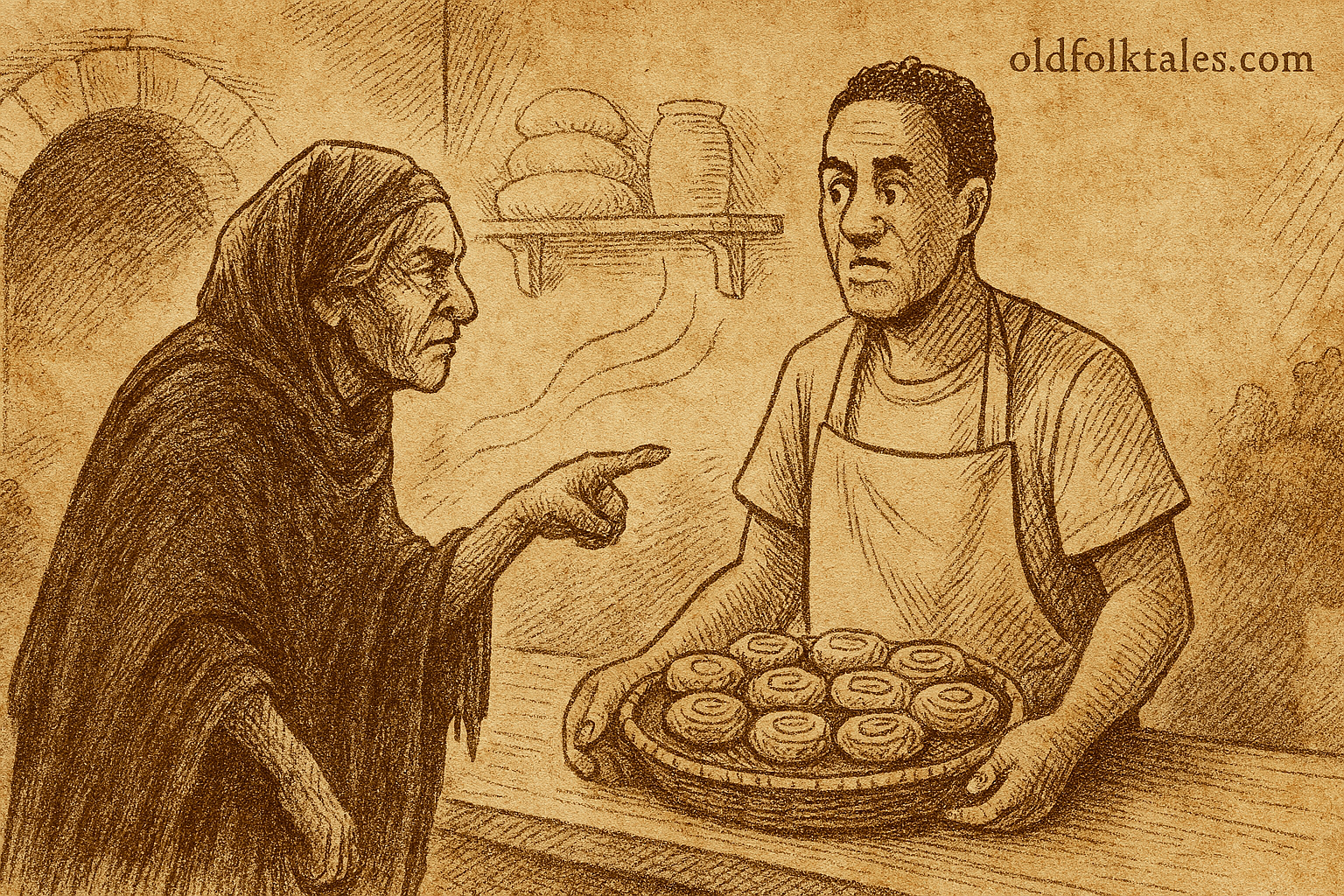
Long ago, in a bustling village nestled along the life-giving banks of the Zambezi River, where the waters flowed wide and strong and fishermen cast their nets at dawn, there lived a baker named Chanda. He was known throughout the land from the river valley to the distant hills for being as honest as a man could be. His reputation for fairness was spoken of in marketplaces and whispered approvingly by grandmothers teaching their grandchildren the value of integrity.
Every morning, long before the sun rose over the river to paint the sky in shades of gold and orange, Chanda would wake in the darkness and light his clay oven. He checked his brass scales with meticulous care, adjusting the weights until they balanced perfectly. He took great pride in giving his customers exactly what they paid for not a single grain more, and certainly not a grain less. This was his code, his honor, the foundation upon which he had built his livelihood.
Chanda’s small shop, with its thatched roof and mud-brick walls, was always busy. The air inside was perpetually warm and thick with the sweet aroma of baking. People trusted him implicitly, and he was truly a fine baker. His hands, dusted with flour and strong from years of kneading, crafted sweet fritters that melted on the tongue, soft buns perfect for breakfast, and honey cakes so delicious that travelers purchased them in bundles to carry on long journeys across the dusty roads.
Love this story? Discover our full Southern African folktales collection
And never was his shop busier than in the days leading up to the great village festival that joyous time when families gathered from near and far to dance to the pounding of drums, feast on roasted meats and vegetables, and honor their ancestors with prayers and offerings.
The Mysterious Customer
On the morning before the festival, as Chanda prepared his very best honey cakes mixing the dough with extra care, drizzling them with the finest golden honey from the village beekeeper the wooden door of his small shop opened with a long, deliberate creak. The sound made Chanda look up from his work.
An old woman entered, moving slowly but with dignified purpose. She was wrapped in a faded black chitenge cloth that had clearly seen many years of use, its once-vibrant patterns now muted by time and washing. Her eyes, however, were sharp as a hawk’s, missing nothing. Despite her obvious age, her steps were steady and sure.
“I have come for a dozen of your honey cakes,” she said, her voice clear and commanding despite her elderly appearance.
Chanda nodded respectfully, wiped the flour from his hands on his apron, took a woven tray from the shelf, and carefully counted out twelve golden honey cakes, each one perfect and fragrant. He was about to wrap them in banana leaves when the old woman raised her weathered hand, stopping him mid-motion.
“I asked for a dozen. You have given me only twelve.”
Chanda looked at her with confusion creasing his brow. “Madam,” he said politely, keeping his tone respectful, “everyone knows that a dozen is twelve. It has always been so.”
“But I say a dozen is thirteen,” the woman replied firmly, her sharp eyes boring into his. “Give me one more cake.”
Chanda frowned, feeling his patience being tested. He was not a man to entertain foolishness or to be cheated, even by an elderly woman who should know better. “Madam, my customers get exactly what they pay for not more and not less. This is my way. This is how I conduct honest business.”
The old woman’s face remained impassive. “Then keep your cakes,” she said coldly. She turned to leave, her chitenge swirling around her thin frame, but at the doorway she paused and looked back over her shoulder.
“Chanda!” Her voice carried a weight that made him shiver despite the warmth of the oven. “However honest you may be, your heart is small and your hand is tight. You count coins but cannot count blessings. Fall again, rise again, learn how to count again!”
And then she was gone, disappearing into the bright morning sunlight as if she had never been there at all.
The Curse of Misfortune
From that very day, nothing went right in Chanda’s bakery. It was as if some invisible hand had reached into his shop and twisted everything out of balance. His bread dough, which had always risen beautifully, now rose too high and spilled over the pans in a sticky mess or refused to rise at all, remaining flat and hard as stones. His fritters, once crispy and golden, came out either hard as pebbles or undercooked and soggy with oil. His famous honey cakes, his pride and joy, crumbled into dust at the slightest touch, as if they had been baked from sand rather than flour.
His customers soon noticed the dramatic change. Women who had come to his shop for years began whispering to one another in the market. Men who had always praised his baking shook their heads in disappointment. Before long, they went to other bakers whose shops lined the village streets.
“That old woman has bewitched me,” Chanda muttered bitterly to himself as he swept flour from his empty shop floor. “Is this the reward for my honesty? For giving people exactly what they pay for?”
But the ancestors, if they heard his complaints, offered no answer.
A full year passed, marked by the changing of seasons the rains came and went, the river rose and fell, the fields were planted and harvested. And through it all, Chanda grew poorer and poorer. Since he sold little, he baked little, conserving his precious flour and honey. His shelves, once overflowing with golden-brown goods, grew increasingly bare. His last few loyal customers, after one too many disappointing purchases, slipped away to other bakers.
Finally, on the eve of the next festival, when drums could already be heard practicing in distant compounds, not one single person came to his shop. At day’s end, as the sun set over the Zambezi in a blaze of red and purple, Chanda sat alone on his wooden stool, staring at the few unsold honey cakes gathering flies on his counter.
“I wish the ancestors could help me now,” he sighed, his voice heavy with defeat and confusion. Then he closed his shop door, bolted it from the inside, and went sadly to his sleeping mat.
The Dream That Changed Everything
That night, Chanda dreamed a dream more vivid than any he had experienced before. In his dream, he was a small boy again, no more than six or seven years old, playing joyfully among a crowd of laughing children in the village square. Their voices rang with pure happiness, and the air was filled with the excitement of celebration.
In their midst stood a tall, imposing figure draped in magnificent red and white cloth the sacred colors of the ancestors. The figure’s face was hidden in shadow, but their presence radiated warmth and abundance. They held large woven baskets filled to overflowing with food fruits, grain, honey cakes, roasted nuts. The figure gave out one treat after another to the eager children, yet miraculously, the baskets never grew empty. In fact, the more the figure gave away, the more the baskets seemed to hold, as if generosity itself created abundance.
At last, the figure turned to young Chanda and handed him a perfect, golden honey cake, still warm and fragrant. Chanda looked up in wonder, eager to see the face of this generous ancestor and saw, not the shadowy ancestor figure, but the same old woman in the faded black chitenge who had visited his shop a year before.
Chanda woke with a start, his heart pounding. The pale moonlight shone through the cracks in his mud-brick hut, casting silver lines across the floor. He lay there on his mat, unable to return to sleep, thinking deeply about the dream’s meaning.
“I always give my customers exactly what they pay for,” he whispered into the darkness, finally understanding. “But why not give more? Why not add something extra, a gift, a blessing, a gesture of abundance?”
The Lesson Learned
The next morning, as the festival drums began to echo from the village square and people emerged from their homes in their finest clothes, Chanda rose early with renewed purpose. He lit his oven with trembling hands and baked his honey cakes with more care than he had ever taken before, pouring his newfound understanding into every batch. The air grew thick with sweetness, and for the first time in a year, everything turned out perfectly.
He had just placed the last batch on his shelf to cool when the shop door creaked open with that same familiar sound. In walked the old woman in the faded chitenge, looking exactly as she had a year before as if no time had passed at all.
“I have come for a dozen of your honey cakes,” she said, her voice calm and steady.
Chanda smiled a genuine smile that came from deep within his heart. He took his tray and counted out twelve perfect honey cakes, their surfaces glistening with honey then deliberately, purposefully, added one more. “In this shop,” he said with quiet pride, “a dozen is thirteen. This is how I count now.”
The old woman’s sharp eyes sparkled with approval and something that might have been affection. “You have learned to count well, Chanda,” she said softly. “You understand now that abundance flows from generosity, not from tight-fisted measuring. You will be rewarded.”
She paid for the cakes with worn coins and turned to leave. But as the door swung shut behind her, Chanda could have sworn that he glimpsed not the faded black chitenge but the shimmering, sacred hem of a red-and-white cloth the colors of the ancestors.
Prosperity Returns
From that day forward, Chanda’s baking prospered again as if the year of hardship had never happened. When word spread through the village and beyond that Chanda gave thirteen cakes for the price of twelve, people flocked to his shop from every corner of the valley from riverside villages and hilltop compounds, from near and far. Travelers told the story in distant marketplaces.
Soon Chanda grew wealthy, his shop expanded, and he employed helpers to meet the demand. Other bakers in the village, seeing his success and understanding the wisdom behind it, began doing the same giving a little extra, adding a gift of generosity to every transaction.
And that is how, in that part of Zambia along the Zambezi River, people began to say that a proper dozen is thirteen the baker’s dozen, a gift of generosity that still carries the wisdom of the old woman who taught a honest but tight-fisted baker that true abundance comes not from measuring exactly, but from giving freely.
The Moral Lesson
This Zambian folktale teaches us that true prosperity comes not from rigid adherence to the minimum, but from generosity of spirit. Chanda learned that being technically “honest” while being stingy creates poverty, while adding a gift of abundance giving more than expected creates wealth for everyone. The story emphasizes that the ancestors and spirits value generosity over mere correctness, and that opening our hands and hearts to give freely brings blessings that multiply. It reminds us that sometimes we must “fall again, rise again, and learn to count again” unlearning our rigid ways and embracing a more generous approach to life and business.
Knowledge Check
Q1: Who is Chanda in this Zambian folktale from the Zambezi River?
A1: Chanda is an honest baker who runs a shop in a village along the Zambezi River. He is known throughout the land for his fairness and for giving customers exactly what they pay for not more, not less. However, his rigid adherence to exact measurement without generosity leads to his downfall until he learns that true prosperity comes from giving more than expected. He becomes the originator of the “baker’s dozen” tradition in his region.
Q2: What does the old woman in the faded black chitenge represent in this Zambian story?
A2: The old woman represents an ancestor spirit or divine messenger testing Chanda’s generosity and teaching him an important lesson. Her faded black chitenge contrasts with the red-and-white cloth of the ancestors glimpsed at the end, suggesting she is a supernatural being in disguise. She has the power to curse Chanda’s baking when he refuses to give generously and to bless him when he learns to add the thirteenth cake, demonstrating that the ancestors value generosity over rigid honesty.
Q3: Why did Chanda’s bakery fail after the old woman’s visit?
A3: After Chanda refused to give the old woman thirteen cakes for a dozen, insisting on the exact measure of twelve, she cursed him with the words “your heart is small and your hand is tight.” From that day, everything went wrong in his bakery bread wouldn’t rise properly, fritters were hard or undercooked, and his famous honey cakes crumbled to dust. This supernatural punishment lasted an entire year until he learned the lesson of generosity, showing that the ancestors punish stinginess even when it masquerades as honesty.
Q4: What is the significance of Chanda’s dream in this folktale?
A4: Chanda’s dream is the turning point of the story, providing divine guidance from the ancestors. In the dream, he sees a figure in sacred red-and-white cloth (ancestral colors) distributing food from baskets that never empty the more given, the more they hold. This teaches him that generosity creates abundance rather than scarcity. When the figure reveals itself as the old woman and gives him a honey cake, he wakes understanding that he must give more than expected to receive blessings.
Q5: What cultural values does this Zambian Zambezi River folktale emphasize?
A5: This folktale emphasizes several important Zambian and African cultural values: generosity and abundance over stinginess, respect for ancestors and their wisdom, the importance of community prosperity over individual gain, hospitality and giving freely, and the understanding that spiritual blessings flow to those with open hands and hearts. It also reflects the festival tradition where families honor ancestors, and it teaches that business success comes not just from honesty but from generosity that builds community trust and goodwill.
Q6: How did the “baker’s dozen” tradition begin according to this Zambian story?
A6: According to this folktale, the baker’s dozen (thirteen instead of twelve) began when Chanda finally learned his lesson and gave the old woman thirteen honey cakes when she returned exactly one year after their first encounter. After being rewarded with restored prosperity, word spread throughout the valley about his generosity. Other bakers adopted the same practice of giving thirteen for twelve, and the tradition spread across that region of Zambia as a lasting reminder that giving more than expected brings greater rewards and blessings from the ancestors.
Cultural Source: Traditional Zambian folktale from the Zambezi River region