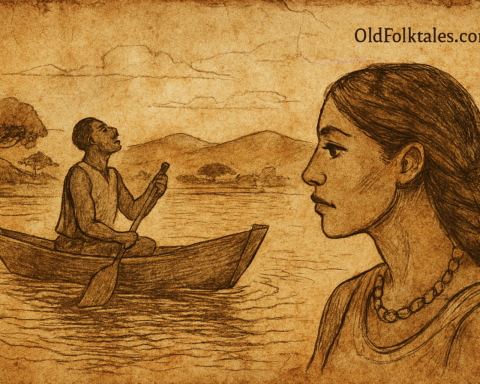
Long ago, in the royal city of Mengo, the ancient heart of the Buganda Kingdom, there lived a man named Kato and his wife Namakula. Their home was modest, their possessions few, but Kato was content with his simple life. He was an ordinary man with no special craft or training, no inherited wealth or noble lineage. What he did possess was a sturdy hoe and a sharp panga, and with these humble tools, he earned his living digging in the gardens of wealthier men.
“If you can dig,” Kato would often tell his wife with a philosophical shrug, “you can always find food to keep yourself alive.” For Kato, this simple truth was enough. He asked for nothing more than honest work, a full belly, and peace in his home.
But it was not enough for Namakula. She watched the wives of craftsmen and healers parade through the marketplace in their finest bark-cloth, their arms heavy with ivory bracelets, while she wore plain garments and carried an empty water pot. The seed of discontent grew daily in her heart.
Looking for more? Explore the magic of East African folktales here
One afternoon, as was her custom, Namakula went to the public well to draw water and exchange gossip with the other women of the neighborhood. But when she arrived, she found her way blocked by the water keeper, who raised his hand firmly against her approach.
“You cannot draw water now,” he announced with an air of authority. “The wife of the Kabaka’s chief healer is fetching her water. The well is reserved for her alone today. Come back later.”
Namakula’s face flushed with humiliation and rage. “What arrogance!” she snapped bitterly. “Just because her husband sits in a corner muttering charms over sick people!” Fuming with wounded pride, she carried her empty pot home, her mind churning with resentment.
That evening, when Kato returned home dusty and tired from a long day’s labor, he placed a few small coins on the table, his wages for digging in another man’s garden. Namakula looked at the meager payment and waved it away with disgust.
“Look at this pitiful money!” she said scornfully. “We will never rise in the world this way. From tomorrow, you must sit in the marketplace as a healer and seer like the others.”
Kato stared at his wife as though she had lost her senses. “Are you mad, woman? What do I know about charms and fortunes? I cannot heal a headache, much less read the future!”
“You needn’t know a thing,” Namakula replied with cold determination. “When people come asking questions, just toss some cowrie shells on the ground and say something that sounds wise and mysterious. Either you do this, or I pack my things and go back to my father’s house tomorrow!”
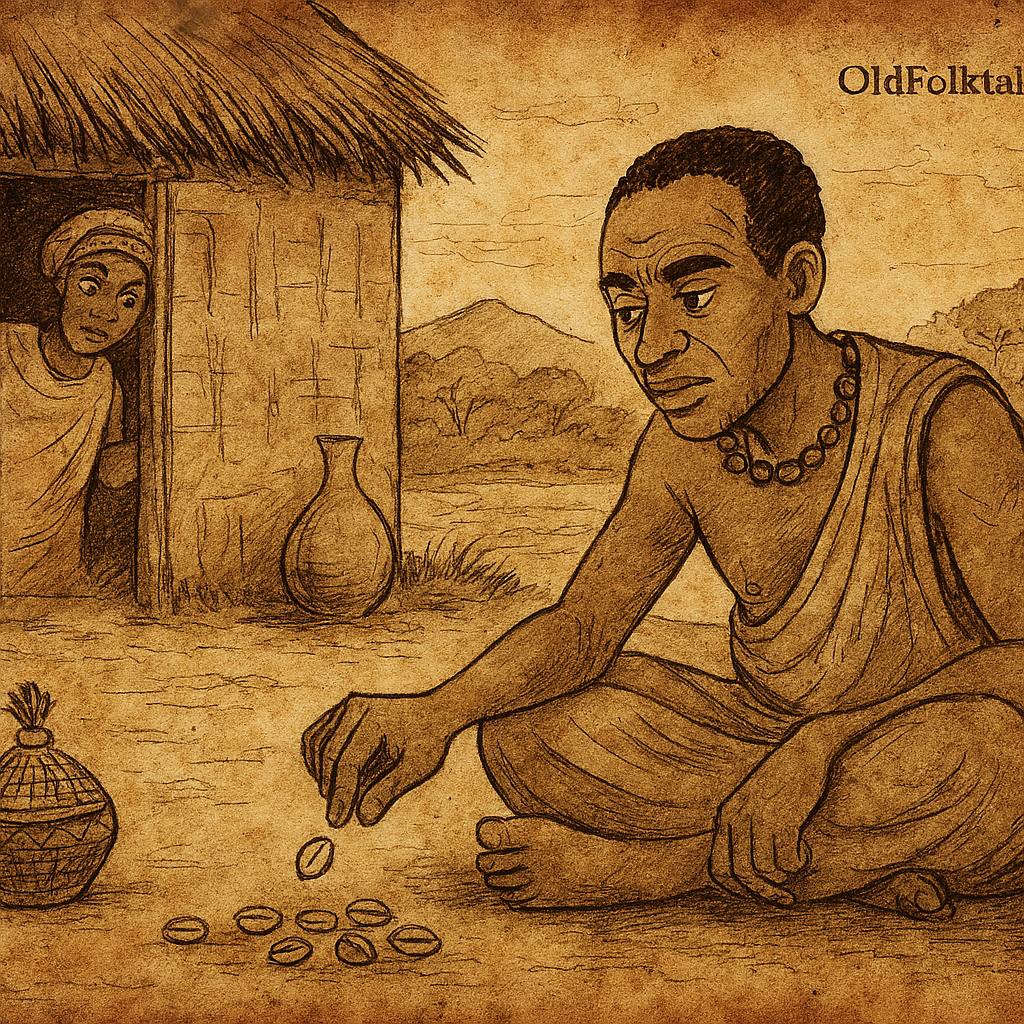
The next morning, with a heavy heart and trembling hands, Kato sold his beloved hoe and panga, the very tools that had sustained him. With the money, he purchased a small gourd rattle decorated with beads, a handful of cowrie shells for divination, and a bark-cloth robe to make himself look the part of a proper healer. Then, feeling like the greatest fraud in all of Buganda, he seated himself nervously in the marketplace.
Before long, a well-dressed woman clearly the wife of a royal minister came running up to him in great distress. “Healer! I need your powers urgently! I lost my precious ivory bracelet at the well today. Please, you must tell me where it is!”
Kato’s heart hammered in his chest. His hands trembled as he shook his shells and cast them on the ground, having no idea what pattern to look for or what any of it meant. As he glanced up nervously at the woman, his eye caught something, there, in her fine gomesi, was a small tear in the fabric where her arm showed through.
Without thinking, startled by what he saw, he whispered, “Madam, I see a hole.”
“What?” she asked, leaning closer.
“A hole, a hole!” he repeated, more loudly this time, his voice taking on what he hoped sounded like mystical certainty.
The woman’s eyes widened with sudden understanding. “Of course!” she cried out. “The hole in the wall!” She rushed back toward the well, and Kato sat there bewildered, certain his fraudulent career was about to end in public humiliation.
But within the hour, the woman returned, breathless and joyful. “You are truly gifted! There was indeed a small hole in the wall by the well where I had hidden my bracelet for safekeeping while I drew water, and I had forgotten! Here!” She pressed a gold coin into his palm, more money than Kato had seen in months.
That evening, Namakula laughed with delight when she saw the coin. “You see? I told you! You are a true seer! You have the gift!”
“By God’s mercy only,” Kato said solemnly, his face pale with the memory of his terror. “It was pure luck, nothing more. I will not test the Almighty’s patience again.”
“Nonsense,” said Namakula firmly. “Tomorrow you will sit in the marketplace again. This is our fortune!”
But that very night, while the city slept, a terrible crime took place in the royal palace. Forty thieves crept into the Kabaka’s treasury and stole forty large baskets filled with precious cowrie shells and beads, a fortune beyond imagining.
When the Kabaka awoke and learned of the theft, his rage shook the palace walls. He immediately summoned all his royal seers and diviners. They came with their rattles and shells, their charms and incantations, casting their lots and muttering their prophecies. But though they performed elaborate rituals and spoke in mysterious tongues, not one could reveal who the thieves were or where the treasure had been taken.
“Frauds! Charlatans!” thundered the Kabaka. “You eat my food, wear fine clothes, and claim great powers, yet you are useless! Throw them all in the dungeon!”
But then word reached the palace of a remarkable new healer in the marketplace, one who had found the minister’s wife’s lost bracelet through his extraordinary powers. The Kabaka’s guards were immediately dispatched, and they dragged the terrified Kato before the throne.
“Kato the healer,” said the Kabaka in a voice that brooked no argument, “forty baskets have been stolen from my treasury. Tell me about the thieves who took them.”
Kato’s heart thudded so loudly he was certain everyone in the throne room could hear it. His mind raced frantically. He thought of the forty baskets, and in his panic, blurted out the first thing that came to his mind: “Your Majesty, I can tell you this much: there were forty thieves.”
The Kabaka’s eyes widened with amazement. “Incredible! None of my own diviners knew that detail! This man truly has powers!” Then his expression hardened. “Now find my treasure and bring back the thieves, or you will rot in the dungeon with the others.”
Terrified beyond measure, Kato begged desperately, “Great Kabaka, such powerful divination takes time… forty days. One day for each thief, so that I may locate them properly.”
The Kabaka considered this, then nodded. “Very well. Forty days. But not one day more.”
That night, Kato returned home in despair. He counted out forty groundnuts into a clay pot and showed them to Namakula. “Each night I will eat one,” he said miserably. “When the pot is empty, my forty days are done, and I will likely be executed for my deception.”
But fortune, which had brought Kato to this dangerous place, now worked in his favor through the strangest coincidence. One of the royal palace guards happened to be secretly one of the forty thieves. He had been present in the throne room and had heard every word of Kato’s pronouncement. That night, he hurried to the thieves’ hideout in the forest.
“Brothers, we have a problem!” he said urgently. “This new seer is dangerous! He already knows there are forty of us, and he says he will expose us all in forty days!”
“He’s bluffing,” scoffed the chief thief. “No one could possibly know that. But we must be certain. Go listen at his house tonight and see what he does.”
That night, as darkness fell over Mengo, the thief crept silently through the shadows to Kato’s house. He climbed carefully onto the thatched roof and pressed his ear to a gap in the reeds, listening intently.
Inside, Kato sadly picked up one groundnut from his pot, looked at it with the resignation of a doomed man, ate it slowly, and said, “That’s one.”
The thief on the roof nearly fell off in terror. His heart racing, he scrambled down and ran back to the hideout. “He knew I was there!” he gasped. “I was listening on his roof, and he said, ‘That’s one!’ Nothing is hidden from him!”
The next night, two thieves went together, thinking there was safety in numbers. Again, Kato ate his second groundnut and sighed, “That’s two.”
The thieves fled in absolute terror, convinced the seer could see through walls and darkness. Each night after that, more thieves came, three on the third night, four on the fourth, five on the fifth, until the fortieth night arrived, when the chief thief himself led all forty men to Kato’s house.
Inside, unaware of his audience, Kato sadly picked up the last groundnut from the now-empty pot. He held it in his palm, knowing his time had run out. “That’s forty,” he said with finality. “The number is complete. Tomorrow I face my fate.”
Outside, the forty thieves stood frozen in terror. This man knew everything, every single one of them had been counted and identified! Trembling with fear, they rushed to Kato’s door and pounded urgently.
When Kato opened it, they all fell to their knees before him. “O great seer! Nothing is hidden from your all-seeing eyes! We confess, we are the forty thieves who stole from the Kabaka! Spare our lives, and we will return every basket of treasure!”
Kato stood there astonished, barely able to believe what he was hearing. But he recovered quickly and drew himself up with newfound authority. “Then bring back every single basket before dawn breaks,” he commanded. “If even one cowrie shell is missing, my curse will follow you forever!”
That night, the thieves worked frantically, carrying all forty heavy baskets back through the darkness and returning them to the royal treasury.
The next morning, Kato appeared before the Kabaka. “Your Majesty,” he said carefully, “my mystical arts can reveal either the treasure or the identities of the thieves, but not both. The power required is too great. You must choose which you desire more.”
The Kabaka thought carefully. “The treasure,” he finally decided with a sigh. “The thieves may be punished another day, but the kingdom’s wealth must be secured.”
“Then know this,” said Kato, waving his hands dramatically. “By my magic, performed through the night, the baskets have already been restored to your treasury.”
Guards rushed to check, and indeed, all forty baskets stood in their proper places, not a single cowrie shell missing.
The Kabaka clapped his hands in delight. “You are the greatest healer and seer in all the land! You must become my royal diviner forever!”
But Kato bowed low and spoke humbly. “Alas, Your Majesty, returning the treasure required such powerful magic that it has drained all my mystical powers. I can never divine again. The spirits have left me.”
“What a loss to the kingdom!” said the Kabaka sadly. “But such sacrifice deserves great reward. I will give you two of those baskets as your own.”
And so Kato went home, rich beyond his dreams, safe from execution, and infinitely wiser about the dangers of pretending to be what one is not. And Namakula, who had pushed her husband into this dangerous charade, learned never again to let pride and ambition drive her to risk what truly mattered.
The Moral Lesson
This clever Ugandan folktale teaches us that pretending to be something we are not can lead to dangerous situations, yet also reminds us that quick thinking and humility can save us when fortune unexpectedly intervenes. Kato’s story warns against the dangers of pride and false pretenses, both Namakula’s social ambition and Kato’s fraudulent claims nearly led to disaster. However, the tale also celebrates wit, adaptability, and the wisdom to know when to quit while ahead. Sometimes our greatest successes come not from our skills but from lucky coincidences, and the truly wise person knows not to tempt fate twice.
Knowledge Check
Q1: Who is Kato in this Buganda folktale and why does he become a healer?
A: Kato is an ordinary laborer in the royal city of Mengo who owns only a hoe and panga. He becomes a fake healer not by choice, but because his wife Namakula, humiliated by social inequality and ambitious for higher status, threatens to leave him unless he poses as a diviner in the marketplace to earn more money and prestige.
Q2: What is the significance of the forty groundnuts in the story?
A: The forty groundnuts represent Kato’s countdown to his expected doom, one for each of the forty days the Kabaka gave him to find the thieves. Ironically, this private counting ritual becomes the key to his success when the thieves, listening secretly each night, believe he is counting them individually, proving their guilt and his supposed mystical powers.
Q3: What does this folktale teach about pride and ambition?
A: The story teaches that excessive pride and social ambition can be dangerous. Namakula’s resentment at being denied access to the well and her desire for higher social status drive her to push Kato into a fraudulent profession that nearly costs him his life. The tale warns that comparing ourselves to others and seeking status through deception leads to perilous consequences.
Q4: How does Kato escape punishment at the end of the story?
A: Kato cleverly tells the Kabaka he can only reveal either the treasure or the thieves, not both, knowing the ruler will choose the treasure. When it’s found restored, Kato claims the powerful magic drained all his divination powers permanently, allowing him to retire wealthy with his reward while avoiding future requests that would expose his fraud.
Q5: What is the cultural significance of Mengo and the Kabaka in this tale?
A: Mengo was the traditional capital of the Buganda Kingdom in present-day Uganda, and the Kabaka is the title for the king of Buganda. The story’s setting in the royal court reflects the hierarchical structure of Buganda society, where healers and diviners held prestigious positions, and the Kabaka’s authority was absolute, making Kato’s deception all the more dangerous.
Q6: What role does coincidence play in the moral of this story?
A: Coincidence is central to the tale’s message. Kato’s accidental success, the torn gomesi, the thief happening to be a guard, the groundnut counting—shows that luck can save us from our foolish choices. However, the story also emphasizes that wise people don’t keep testing their luck. Kato survives by recognizing when to stop, teaching that prudence and humility matter more than repeated risk-taking.
Source: Buganda folktale, Uganda (East Africa)