Long ago in the kingdom of Buganda, there lived a young man named Kintu. He was strong of body and handsome of face, blessed with youth and vigor, but he carried within him one serious fault, he never listened to anyone. Whatever advice his father offered, no matter how wise or well-intentioned, Kintu stubbornly did the exact opposite. It was as if some contrary spirit possessed him, driving him to reject every word of counsel.
One day, his father sat him down with great seriousness. “My son,” he warned, his voice heavy with concern, “it is good for a young man to think for himself and make his own decisions. But true wisdom also means listening when others know better than you do. And above all else, I warn you never, never go to work for the ekisolo, the ogre spirit who dwells in the great forest. No good can come of it.”
But Kintu, true to his stubborn nature, decided at that very moment to do exactly what his father forbade. The next morning, he packed a small bundle and set off walking, his feet carrying him deeper and deeper into the dense forest where the terrible ogre was said to live.
Looking for more? Explore the magic of East African folktales here
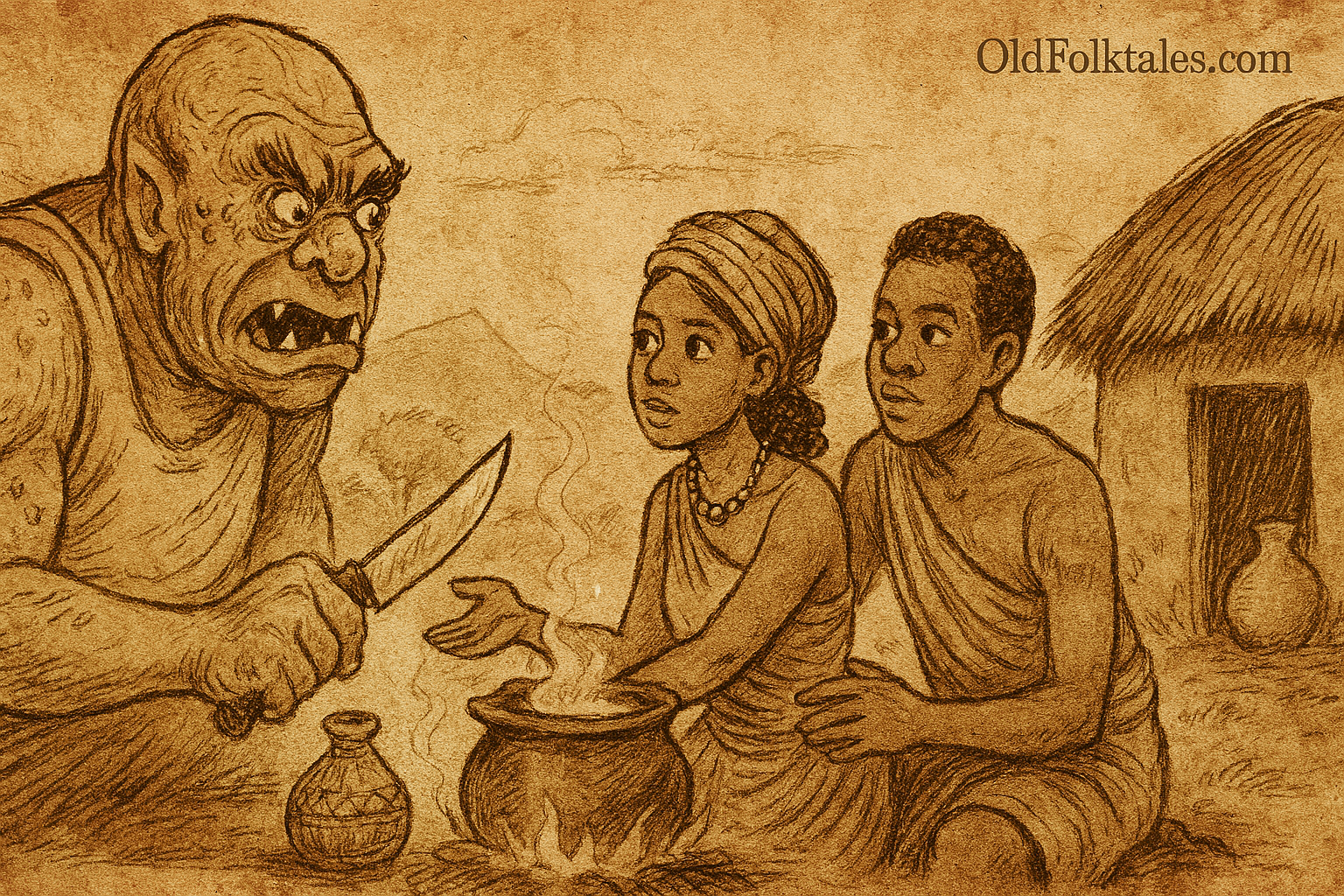
At last he came to a strange dwelling that stood among the ancient trees, a house built of bones and shadows. The ogre himself answered Kintu’s knock. He towered taller than any tree, his skin mottled and warty, his face uglier than any nightmare that had ever haunted a sleeping child. He opened the door and growled in a voice like grinding stones, “What do you want here, boy?”
“I’m looking for work,” said Kintu boldly, refusing to show the fear that fluttered in his belly.
The ogre’s lips split into a terrible grin, revealing teeth like broken spears. “Good. You’ll do nicely.”
That very day, the ogre sent Kintu to the cattle kraal behind the house. “Clean out all the dung,” he commanded. “But mind you well, never wander into my house. If you disobey, you will regret it with your last breath.”
Of course, being told not to enter the house made that the very thing Kintu wanted most to do. As soon as the ogre’s heavy footsteps faded into the distance, Kintu crept quietly to the door and slipped inside. There, in the dim kitchen lit by a cooking fire, he discovered the most beautiful girl he had ever seen, stirring a clay pot of food with graceful movements.
“Eh! What are you doing here?” she whispered urgently, her eyes wide with alarm.
“I came to work for the ogre,” Kintu replied, unable to take his eyes from her lovely face.
“Then you are surely doomed,” she sighed sadly. “No one who comes here survives. The ogre devours them all eventually.”
But Kintu only smiled, his heart already captured. “I don’t regret coming, for otherwise I would never have met you.”
The girl, who was the ogre’s captive daughter kept as a servant and cook, felt her heart soften at his words. “Then if you value your life, listen carefully to what I tell you. The job he gave you is a trap designed to kill you. If you shovel the dung the normal way, the kraal will fill faster than you can possibly clear it, and you’ll be buried alive. Instead, use the hoe backwards, handle where the blade should be, and the dung will fly out on its own.”
Kintu thought she must be joking or perhaps mad. But when he returned to the kraal and began shoveling the ordinary way, he discovered she spoke truth, the dung multiplied impossibly fast, rising like a foul tide that threatened to drown him. At last, in desperation, he tried her strange trick and behold! The kraal was clean as new in moments.
When the ogre returned at sunset and saw the spotless kraal, he eyed Kintu with deep suspicion. “You didn’t figure this out by yourself. Have you been talking to my Master Girl?”
“Master Girl?” said Kintu innocently. “What’s that?”
The ogre only grunted, but his eyes narrowed dangerously.
The next day, the ogre gave him a new task. “Go to the hillside and fetch my wild bull. Bring it back here.”
Again Kintu sneaked into the kitchen to see the beautiful girl. She warned him urgently, “That bull is no ordinary beast, it breathes fire from its nostrils and has killed many men. Take the enchanted rope hanging by the door. Hold it before you as you approach, and the bull will become tame.”
But Kintu laughed confidently. “I’m strong enough. I can manage without magical tricks.” Yet when he approached the hillside and the bull charged toward him, belching flames that singed his hair and clothes, he nearly died on the spot. In panic he flung the rope before him, and at once the terrible bull became as gentle as a calf. He led it home without further trouble.
“You didn’t accomplish this alone,” snarled the ogre, his voice dripping with suspicion. “You’ve been speaking to my Master Girl!”
Kintu only shrugged, keeping his face carefully blank.
On the third day, the ogre commanded, “Go to the sacred hill and collect my tax from the mizimu, the fairy folk who dwell within the rock.”
Once more, Kintu crept to the kitchen. The girl pressed a carved stick into his hand and whispered, “Strike the rock with this. When it opens, ask for only as much treasure as you can carry in one trip, no more, or you’ll regret it.”
But when Kintu reached the hill and struck the rock, watching it split open to reveal mountains of gold and rivers of cowrie shells, greed seized his heart. “Give me all you can!” he demanded. At once a flood of treasure poured out like a golden avalanche, burying him completely. Suffocating beneath the weight, he desperately shouted the correct words the girl had taught him, and the treasure flew back inside the rock, leaving him with only one modest sack.
When he returned, the ogre’s eyes burned with rage. “Now I know for certain. You and the Master Girl have been conspiring. Tomorrow, you will both pay the price.”
The next morning, the ogre dragged Kintu roughly into the kitchen where the girl stood trembling. “Cut him up for stew,” he ordered her coldly, thrusting a sharp knife into her hand. “Cook him well, and wake me when he’s ready to eat.” Then he lay down on a mat and began snoring like thunder.
But the girl moved swiftly. She pricked her finger with a thorn, letting three drops of blood fall onto a wooden stool. She whispered to the blood drops, “Answer for me when he calls.” Then she threw old rags, animal bones, and dung into the cooking pot to create the illusion of a bubbling stew. She grabbed her precious possessions, a wooden comb, a lump of salt, and a small flask of water. “Quick!” she hissed to Kintu. “We must flee now, or we’re both dead!”
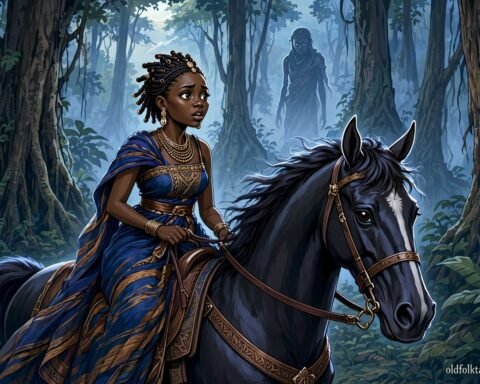
They ran to the stable, mounted the swiftest horses, and galloped away as fast as the wind. Behind them, the drops of blood answered the ogre’s drowsy calls: “Still tough… still chewy… now tender and ready.”
At last the ogre lifted the lid of the pot and tasted the stew. “Pfaugh! Dung and rats!” He roared like a wounded lion. “That witch has escaped with my worker!” He leaped onto his fire-breathing bull and thundered after them in terrible rage.
As the ogre closed the distance behind them, the girl threw her wooden comb over her shoulder and sang:
“Comb of wood, hear my plea,
Turn to forest and shelter me.”
Instantly, a great forest sprang up from the earth, its trees thick and tangled, blocking the ogre’s path completely. But the ogre summoned a terrible monster with iron teeth to chew through the forest, and soon he was chasing them again.
Next, the girl threw the lump of salt behind her and called:
“Salt of earth, hear my plea,
Rise to mountain, shelter me.”
A towering mountain rose from the ground, its peaks touching the clouds. But the ogre called another beast, one that could bore through solid rock, and it tunneled through the mountain.
At last, exhausted and desperate, they reached the shores of the great lake. As they pushed a boat into the water and began rowing frantically, the ogre reached the shore and shouted to the water spirit:
“Water-drinker, curse her soul,
Drink the lake and help me, troll!”
The water spirit obeyed, drinking and drinking until the lake nearly vanished, the boat scraping against the muddy bottom. But the girl poured a single drop from her precious flask and sang:
“Drop of water, hear my plea,
Fill the lake and shelter me.”
The waters rushed back with the force of a thousand rivers, rising in a great wave that drowned both the ogre and his terrible beast, dragging them down to the depths forever.
Kintu and the Master Girl reached the far shore safely, their hearts pounding with relief and joy. Soon after, they were married in a beautiful ceremony attended by all of Kintu’s family.
At their wedding, when the priest asked if the bride would obey her husband in all things, Kintu laughed aloud and said, “No need for that question, from this day forward, I will obey her. She has already saved my life three times over, and she knows far better than I do.”
And he kept his word. From that day forward, Kintu finally learned to listen to wisdom when he heard it. Which is exactly why they lived happily ever after.
The Moral Lesson
This enchanting Buganda folktale teaches us the vital importance of listening to wise counsel and humility in accepting help from others. Kintu’s stubborn refusal to heed advice nearly cost him his life repeatedly, but his willingness to eventually learn and adapt, especially his recognition of the Master Girl’s superior wisdom saved him and brought him lasting happiness. The story also celebrates female intelligence and capability, showing that true strength lies not in blind independence but in recognizing and valuing the knowledge and skills of others, regardless of gender or status.
Knowledge Check
Q1: Who is Kintu in this Buganda folktale and what is his main character flaw?
A: Kintu is a strong and handsome young man from Buganda whose main flaw is his stubborn refusal to listen to anyone’s advice. He always does the opposite of what people tell him, which leads him to deliberately seek work with the dangerous ekisolo (ogre spirit) despite his father’s explicit warnings against it.
Q2: What is the significance of the “Master Girl” title in the story?
A: The “Master Girl” is the ogre’s captive daughter who possesses superior knowledge and magical wisdom. Her title reflects her mastery of survival skills, magical solutions, and clever problem-solving. She represents wisdom and intelligence that transcends her captive status, ultimately proving more powerful than both Kintu’s strength and the ogre’s brute force.
Q3: What do the three impossible tasks symbolize in this folktale?
A: The three tasks cleaning the self-multiplying dung, capturing the fire-breathing bull, and collecting treasure from the mizimu represent tests that cannot be overcome by strength or stubbornness alone. They symbolize life’s challenges that require wisdom, magical knowledge, and the humility to accept help from others, particularly from those we might underestimate.
Q4: What is the cultural significance of the magical transformations in the escape scene?
A: The transformations (comb to forest, salt to mountain, water drop to lake) reflect traditional Buganda beliefs in the power of natural elements and sympathetic magic. These transformations show how everyday objects can contain spiritual power when used with the right knowledge and incantations, demonstrating the connection between the physical and spiritual worlds in Buganda cosmology.
Q5: How does this story challenge traditional gender roles?
A: This folktale subverts typical gender expectations by making the female character the source of all wisdom, magical knowledge, and practical solutions, while the male protagonist must learn humility and obedience. The ending, where Kintu publicly declares he will obey his wife rather than the reverse, directly challenges patriarchal marriage customs and celebrates female intelligence and leadership.
Q6: What is the significance of the ekisolo (ogre) in Buganda folklore?
A: The ekisolo represents dangerous supernatural forces in Buganda tradition beings that exist at the boundary between the human and spirit worlds. Working for or dealing with such creatures was considered extremely perilous, as they often set impossible tasks designed to destroy humans. The ogre in this story embodies the consequences of ignoring traditional wisdom and venturing into forbidden supernatural realms.
Source: Buganda folktale, Uganda (East Africa)