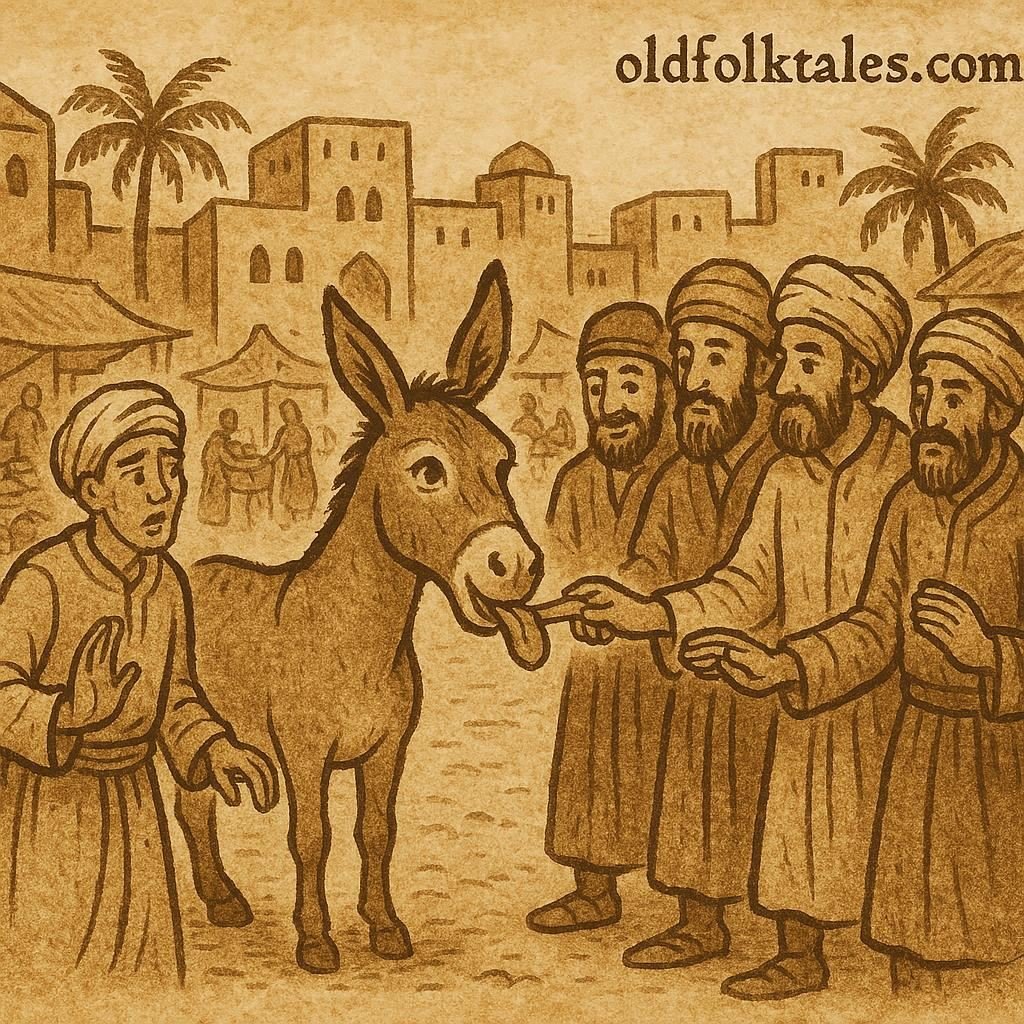
In a bustling Moroccan town where merchants called out their wares and children played between rows of colorful stalls, there lived a merchant who owned a strong gray donkey. This donkey was not only loyal but also sharp in ways no one expected.
One morning, the town woke to news of theft. A bag of coins had been stolen from a wealthy trader, and no one knew the culprit. Whispers spread quickly, and suspicion fell on innocent people, yet the truth remained hidden.
The wealthy trader was furious. He shouted in the market, “If no one confesses, I will call upon the qadi, and you will all pay for this crime.” Fear gripped the townsfolk. Among the crowd stood the donkey’s master, who also felt uneasy, for the thief could have been anyone near his stall. But the donkey, with his long ears twitching, seemed to sense the unrest.
Fascinated by this tale? Discover more North African folktales
Then an idea sparked in the mind of a wise old man. He stepped forward and declared, “Let us ask the donkey. His tongue will tell us the truth.” At this, the people laughed, thinking it a joke. How could a donkey reveal a thief? But the wise man smiled calmly. “Do not doubt. I will show you.”
The wealthy trader, desperate for answers, agreed. The wise man led the donkey to the center of the market. He announced, “Each man will step forward and touch the donkey’s tongue. The donkey will know the thief and reveal him.”
One by one, the townsfolk approached. They were told to open the donkey’s mouth gently, place their hand upon his tongue, and then step aside. The donkey stood quietly, obedient as each person followed the instruction. But what the crowd did not know was that the wise man had coated the donkey’s tongue with soot from the cooking fires.
The innocent, with no fear in their hearts, touched the donkey’s tongue as they were told. When they stepped away, their palms were blackened with soot. But when the thief’s turn came, his fear betrayed him. He thought to himself, “If I touch the donkey’s tongue, it will know I am guilty.” So he pretended, stretching out his hand but not actually touching. When he pulled his hand back, it was clean.
The wise man clapped his hands and cried, “There! Look at his hands. They are clean, yet all others are blackened. This is the thief!”
Gasps filled the marketplace. The thief stammered and tried to deny it, but his guilt was clear for all to see. He fell to his knees, begging for forgiveness. The wealthy trader retrieved his stolen bag of coins, and the townsfolk marveled at how a donkey’s tongue had revealed the truth without a single word.
From that day on, whenever someone in the town tried to hide dishonesty, the people would laugh and say, “Beware the donkey’s tongue, for it cannot be deceived.”
Moral Lesson:
Truth cannot be hidden forever. Cleverness and wisdom will always uncover lies, just as the donkey’s tongue revealed the thief.
Knowledge Check
What is the main lesson of The Donkey’s Tongue Moroccan folktale?
Answer: The story teaches that truth cannot be hidden and cleverness will always expose dishonesty.How did the wise man use the donkey to find the thief?
Answer: He coated the donkey’s tongue with soot so that only the guilty thief, who refused to touch it, would be revealed.Why did the thief avoid touching the donkey’s tongue?
Answer: He feared that the donkey would magically expose his guilt, so he pretended to touch it.What did the townspeople learn from the donkey’s tongue test?
Answer: They learned that dishonesty brings shame and that wisdom can uncover the truth in clever ways.How did the market react when the thief was revealed?
Answer: The people gasped in shock, the thief begged for forgiveness, and the stolen coins were returned.Why is the donkey important in this Moroccan folktale?
Answer: The donkey became a symbol of cleverness and truth, remembered for helping expose the thief.
Source: Moroccan folktale. Collected in: Johnson-Davies, Denys. Folk Tales of Morocco (1980).