Long ago, in the seaside village of Sidi Bou Said where the white walls shone under the blue Tunisian sky, there lived a young woman named Leila. She was known throughout the coast for her beauty. Her skin was as soft as sea foam, her eyes sparkled like the Mediterranean waves, and her laughter rang brighter than the gulls that danced above the cliffs. But though she was beautiful, she was also proud, and her heart often forgot to see the beauty in others.
Each morning, Leila stood before her bronze mirror, brushing her long black hair and admiring her reflection. She would say, “No one in Sidi Bou Said is as fair as I am.” Her mother, a humble weaver, would sigh and whisper, “Child, the face in the mirror fades, but the heart remains.” Leila would laugh and reply, “Then I shall have both, a perfect face and a perfect heart.”
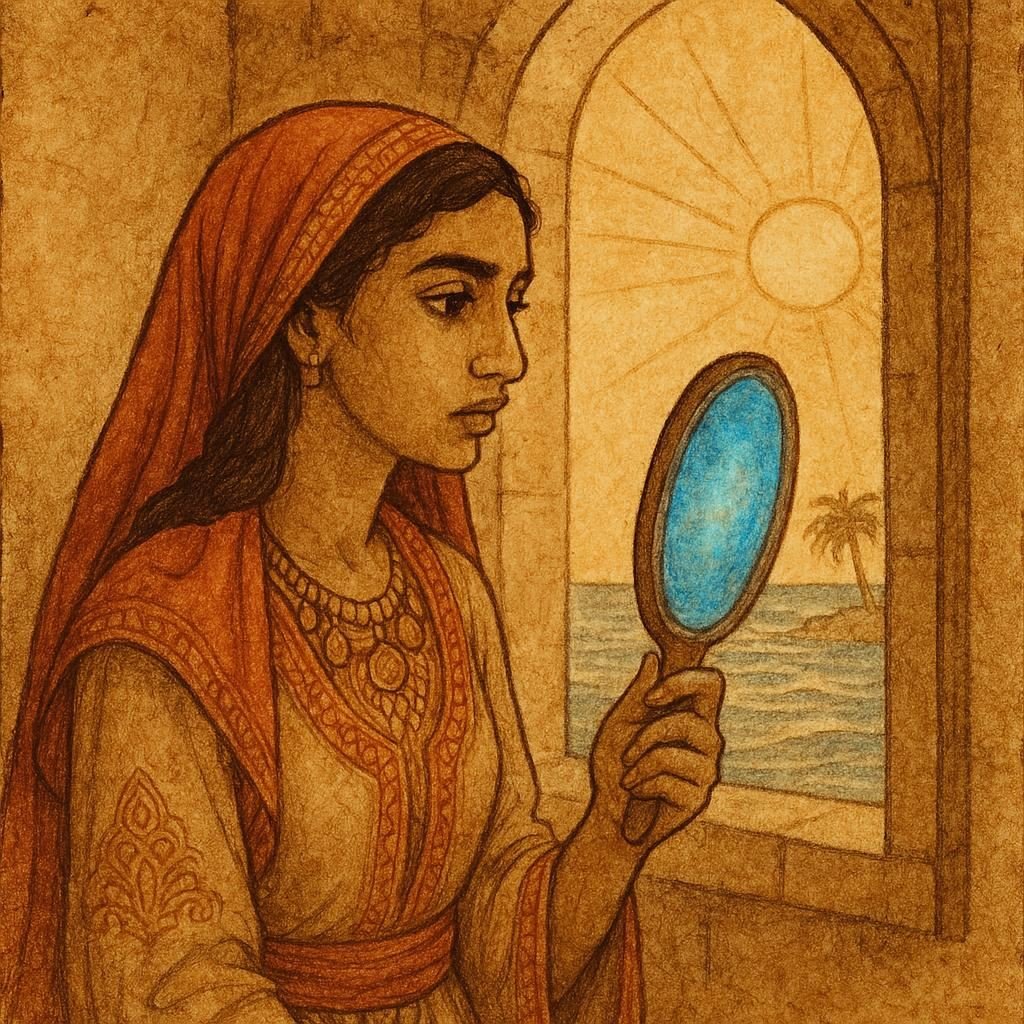
One day, a travelling merchant arrived in the village. He came from the desert beyond Tunis, carrying carpets, spices, and trinkets from faraway lands. Among his wares was a mirror unlike any other. It shimmered with a faint blue glow, as if it held the sea inside it. Leila saw it and was instantly drawn to it.
“How much for this mirror?” she asked.
Fascinated by this tale? Discover more North African folktales
The merchant looked at her and said softly, “This is not a mirror for vanity. It is a mirror for truth. It shows the beauty of the soul, not the skin.”
Leila smiled proudly. “Then I have nothing to fear.” She offered her necklace of coral beads, and the merchant agreed. As he handed her the mirror, he added, “Remember this. The reflection remains only while the heart is true. One lie and it vanishes.”
That night, Leila placed the mirror on her table and peered into it. To her surprise, her reflection was even more radiant than in her bronze mirror. Her eyes glowed softly, and her smile seemed alive with warmth. “How beautiful I am,” she whispered. The mirror shimmered, as if agreeing with her.
Days passed, and the villagers came to see her new treasure. Some admired her reflection, others admired the mirror’s glow, but one girl named Amira, who had always been kind to Leila, said gently, “It shines because your heart is pure. Keep it so.”
But pride is a shadow that grows with attention. One afternoon, a visitor from Tunis, a young painter, came to the village. He admired Leila and said he wished to paint her portrait. “You are the most beautiful woman I have ever seen,” he told her. Leila blushed, and her heart swelled with pride.
That night, as she gazed into the mirror, she said to herself, “I am not only beautiful. I am better than all who live here.” But this time, the mirror flickered. Her reflection wavered, and for a heartbeat, her face disappeared. Alarmed, she touched the glass, and it steadied again, though the glow had dimmed.
The next morning, her mother asked, “Leila, did you help Amira with her weaving as you promised?” Leila hesitated, ashamed. “Yes, Mother, I did,” she lied quickly.
That evening, when she looked into the mirror, her reflection was gone. Only a faint outline remained, like mist on glass. “No,” she cried, “please, come back.” But the mirror stayed dark. In its place, she saw only her room, plain and empty.
Panicked, she ran to the merchant’s stall by the shore, but he was nowhere to be found. Only the sound of waves and the cry of seabirds filled the air. She knelt in the sand and whispered, “I told only one small lie.” The sea breeze answered softly, “A lie, no matter how small, clouds the truth of the soul.”
For days, Leila could not eat or sleep. She stopped admiring herself and began to think of those she had ignored. She helped her mother weave, carried water for the elders, and visited Amira to apologise. Her heart, once proud, began to soften.
One morning, as the sun rose over the blue sea, Leila sat quietly before the mirror. “I have been foolish,” she said aloud. “I see now that beauty without kindness is emptiness. If I must live without my reflection, so be it. I would rather have a true heart than a false face.”
As she turned to leave, a soft light filled the mirror once more. The blue glow returned, brighter than before. Slowly, her reflection appeared, but it looked different. Her face seemed gentler, her eyes calmer, and the pride that once shadowed her smile was gone. The mirror had accepted her truth.
From that day on, Leila kept the mirror not for vanity but as a reminder. Whenever she was tempted to lie or boast, she would glance at the glass and see the faint shimmer that warned her to stay honest. The villagers noticed her change and began to respect her not just for her beauty but for her kindness.
Years later, when Leila grew old, the mirror still hung in her room. Some say it no longer showed faces at all, only the light that lived within each person who looked into it. Others said that the mirror vanished the night Leila died, returning to the sea that had once whispered its warning.
Even now, the people of Sidi Bou Said tell the story of the mirror that reflected truth instead of vanity. They say that if you walk by the shore on a clear night, you may see a faint blue shimmer upon the waves, and if your heart is honest, the sea will smile back at you.
Moral Lesson:
The Mirror of Sidi Bou Said teaches that true beauty lies within an honest heart. Vanity and pride fade with time, but kindness and truth keep the soul shining forever. When we live with honesty, we reflect light in the lives of others.
Knowledge Check
Where does The Mirror of Sidi Bou Said take place?
It takes place in the coastal village of Sidi Bou Said in Tunisia.What was special about the mirror the merchant sold?
It was a magical mirror that showed the beauty of the soul, not the skin.What warning did the merchant give Leila?
He told her that the reflection would disappear if she ever told a lie.What caused Leila’s reflection to vanish?
Her reflection vanished when she lied to her mother.How did Leila regain her reflection?
She became humble, kind, and truthful, proving that her heart had changed.What is the message of this folktale?
The story teaches that honesty and humility are the true forms of beauty.
Source: Coastal legend of Sidi Bou Said, Tunisia. Collected by Youssef El Kamel in Légendes de la Côte Bleue (1959).