Long ago, in a time when travelers journeyed for days across vast stretches of land without seeing another living soul, when the road between villages could be treacherous and lonely, and when the bonds of hospitality were considered sacred obligations among desert peoples, there lived a man who was about to learn a hard lesson about honesty, generosity, and the consequences of selfish behavior.
This particular man was traveling along a dusty road that wound through the harsh, unforgiving landscape, embarking on what he claimed would be a very long and difficult journey to a distant destination. The sun beat down mercilessly upon his head, and his feet ached from walking mile after endless mile across the hard-packed earth. His body was weary, his throat was parched, and his stomach growled with the fierce hunger that comes from traveling without adequate provisions.
As the burning sun began its slow descent toward the western horizon, painting the sky in brilliant shades of orange and deep purple, the exhausted traveler’s eyes caught sight of something that lifted his sagging spirits, a modest family compound in the distance, with smoke rising from cooking fires and the welcoming sounds of domestic life drifting on the evening breeze.
Don’t stop yet! See our complete East African folktales collection
An Act of Sacred Hospitality
Gathering what remained of his energy, the weary man quickened his pace and approached the family’s home with hope rising in his chest. When he reached the entrance to their compound, he called out in the traditional manner to announce his presence, and soon a family emerged to greet this unexpected visitor with cautious but genuine curiosity.
The traveler bowed respectfully and addressed them with carefully chosen words, his voice hoarse from thirst and exhaustion. “Peace be upon you, good people,” he began, his eyes reflecting both his fatigue and his desperate need. “I am traveling a very far distance to reach my destination, and the journey has taken a great toll on my body and spirit. Would you be so kind and generous as to allow me to stay with you for just one night? I desperately need to rest and restore my strength before I continue on my way in the morning light.”
The family exchanged glances with one another, silently communicating in the way that close-knit families do, and then the head of the household nodded with warm approval. In their culture, hospitality to travelers was not merely a kind gesture, it was a sacred duty, a moral obligation that bound all people together in a web of mutual support and protection. To turn away a traveler in need would bring shame upon the entire household and invite the displeasure of the divine.
“You are most welcome in our home, weary traveler,” the family patriarch declared with genuine warmth and sincere generosity. “Please, come inside and rest. We will provide everything you need for your comfort and wellbeing.”
True to their word, the family immediately set about making their unexpected guest as comfortable as possible. They brought out their finest pillows, softest blankets, and most comfortable cushions, arranging them carefully so the traveler would have a proper place to rest his aching body. They brought him cool, refreshing water to quench his burning thirst, and they prepared a welcoming space for him within their home, treating him not as a stranger but as an honored guest deserving of their best hospitality.
The Evening Feast
As the purple twilight deepened into the velvety darkness of night and stars began to appear one by one in the vast desert sky, the family’s herds of livestock returned home from their day of grazing in the distant pastures. The animals, sheep, goats, and cattle, filed into their pens with familiar bleating and lowing, their bells jingling softly in the cooling evening air.
Understanding that their guest was likely famished after his long day of travel, and wishing to honor him with the best they could offer, the family made a significant sacrifice. They selected one of their finest, fattest sheep from the flock, an animal that represented considerable wealth and sustenance for the family, and they slaughtered it according to proper ritual, preparing its meat for their guest’s evening meal.
The women of the household worked with practiced efficiency, cooking the fresh mutton over the fire until it was tender and flavorful, seasoning it with precious spices they usually reserved for special occasions. They also brought out bowls of fresh, creamy milk still warm from the evening milking, rich with nutrition and offered as a sign of their genuine care for this stranger they had welcomed into their midst.
When the meal was finally prepared and laid before him, the traveler’s eyes widened at the generous feast spread out before his hungry gaze. The aroma of the cooked meat made his mouth water uncontrollably, and his empty stomach cramped with anticipation.
What happened next shocked the entire family into stunned, uncomfortable silence.
The Revelation of Greed
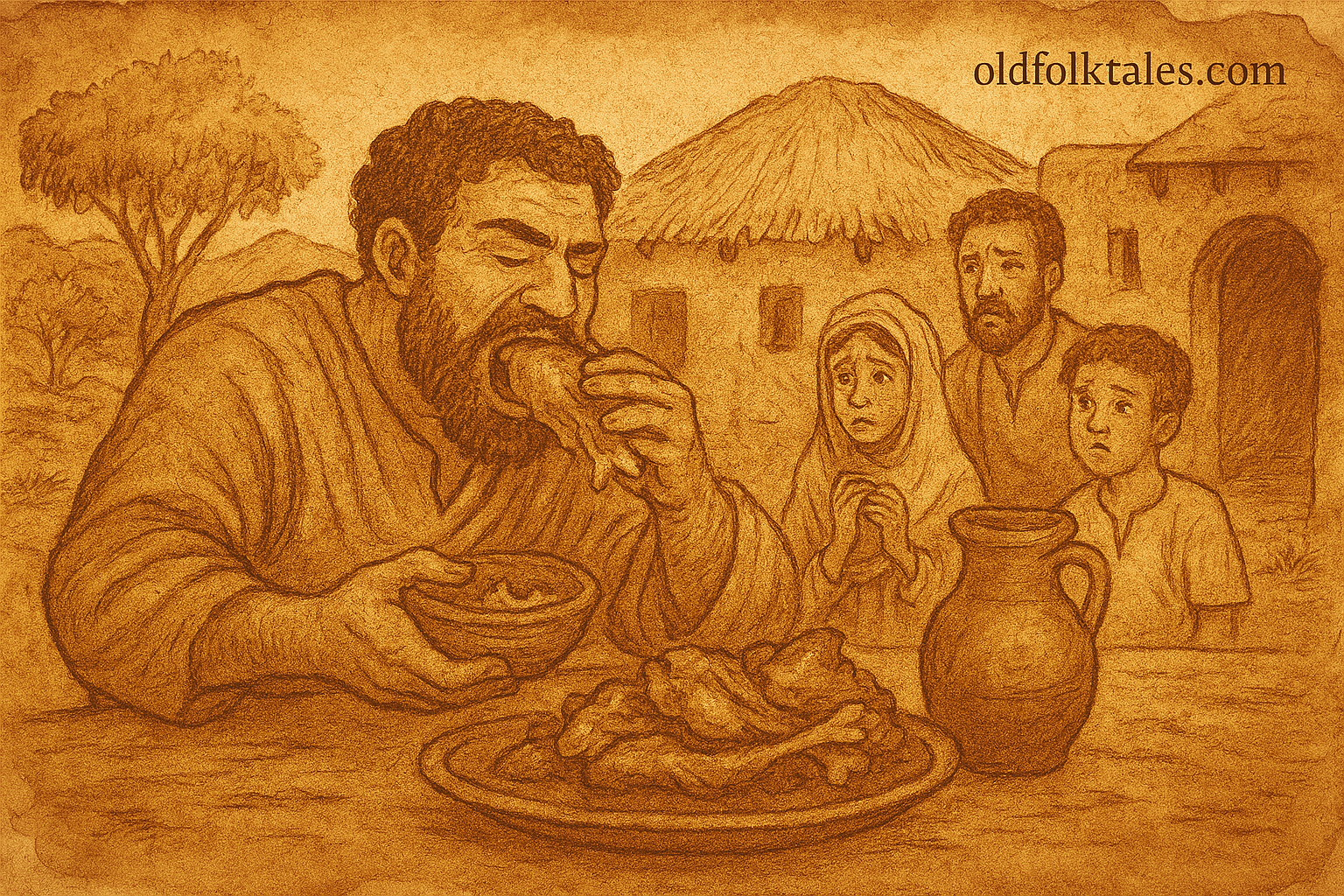
The traveler fell upon the food like a starving wolf upon a helpless lamb. With shocking speed and complete disregard for proper etiquette or common courtesy, he devoured every single morsel of the carefully prepared meat, drank every last drop of the precious milk, and left absolutely nothing not even the smallest piece to be shared with the family who had so generously provided this feast from their own limited resources.
The family members sat in growing disbelief, watching as their guest consumed an entire sheep’s worth of meat along with all the milk they had offered, his hands and mouth moving constantly, his eyes focused only on the food before him, completely oblivious to or uncaring about the hungry eyes of the children watching him eat their family’s valuable provisions.
When the traveler had finally consumed the last bite and licked his fingers clean with obvious satisfaction, the head of the household cleared his throat and spoke, his voice carefully controlled but his eyes reflecting his shock and growing concern. “Tell me, honored guest,” he said slowly, choosing his words with deliberate care, “where exactly are you traveling to, and what is the purpose of your long journey?”
The traveler leaned back contentedly, patting his distended belly with satisfaction, completely unaware of the irony of what he was about to say. “I am making this difficult journey,” he replied with apparent sincerity, “because I must see a very skilled doctor who lives far from here. You see, I suffer from terrible stomach problems that have plagued me for a long time. My appetite has become so poor, so severely diminished, that I can barely eat anything at all. I hope this doctor can provide medicine to restore my appetite to normal.”
The Host’s Wisdom
The owner of the house sat in stunned silence for several long moments, his mind struggling to process the incredible contradiction between what he had just witnessed and what this shameless man was now claiming. His eyes widened in disbelief, and he had to fight the urge to laugh at the absurdity of the situation.
Finally, composing himself and speaking with a mixture of dry humor and barely concealed sarcasm, the host responded in a voice that everyone present could hear clearly. “You say that your appetite is bad? That you can barely eat anything? My dear traveler, I must earnestly beg you, please, I implore you with all my heart, do not return this same way after you have obtained medicine from this doctor of yours.”
The traveler looked confused, not understanding the host’s meaning, but the family patriarch continued, turning to address his own family members with words that mixed wisdom, humor, and genuine concern. “Listen well, my family,” he said, gesturing toward their oblivious guest. “This man claims he has a poor appetite, yet tonight, before receiving any medicine, he has already consumed an entire sheep by himself, along with all the milk we offered. Just imagine what will happen if he returns this way after the doctor gives him medicine to improve his appetite! If he eats one whole sheep now with his ‘bad’ appetite, he will surely devour ten sheep when his appetite is restored! We cannot possibly afford to host him again, our entire flock would disappear into his bottomless stomach!”
The family members nodded in understanding, some covering their mouths to hide smiles, others shaking their heads in amazement at the traveler’s shocking selfishness and complete lack of self-awareness. The children whispered to each other, marveling at how someone could be so greedy and yet so blind to their own gluttony.
The traveler, finally beginning to understand that he was being criticized, shifted uncomfortably but said nothing in his defense, for what defense could possibly excuse such behavior? He had revealed his true character through his actions, and now he would carry the shame of his greed wherever his journey took him.
The Morning Departure
When the sun rose the next morning, bringing with it the promise of another scorching day, the traveler departed quickly and quietly, unable to meet the eyes of the family who had shown him such generous hospitality only to be repaid with shocking selfishness. He continued on his journey, but the story of his greed traveled even faster than he did, spreading from village to village, becoming a cautionary tale told around fires to teach children about the importance of gratitude, sharing, and consideration for others.
The family, though they had lost a valuable sheep and received nothing but disappointment in return, had gained something perhaps more valuable, a story that illustrated an important truth about human nature, one that would be told and retold for generations to come.
The Moral Lesson
This timeless folktale teaches us that selfishness and greed ultimately reveal a person’s true character, and that those who think only of themselves, taking without giving and consuming without sharing, will find themselves unwelcome wherever they go. The story reminds us that hospitality is a sacred trust that should be honored with gratitude and reciprocity, and that dishonesty, especially when combined with greed, brings shame upon the deceiver. True community depends on mutual care, honest communication, and the understanding that we are not alone in this world, and our actions affect those around us.
Knowledge Check
1. What was the main character’s journey about in this Somali folktale? A: The traveler claimed he was making a long journey to see a doctor because he suffered from severe stomach problems and a poor appetite that prevented him from eating properly. However, his actions completely contradicted his words, revealing his dishonesty and greed.
2. How did the family demonstrate traditional Somali hospitality? A: The family welcomed the stranger into their home without hesitation, provided him with comfortable pillows and blankets, slaughtered one of their valuable sheep to feed him, and offered fresh milk, demonstrating the sacred cultural obligation of hospitality to travelers that is central to Somali and broader East African traditions.
3. What shocking behavior did the traveler display during the meal? A: Despite claiming to have a poor appetite, the traveler consumed an entire sheep’s worth of meat and all the milk provided without sharing even a single bite with the family who had sacrificed their valuable resources to feed him, revealing his extreme selfishness and complete lack of gratitude or proper etiquette.
4. What was the host’s clever response to the traveler’s contradiction? A: The host sarcastically begged the traveler not to return the same way after getting medicine for his “poor appetite,” explaining to his family that if the man could eat one whole sheep with a bad appetite, he would surely eat ten sheep once his appetite was restored, using humor to expose the traveler’s dishonesty.
5. What cultural values does this East African tale emphasize? A: This Somali folktale emphasizes the sacred duty of hospitality, the importance of gratitude and reciprocity, the value of honesty in social interactions, the obligation to share resources within a community, and the understanding that selfish behavior brings shame and social consequences.
6. What does the sheep symbolize in this folktale? A: The sheep represents significant wealth and sacrifice in pastoral Somali culture, where livestock is a primary measure of prosperity. The family’s willingness to slaughter a valuable animal for a stranger demonstrates the depth of their hospitality, making the traveler’s greedy consumption without sharing even more offensive and culturally inappropriate.
Source: Traditional Somali folktale, East Africa