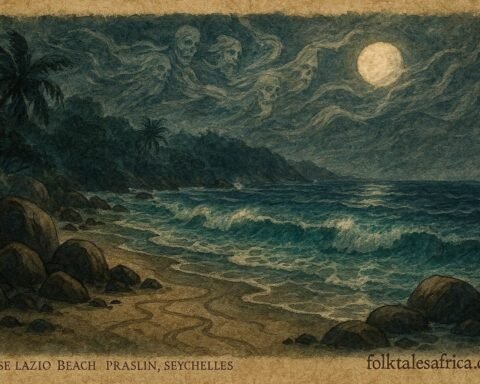
Long ago, before the modern harbour lights of Victoria ever glimmered against the night, the waters around Eden Island were known to sailors as a place of beauty and danger. The sea there was deep and mysterious, a mirror that reflected both the moon and the sins of men. Among the old Creole tales whispered by the fishermen of Mahé, none chilled the heart more than the story of the Ghost Captain of Eden Island.
He had once been a living man, Captain Durand, a seafarer of great skill and reputation. His ship, The Alouette, sailed the Indian Ocean from Madagascar to Zanzibar, carrying spices, pearls, and silks. Yet beneath his polished manner hid a heart consumed by greed. He cared little for his crew, seeing them only as tools to increase his fortune. Though the sea had made him rich, he wanted more, and the glitter of gold soon became the only thing that guided him.
Don’t stop yet! See our complete East African folktales collection
One voyage changed everything. After trading in Madagascar, the captain and his crew discovered an ancient chest of coins buried on a remote coral island. The markings on the chest warned, “For the sea and her spirits, not for mortal hands.” The crew begged their captain to leave it untouched, for they feared the curse of the ocean spirits. But Durand only laughed. “Curses are for fools,” he said. “This gold will buy us kingdoms.”
As they sailed home toward Mahé, the weather turned strange. The waves swelled though no wind blew, and mist began to curl around the ship like pale smoke. The crew whispered that the sea spirits were angry. At last, one brave sailor confronted the captain, urging him to return the treasure. Durand’s eyes burned with greed. “The gold is mine,” he shouted. “Anyone who defies me will meet the deep.” And in his fury, he struck the sailor down. The man fell into the dark water and vanished beneath the foam.
That night, as the ship drifted in the mist, a sound like a woman’s wail echoed across the sea. The lanterns dimmed, and the air grew cold as if the sea itself had turned to ice. Then the captain saw her, a ghostly figure rising from the water, her hair flowing like seaweed, her eyes glowing with sorrow. “You have taken what belongs to us,” she said. “Your greed has stained the waters. You shall wander until your debt is paid.”
Before the captain could reply, the ghost vanished, and the waves rose in fury. Lightning struck the mast, tearing it in two. The ship split apart, swallowing Durand and his gold beneath the waves. The sea was silent again by morning, and The Alouette was never seen alive.
Yet the story did not end there. Years later, fishermen began to tell of a phantom ship that drifted silently through the mists off Eden Island. On calm nights, they saw its tattered sails glowing faintly under the moon. At its helm stood a shadowy figure, steering endlessly toward the horizon. Sometimes, a faint voice could be heard across the water, whispering, “Forgive me.”
Those who saw the ghost ship said that it appeared whenever a storm was near, as if warning the living of danger. Some claimed that Captain Durand now guided lost sailors to safety, seeking redemption for his betrayal. Others believed he still searched for his stolen treasure, doomed to wander the sea until he returned every coin he once claimed.
One old fisherman named Baptiste told of an encounter on a foggy night near Victoria Harbour. His boat had been caught in the mist, the wind lost, and the sea still as glass. Then through the grey fog, a pale light appeared. A tall figure stood at the bow of a shadowy ship, holding a lantern that flickered blue like fire. “Turn your sail, brother,” the ghostly voice called. “The reef lies ahead.” Baptiste obeyed, and when the fog lifted, he saw the jagged rocks where his boat would have broken. The phantom ship was gone.
From that day, Baptiste left offerings of rum and flowers by the shore whenever he went to sea. “He may have been wicked,” he told the younger fishermen, “but even a cursed man can seek forgiveness.”
Today, when the sea mists roll in from the east and the air turns heavy, the people of Mahé still tell the story of the Ghost Captain of Eden Island. They say the glow of his lantern can be seen far out at sea, guiding lost boats away from danger. And though his soul remains bound to the waters, some believe that with each life he saves, the ocean spirits loosen the chains of his curse, one tide at a time.
Moral Lesson
The Ghost Captain of Eden Island teaches that greed blinds the heart and destroys the soul. True redemption is found only through repentance and good deeds, no matter how late they come. Those who respect the sea and live with honesty find peace, but those ruled by selfishness are haunted by their choices.
Knowledge Check
What was Captain Durand’s greatest flaw in The Ghost Captain of Eden Island?
His greed for gold and his lack of respect for his crew led to his downfall and eternal curse.What warning was written on the treasure chest the crew found?
The chest bore a warning that said, “For the sea and her spirits, not for mortal hands.”What caused the curse that doomed Captain Durand?
He killed a crew member and stole gold that belonged to the sea spirits, provoking their wrath.How did the ghost of the captain appear to the fishermen of Mahé?
He appeared steering a phantom ship through the mist, holding a blue lantern and whispering to sailors.What act showed that the ghost captain sought redemption?
He guided lost sailors away from danger, saving lives to repay his debt to the sea.What message does the story of The Ghost Captain of Eden Island give about human behaviour?
It warns that greed brings destruction, but repentance and good deeds can bring peace even to a cursed soul.
Source: Maritime ghost tale, Victoria Harbour, Seychelles. Documented by M. L. Savigny in Creole Nights: Stories of the Seychelles (1942).