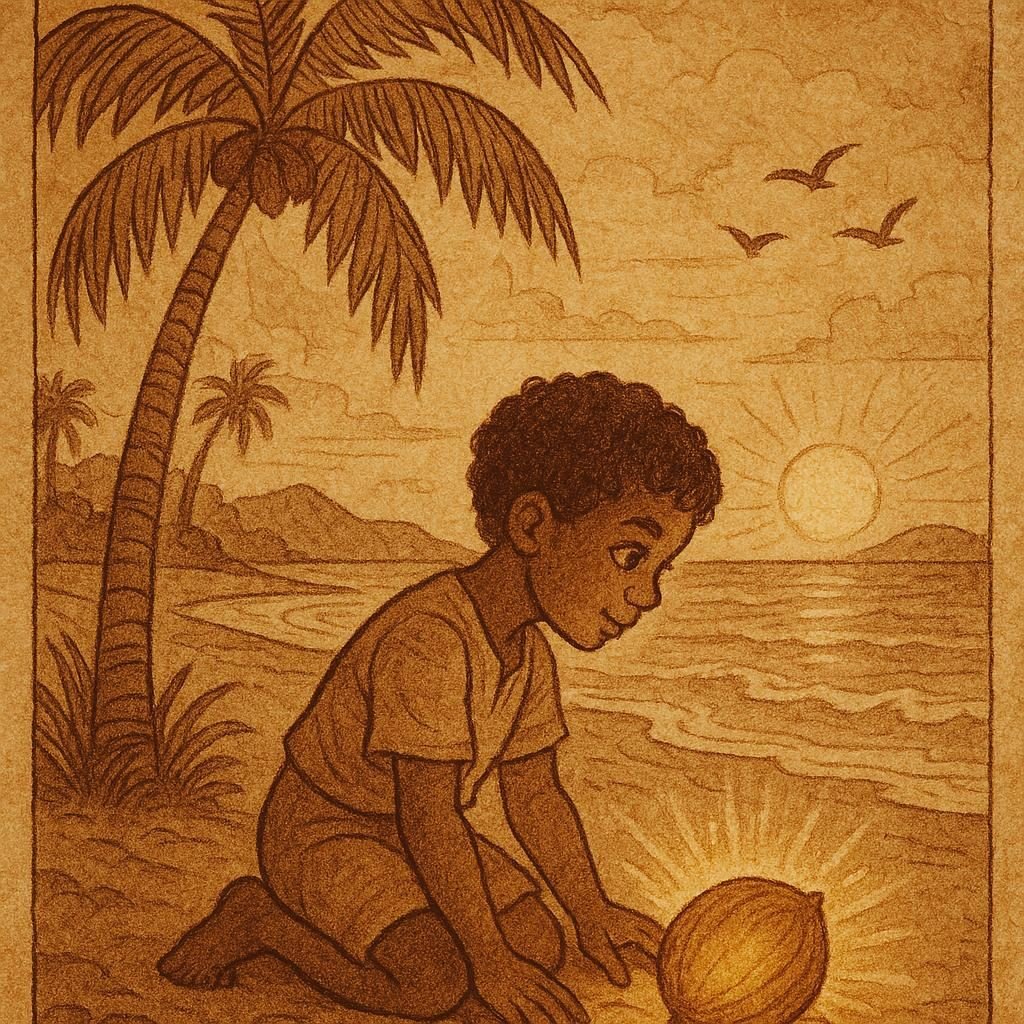
Long ago in the quiet village of Anse Boileau on Mahé Island, there lived a boy named Kavi. His family was poor, and the land had suffered a long drought. The streams had dried, the breadfruit trees no longer bore fruit, and even the sea breeze carried dust instead of coolness. Each morning, the villagers prayed for rain, but the clouds passed without mercy. Kavi, though young, worked tirelessly beside his mother, collecting what little coconuts and herbs the dry soil still offered.
One day, while wandering near a lonely stretch of beach, Kavi found a single coconut lying apart from the rest. Its shell gleamed faintly in the sunlight, as if it had just rolled out of the sea. Curious, he picked it up. To his astonishment, a soft voice came from within. “Do not be afraid, Kavi,” it said. “I am no ordinary coconut. I have come to guide you.”
Kavi dropped it in shock, then blinked and picked it up again. “Who are you?” he whispered.
Continue your journey: Read more East African folktales
“I am a spirit of the earth,” the coconut replied. “The land cries for water, and you alone can bring the rain. But you must walk where I lead you and keep faith, even when others laugh.”
The boy hesitated, for he had never heard a fruit speak. Yet something in the voice filled him with calm. He carried the coconut home and placed it in a woven basket by his bed. That night, he dreamt of green hills, rushing rivers, and a shining spring hidden deep in the mountains. When he awoke, he knew it was a sign.
The next morning, Kavi told his mother about the dream and the speaking coconut. She smiled kindly but did not believe him. “Dreams are only dreams,” she said. “Work hard, and the rain will come when it will.” But Kavi’s heart would not rest. He took the coconut and set out toward the hills, following the same path he had seen in his dream.
The journey was long. The sun beat down, and the dry earth cracked beneath his feet. At times, he felt faint with thirst, but the coconut spoke again, encouraging him. “Do not turn back, Kavi. The spring is near.” The boy pressed on, climbing over rocks and through dry forests where birds no longer sang.
At last, he reached a hidden valley surrounded by tall palms. In the centre lay a flat stone carved with strange old markings. The coconut’s voice grew stronger. “Strike the stone three times,” it said. “Then place me in the hollow that appears.”
Kavi obeyed. He lifted a nearby stick and struck the stone once, twice, and a third time. The ground trembled. A crack opened in the rock, and from its depths gushed a stream of clear water that sparkled like light itself. The coconut rolled from his hands into the flow, glowing softly before sinking beneath the surface.
The water spread quickly, forming rivulets that raced down the valley toward the plains. Kavi ran after them, laughing and crying all at once. When he returned to his village, the air had already begun to change. The wind carried the smell of rain, and thunder rolled in the distance. Within moments, the skies opened, pouring blessings over the parched land.
The villagers danced in the rain, lifting their faces to the heavens. When Kavi told them what had happened, they were astonished. Some fell to their knees in gratitude, while others shook their heads in disbelief. “How could a boy and a coconut call down rain?” they murmured. But Kavi only smiled. “It was not me,” he said. “It was the voice of the earth. It only needed someone to listen.”
From that day, Kavi was known throughout Mahé as the boy who brought back the rain. The valley where he found the spring became a sacred place, and people began to leave offerings of coconuts there, thanking the spirit for its gift. Even after Kavi grew old, he never forgot the gentle voice that guided him through the drought. Whenever clouds gathered over Anse Boileau, he would look up and whisper, “Faith speaks softly, but its echo can change the world.”
And so the people learned that the earth itself holds wisdom, speaking to those who believe, not with thunder but with gentle whispers hidden in the simplest things.
Moral Lesson
The story of The Coconut That Spoke teaches that faith and courage can unlock blessings even in the hardest times. When people listen to the quiet guidance of nature and believe in their dreams, they become instruments of hope. True power lies not in strength or wealth, but in trust, patience, and the courage to follow what feels right.
Knowledge Check
What problem faced the village of Anse Boileau at the beginning of the story?
The village suffered a long drought that dried rivers, trees, and farmlands, leaving the people desperate for rain.How did Kavi first encounter the magical coconut?
He found it shining alone on the beach, and it spoke to him, offering guidance to end the drought.What did the coconut tell Kavi to do during his journey?
It instructed him to walk to the hills, strike a marked stone three times, and place the coconut in the hollow that appeared.What happened after Kavi followed the coconut’s instructions?
A spring of clear water burst from the rock, spreading through the valley and bringing back the rain.How did the villagers react to Kavi’s story?
Some believed and rejoiced, while others doubted, but all benefited from the rain that returned to their land.What message does The Coconut That Spoke give about faith and destiny?
It teaches that belief, perseverance, and listening to the wisdom of nature can lead to miracles and change lives.
Source: Rural Seychellois folktale from Anse Boileau. Collected by Jean-Pierre Prosper in Island Echoes: Oral Tales of Seychelles (1951).