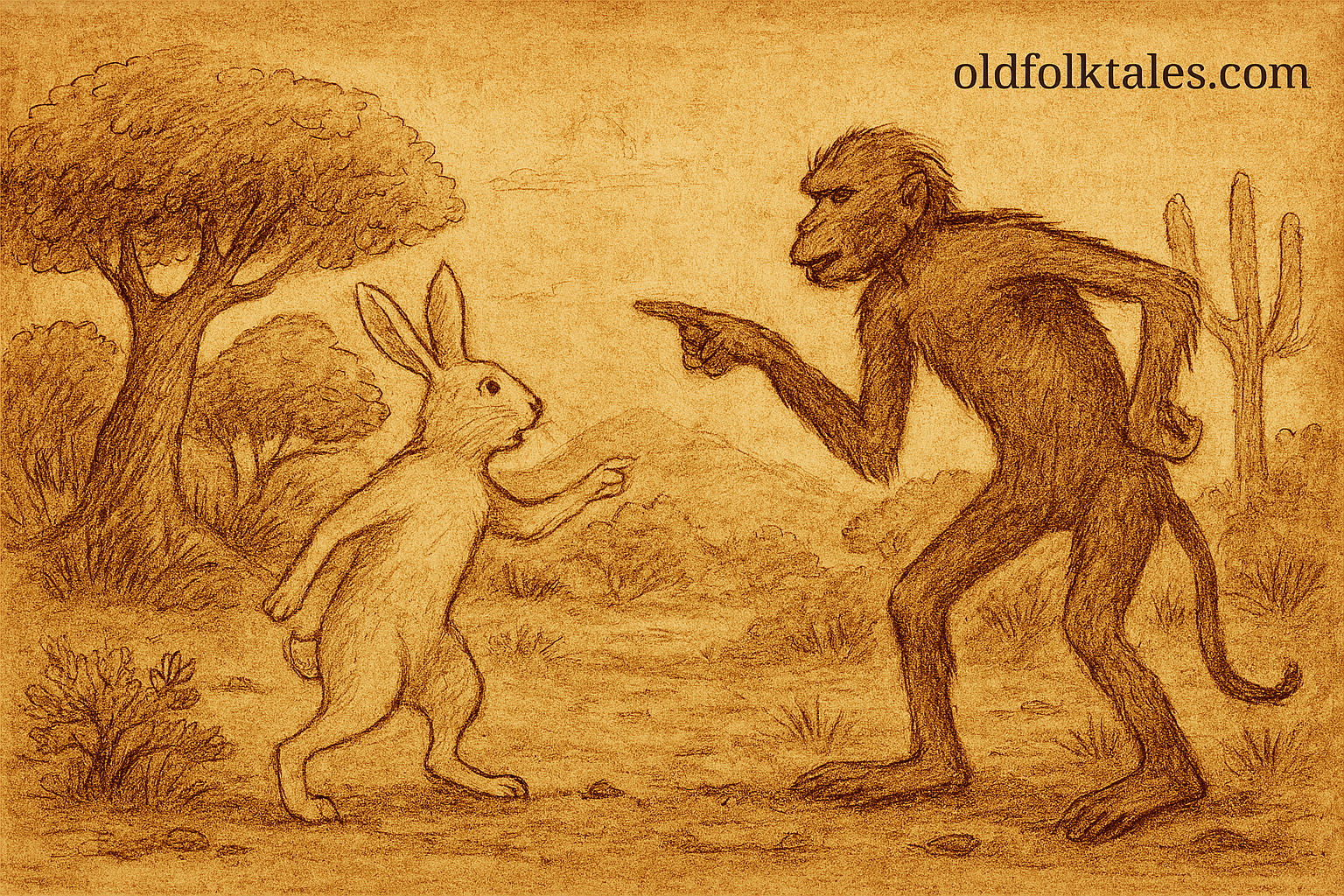
Far away in a hot country where the forests grew thick and dark, and rivers ran swift and strong through the dense vegetation, there once lived an unusual pair of friends. One was Isuro, a large white rabbit with soft fur and alert pink eyes, and the other was Gudu, a tall baboon with coarse hair and cunning ways. The two were inseparable, or so it seemed, for they were seldom seen apart in all the villages of that land.
One sweltering afternoon, when even the birds had fallen silent in the oppressive heat, Isuro awoke from his midday sleep to find Gudu the baboon standing over him with an expectant look in his eyes.
“Get up, my friend,” Gudu announced. “I am going courting to visit my betrothed, and you must accompany me on this journey. Gather some food and put it in a bag to sling around your neck, for the road is long and we may not find anything to eat along the way.”
Click here to discover more legendary tales from West Africa
Isuro rubbed his eyes sleepily and gathered a generous store of fresh green vegetables and tender shoots from beneath the bushes. When his bag was full, he nodded to Gudu that he was ready, and together they set off down the dusty path.
For some time they traveled in companionable silence, the sun beating down mercilessly upon their backs. Eventually they came to a wide river where rocks jutted up from the rushing water like stepping stones placed by giants. The current swirled dangerously between each stone, and the gaps looked treacherous.
“We can never jump those wide spaces while burdened with food,” Gudu declared, his voice full of false concern. “We must throw our provisions into the river, unless we wish to fall in ourselves and drown.” And while Isuro walked ahead examining the crossing, Gudu stooped down unseen, picked up a heavy stone, and hurled it into the water with a tremendous splash.
“It is your turn now, friend,” Gudu called out cheerfully. And with a heavy heart and heavier sigh, the trusting rabbit unfastened his bag of carefully gathered food and watched it disappear into the swirling current.
Once across the river, they followed a road that wound through an avenue of tall trees. Before long, Isuro’s sensitive nose caught the scent of something delicious, and he turned to see Gudu eating beautiful, ripe fruit from a bag hidden in the thick hair around his neck.
“Where did you get that?” Isuro asked, his stomach growling with envy and hunger.
“Oh, I discovered after all that I could cross the rocks quite easily with my bag,” Gudu replied casually, juice dripping from his lips. “It seemed foolish to waste perfectly good food.”
“But you tricked me into throwing mine away!” Isuro protested. “At least let me share yours, since we are friends.” But Gudu pretended not to hear and strode purposefully along the path, leaving the hungry rabbit to hop along behind him.
Soon they entered a dense wood, and there before them stood a magnificent tree so heavy with fruit that its branches swept the ground under the weight. Some of the fruit gleamed green in the dappled sunlight, while others had ripened to a golden yellow.
Isuro hopped forward eagerly, his mouth watering, but Gudu quickly said, “Take the green fruit, my friend. You will find it far superior in taste. I will leave all of it for you since you missed your dinner, and I shall take only the yellow ones for myself.”
The innocent rabbit selected a green orange and bit into it, but the skin was so hard and bitter that he could barely penetrate the rind, and the flesh inside made him grimace.
“This tastes terrible!” he cried. “I would much prefer one of the yellow ones.”
“No, no! I really could not permit that,” Gudu insisted with false concern. “The yellow ones would only make you ill. Be content with what you have.” And since green fruit was all he could obtain, poor Isuro was forced to make do.
After this deception was repeated several more times, Isuro finally understood the truth, whatever Gudu advised him to do, he should do the exact opposite. His friend was no friend at all, but a selfish trickster. This realization came just as they approached the village where Gudu’s betrothed lived.
As they entered the settlement, Gudu pointed to a clump of bushes with particular leaves. “Whenever I am eating and you hear me cry out that my food has burned my mouth, run quickly and gather some of those healing leaves,” he instructed.
The rabbit wanted to ask why anyone would eat food they knew would burn them, but he held his tongue and simply nodded. A short while later, he told Gudu he had dropped his needle and needed to go back. While pretending to search, he gathered a large quantity of the healing leaves and hid them in his fur, thinking cleverly, “If I collect them now, I shall save myself the trouble of running back later.”
When they finally arrived at their destination as the sun touched the horizon, Gudu’s betrothed brought them water to wash the dust from their fur and two portions of food. But once again, Gudu deceived his companion.
“The custom of this village forbids you to eat until I have finished,” Gudu lied smoothly. And though Isuro now suspected this was false, he could not be certain, so he sat watching hungrily as Gudu devoured his own meal and began eyeing Isuro’s portion.
Suddenly Gudu screamed loudly, “I am burned! I am burned!” though nothing had actually burned him at all. Isuro, who had the healing leaves hidden in his fur, went around a corner briefly to make it appear he was fetching them. But when he returned mere moments later, both portions of food had vanished completely.
“How unfortunate!” Gudu exclaimed, snatching the leaves. “No sooner had you left than many people arrived, washed their hands as you see, and ate your share.” But Isuro knew better than to believe him now, though he said nothing. That night he went to bed hungrier than he had ever been in his entire life.
The next morning they journeyed to another village, passing a large garden where workers were harvesting monkey-nuts. Gudu pointed to a heap of empty shells and said generously, “You can have a good breakfast at last, friend.”
But this time, Isuro replied, “Thank you, but I think I prefer these,” and turned instead to the pile of full kernels, eating every last one before Gudu could stop him in front of so many witnesses.
That evening, when they reached the village where the mother of Gudu’s betrothed lived, she served them meat and millet porridge. “I believe you mentioned your fondness for porridge,” Gudu suggested slyly.
“You must be mistaking me for someone else,” Isuro answered firmly. “I always eat meat when I can get it.” And again Gudu was forced to accept the porridge he despised, while Isuro enjoyed the succulent meat.
In frustration, Gudu knocked over a pot of water that hung before the fire, extinguishing the flames. “Now I can steal his meat in the darkness,” the baboon thought. But Isuro had grown equally cunning and hid the meat behind him where Gudu’s grasping hands could not find it.
“Oh Gudu!” Isuro laughed. “It is you who have taught me to be clever!” And he asked the villagers to rekindle the fire for Gudu while he himself went to sleep with friends in another hut.
Before dawn, Isuro heard his name whispered softly. Opening his eyes, he saw Gudu gesturing for silence and beckoning him to follow. Once they were far from the huts, Gudu confessed his plan.
“I am still hungry from that wretched porridge. I am going to kill one of those goats, and since you are a skilled cook, you must prepare the meat for me.” Isuro nodded agreement, and soon Gudu returned dragging a dead goat. Together they skinned it and stuffed the hide with dried leaves, propping it up in the bushes so convincingly that no one would suspect it was not alive.
While Isuro built a fire and Gudu stole a pot, they hung the meat-filled pot over the flames. “It will take at least two hours to cook properly,” Gudu announced. “We should both rest.”
Both pretended to sleep, each planning to take all the meat. Gudu kept checking to see if Isuro was asleep, but the rabbit’s pink eyes remained open, though in truth, Isuro was sleeping with his eyes open, as rabbits do. Eventually Gudu himself fell into exhausted slumber, and Isuro woke, ate all the meat, and tied the bones in Gudu’s fur before returning to sleep.
In the morning, the goat owner discovered the leaf-stuffed skin and raised an alarm. When the villagers gathered, an old man pointed accusingly at the strangers and cried, “Those are thieves!”
“How dare you!” Isuro challenged boldly. “Prove it!” And he danced forward, turned somersaults, and shook himself vigorously before everyone. Nothing fell from his fur.
“Perhaps I was wrong,” the old man admitted. “Now let the baboon do likewise.”
When Gudu began to jump, the goat bones rattled and clattered, falling from his fur. “Gudu is the goat-slayer!” the people shouted.
But Gudu protested desperately, “No! Isuro killed and ate your goat and hung the bones on me while I slept! It is he who should die!”
The villagers looked at one another in confusion. Finally someone suggested, “Let both die, but they may choose their own deaths.”
Isuro spoke up calmly. “If we must die, place us where wood is cut, heap it high around us so we cannot escape, and set it afire. Whoever burns is the guilty one.”
The people agreed and did as Isuro suggested. But Isuro knew of a secret hole beneath the wood-pile, and when the flames began to crackle, he scurried into his hiding place while Gudu perished in the fire.
When only ashes remained and the flames had died, Isuro emerged from his hole and said to the assembled people, “Did I not speak truly? He who killed your goat now lies among those ashes.”
The Moral of the Story
This powerful tale teaches us that persistent deception and betrayal will ultimately lead to one’s own destruction. Gudu’s constant manipulation of his supposed friend created an enemy who learned to match his cunning. The story reminds us that friendship built on lies and selfishness is no friendship at all, and that those who repeatedly take advantage of others will eventually face consequences for their actions. It also illustrates that the oppressed and deceived can learn to recognize patterns of manipulation and use intelligence to survive and achieve justice. True cleverness lies not in exploiting others, but in recognizing when one is being exploited and responding with wisdom.
Knowledge Check
Q1: Who are Isuro and Gudu, and what is unusual about their relationship?
A: Isuro is a white rabbit and Gudu is a baboon who appear to be close friends, always seen together. What makes their relationship unusual is that beneath the appearance of friendship, Gudu constantly deceives and manipulates Isuro, stealing his food and exploiting his trust throughout their journey, making theirs a false friendship based on exploitation rather than genuine care.
Q2: How does Isuro’s character evolve throughout this Ivorian folktale?
A: Isuro begins as a trusting, naive friend who believes everything Gudu tells him and suffers repeatedly from this trust. Through painful experiences, he learns to recognize deception and adopts the strategy of doing the opposite of what Gudu suggests. By the story’s end, Isuro has become as clever as his manipulator, using his intelligence to survive and ensure justice is served.
Q3: What is the significance of the green and yellow fruit incident?
A: The fruit incident represents a turning point in Isuro’s awareness. When Gudu insists the green (unripe, bitter) fruit is better while keeping the yellow (ripe, sweet) fruit for himself, Isuro finally recognizes the pattern of deception. This moment symbolizes the awakening of wisdom—learning to see through false advice and understanding that those who claim to help may actually be serving only themselves.
Q4: What does the goat theft and its aftermath reveal about justice in this tale?
A: The goat theft shows how Gudu attempts to use Isuro as an accomplice while planning to blame him. The trial by fire that Isuro suggests represents a test of truth and justice. Isuro’s knowledge of the hole beneath the wood-pile demonstrates that true justice sometimes requires both cleverness and understanding one’s environment. The story suggests that justice favors the truly innocent who use their wits.
Q5: What cultural values does this West African folktale emphasize?
A: This Ivorian tale emphasizes several West African values: the importance of genuine friendship and community trust, the consequences of betrayal, the virtue of intelligence and adaptability when facing adversity, and the belief that justice will ultimately prevail. It also reflects the oral tradition’s use of animal characters to teach human lessons about character, loyalty, and the dangers of selfishness.
Q6: Why is the rabbit character significant in Ivorian and West African folklore?
A: In West African folklore, including Ivorian tales, the rabbit (or hare) often represents the clever trickster who uses intelligence to overcome larger, stronger opponents. Isuro embodies this archetype, showing how the physically weaker but mentally sharp can survive and triumph over those who abuse power. The rabbit teaches that wisdom and adaptability are more valuable than physical strength or social position.
Source: Ivorian folktale, Côte d’Ivoire (Ivory Coast)