“Once upon a time,” began Outa Karel, his voice settling into that ancient rhythm that meant a grand tale was coming, and his audience of three children looked up with keen anticipation.
“Once upon a time, Oom Leeuw roared, and the entire forest shook with the dreadful, magnificent sound. It was the kind of roar that proclaimed mastery over all creatures, the voice of absolute authority. Then, from far away across the vast vlakte, the endless plains floated another roar in response, eerily similar in its power and resonance.
“The little lion cubs, hearing this distant echo, jumped about in excitement and stood on their heads, tumbling over each other in their innocent merriment.
Love this story? Discover our full Southern African folktales collection
“‘Listen, listen!’ they cried with delight. ‘It is Volstruis, old Three Sticks, the Ostrich! He tries to imitate the King, our father. But hear how well he roars! Truly there is no difference between them.’
“When Leeuw heard his own cubs speak these words, he was filled with rage. How dare anyone suggest that another creature could match the King of Beasts! So he roared again, even louder than before, putting all his royal fury into the sound. Again came back the answering roar across the veld, as if the very earth itself were mocking him.
“‘Ach, no! This will never do,’ thought Leeuw, his pride deeply wounded. ‘I must put a stop to this impudence immediately. I alone am King here, and imitators, I want none of them!’
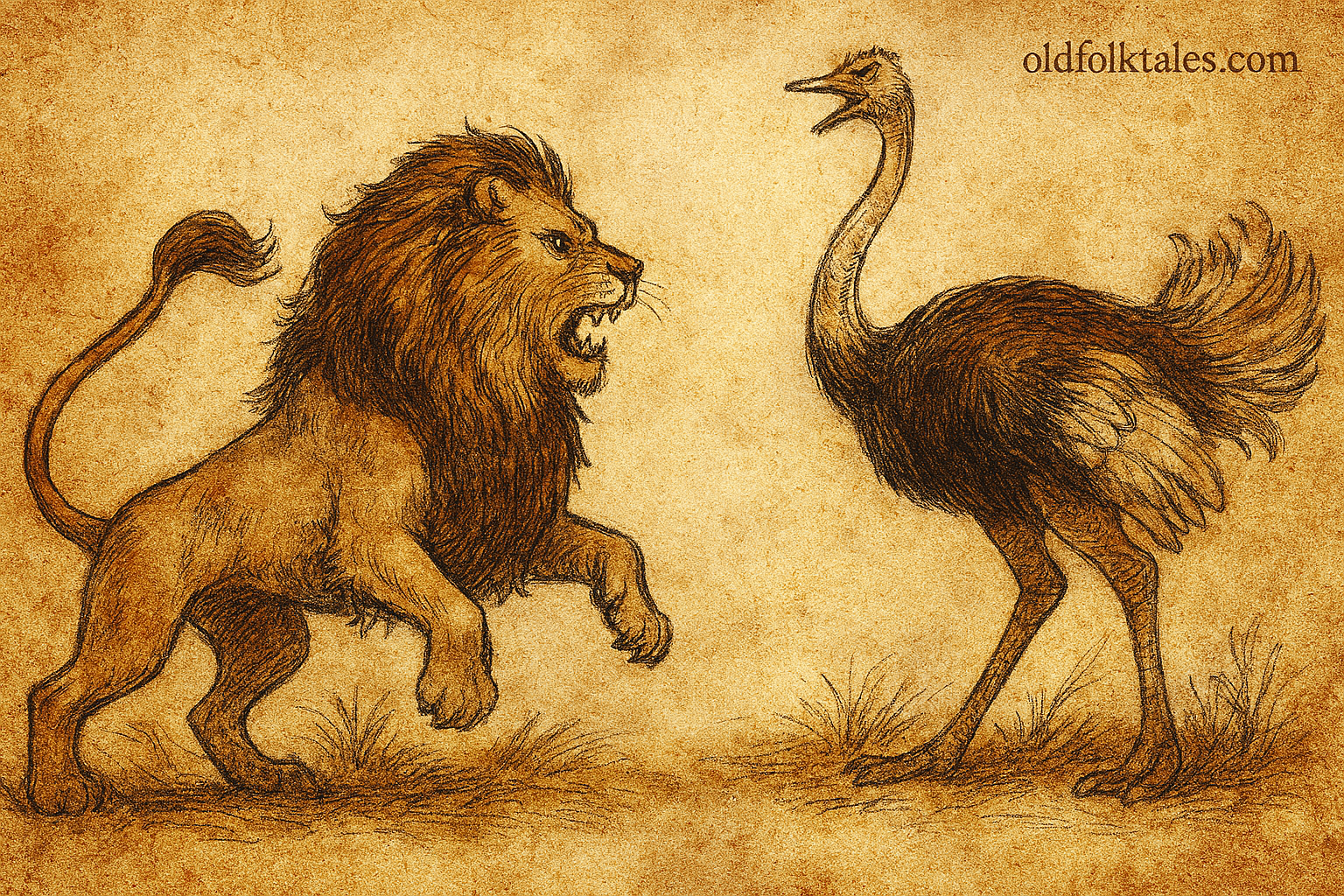
“So he set forth with purpose, roaming across the vast vlakte until he met old Three Sticks himself, the great Ostrich known as Volstruis. They stood facing each other on the open plain, two magnificent creatures, each formidable in his own way.
“Leeuw’s eyes flamed with golden fire, his massive mane rose like a thundercloud around his head, and he lashed his tail back and forth with barely contained fury. Volstruis spread out his beautiful wings those magnificent black and white plumes and swayed from side to side in a hypnotic dance, his beak open and his long neck twisting and coiling like a whip-snake preparing to strike. Ach! It was beautiful to see, but if you baasjes could have seen his eyes! You know, Volstruis’s eyes are normally very soft and beautiful like Nonnie’s when she tells the Bible stories but now there was only fierceness in them, and strange yellow lights that flickered like flames.
“But there was no fight not yet. This was simply their way of meeting, of sizing each other up. Leeuw came a step closer and said with forced civility, ‘We must determine who is baas here. You, Volstruis, please to roar a little for me.’
“So Volstruis roared, blowing out his throat magnificently: ‘Hoo-hoo-hoor-r-r-r!’ It was a fearsome sound indeed the sort of sound that makes you feel streams of cold water running down your back when you hear it suddenly in the darkness and don’t know what it is. Yes, baasjes, if you are safe in bed you curl up tight and pull the blankets over your head, and if you are outside, you run quickly to find the Nooi or Nonnie for protection.”
A slight movement of contradiction passed among his small listeners, but they made it a point of honor never to interrupt Outa in full storytelling mode. Their objections could wait.
“Then Leeuw roared with all his might, and truly, the voices were identical. No one could say with certainty, ‘This is a bigger voice,’ or ‘That is a more terrifying voice.’ No, they were perfectly equal in power and majesty.
“So Leeuw, though reluctant to admit it, said to Volstruis, ‘Our voices are alike. You are my equal in roaring. Let it be so, then. You shall be King of the Birds as I am King of the Beasts. But now let us go hunting together and see who is truly baas in that arena.’
“Out on the vlakte, a herd of sassaby were feeding peacefully big, fat antelopes, a nice klompje of them and so Leeuw started off in one direction while Volstruis went in the other. Both clever hunters kept away from the upwind side, for wild bucks can smell danger with incredible sensitivity. Just one little puff of scent when a hunter is creeping toward them, and instantly all the heads snap up sniff, sniff, sniff and they’re off like the wind itself! All you see is dust, and when that settles ach no! there are no bucks left; the whole veld is empty, empty!”
Outa stretched out his arms dramatically, waving them from side to side with an exaggerated expression of desolation, his voice mournful with a sense of irreparable loss.
“But,” he continued with renewed energy, “Leeuw and Volstruis were experienced hunters who knew their craft. They understood how to get closer and closer without alerting their prey. Leeuw dragged himself along slowly, slowly, pressed close to the ground, and only when he moved could you distinguish which was lion and which was sand the colors were so perfectly matched.
“He selected a fine buck, well-grown and fat but not too old to be tender and juicy. When he got near enough, he hunched himself up very quietly so, my little masters, just so coiled and ready to spring. Then, before you could even whistle, he shot through the air like a stone from a catapult and landed fair and square on the sassaby’s back, his great tearing claws fastened deep into its shoulders and his wicked teeth meeting in the poor creature’s neck.
“Ach! That beautiful big buck would never again lead his herd or pronk proudly across the veld in mating season! When Oom Leeuw gets hold of something, he doesn’t let go until it is completely dead.
“The rest of the herd scattered in panic and soon were mere specks in the distance all except those that Volstruis had killed. And truly, Volstruis was remarkably clever! You see, baasjes, he can run incredibly fast even faster than the sassaby. So when he saw Leeuw preparing to spring, he raced upwind as hard as he could go, knowing instinctively that’s where the frightened herd would flee. There he waited for them, and didn’t he have his fun!
“He stood just so”in his excitement, Outa rose from his stool and struck a dramatic pose”and when they streaked past him in their panic, he jumped like this, striking at them with the hard, sharp claws on his powerful two toes!”
Outa hopped about energetically like a fighting bantam while the children hugged themselves in silent delight at his performance.
“Voerts! There was one dead!” Outa kicked dramatically to the right. “Voerts! There was another!” he kicked to the left “until there was a whole klomp of bucks lying scattered across the veld, giving their last dying bleats. Yes, old Two Toes did his deadly work well that day.
“When Leeuw finally arrived and saw that Volstruis had killed more prey than he had, he was far from pleased. But Volstruis, ever the diplomat, quickly smoothed things over.
“Leeuw said with forced generosity, ‘You have killed the most, so you should rip open the carcasses and begin eating first.’
“‘Oh no!’ said Volstruis with apparent modesty, ‘you have cubs to share the food with, so you rip open and eat. I shall only drink the blood.’
“This response put Leeuw in an excellent humor; he thought Volstruis a noble, unselfish creature. But truly, as I said before, Volstruis was exceptionally clever. You see, baasjes, he couldn’t eat meat at all he had no teeth! But he certainly didn’t want Leeuw to discover this weakness. Therefore he said diplomatically, ‘You eat the meat; I will only drink the blood.’
“So Leeuw ripped open the carcasses sk-r-r-r-r, sk-r-r-r-r—with great satisfaction, called his cubs, and they all feasted until completely satisfied. Then Volstruis approached in a casual fashion, pecking absently as he walked, and drank the blood. Afterward, both he and Leeuw lay down in the shade of some thorn trees and fell into contented sleep.
“The lion cubs, full of energy and mischief, played nearby, rolling and tumbling over each other. As they romped about, they came upon the place where Volstruis lay sleeping.
“‘Aha!’ said one curious cub, ‘he sleeps with his mouth wide open.’
“The cub peeped curiously into Volstruis’s gaping beak. ‘Aha!’ he exclaimed again, ‘I see something strange or rather, I don’t see something!’
“Another cub came to investigate and peeped inside as well.
“‘Alle kracht!’ he gasped in astonishment. ‘I see something too or nothing at all! Let us go quickly and tell our father about this.’
“They ran off in tremendous excitement and woke Leeuw from his pleasant nap. ‘Come, come quickly, Father!’ they urged. ‘Volstruis insults you by claiming he is your equal. He lies sleeping under the trees with his mouth hanging open, and we have peeped into it, and behold he has no teeth at all! Come and see for yourself.’
“Leeuw bounded up immediately and rushed over with the cubs racing at his tail.
“‘Nier-r-r-r,’ he growled threateningly, rudely waking Volstruis, ‘nier-r-r-r! What is the meaning of this deception? You pretend you are my equal, and you haven’t even got teeth!’
“‘Teeth or no teeth,’ said Volstruis, standing up instantly alert, ‘I killed more bucks than you did today. Teeth or no teeth, I’ll fight you right now to prove who’s truly baas here.’
“‘Come on, then,’ challenged Leeuw. ‘Who’s afraid? I’m ready for you this very moment. Come on!’
“‘No, wait just a little,’ said Volstruis with calculated cunning. ‘I have a plan. You see that large ant-heap over there? Well, you stand on one side of it, and I’ll stand on the other side, and we’ll see who can push it over first. After that we’ll come out into the open and fight properly.’
“‘That seems a fair plan,’ agreed Leeuw, and he thought smugly to himself, ‘I’m much heavier and stronger; I can easily send the ant-heap flying onto old Three Sticks, and then spring over and finish him off.’
“But wait! It was not nearly as easy as he imagined. Every time he sprang at the ant-heap, his instincts took over and he clung to it exactly as he was accustomed to clinging to his prey, he had no other way of attacking. And then Volstruis would seize the opportunity to kick high into the air with tremendous force, sending sand and stones flying into Leeuw’s face, making him howl and splutter with rage and frustration.
“Sometimes Leeuw would pause to roar in fury, and Volstruis would send an equally powerful roar back from the other side of the mound.
“So they continued battling until the top of the ant-heap was thoroughly loosened by all the kicks and blows. Leeuw was growing angrier and angrier by the moment, and he could barely see his eyes were so full of dust and grit. He gathered himself together for one tremendous, final spring. But before he could execute it, Volstruis bounded impossibly high into the air and kicked with all his might, sending the entire top of the ant-heap flying. Arré, but the dust was thick as a storm!
“When it finally cleared away, there lay Oom Leeuw, groaning and coughing pathetically, buried beneath the great heap of earth and stones.
“‘Ohé! Ohé!’ wailed the cubs in distress, ‘get up, my father! Here he comes, the Toothless One! He who has teeth only on his feet! Get up and slay him before it’s too late!’
“Leeuw shook himself free of the crushing earth and sprang desperately at Volstruis, but his eyes were still full of sand he could not see properly, so he missed his target completely. As he came down heavily and awkwardly, Volstruis shot out his powerful right leg with lightning speed and caught Leeuw squarely in the side. Sk-r-r-r-r! went the skin, tearing like cloth, and goops! goops! Over toppled poor Oom Leeuw, with Volstruis’s terrible claws, the deadly teeth of old Two Toes fastened deep into his flesh.
“Volstruis danced upon him with grim determination, flapping and waving his magnificent black and white wings, tearing the very life out of Oom Leeuw with methodical precision.
“When it was finally over, Volstruis calmly cleaned his bloodied claws in the sand and waltzed away slowly across the veld to where his mate sat faithfully on their nest, waiting.
“Only the heartbroken cubs were left behind, wailing over the body of the dead King of the Forest.”
The usual excited babel of questions and comments erupted at the close of the story, until at last Pietie’s determined young voice rose above the general chatter.
“Outa, what made you say that bit about pulling the blankets over one’s head and running to Mammie if one heard Volstruis bellowing at night? You know perfectly well that none of us would ever do such a thing.”
“Yes, yes, my baasje, I know very well,” said Outa soothingly. “I never meant anyone who belongs to this land of Volstruise. But other little masters from far away, who did not know the voice of old Three Sticks, they would certainly run to their mam-mas if they heard him calling in the darkness.”
“Oh, I see,” said Pietie, accepting the apology graciously. “I was certain you could not mean a proper karroo farm boy.”
“Is your story a parable, Outa?” asked little Jan thoughtfully, who had been doing some serious thinking during the last minute.
“Ach! And what exactly is that, my little master?”
“A kind of fable, Outa, a story with a lesson.”
“Yes, that’s precisely what it is, baasje,” said Outa, gladly seizing on the familiar word, “a fable, a nice little fable.”
“But a parable is an earthly story with a heavenly meaning,” persisted Jan, “and when Cousin Minnie tells us parables she always explains the meaning for us. What is the heavenly meaning of this one, Outa?”
Little Jan’s innocent grey eyes were earnestly fixed on Outa’s wrinkled face, as though trying to read from it the profound explanation he sought. For once, the wily old native was completely nonplussed. He rubbed his red kopdoek nervously, laid a crooked finger thoughtfully against his flat nose, scratched his sides monkey-fashion, and finally had desperate recourse once more to adjusting the kopdoek. But all these familiar expedients failed to inspire him with any heavenly meaning whatsoever for the story he had just told. Ach! These dear little ones, always thinking of such complicated things! There they all sat, waiting expectantly for his next words of wisdom. He had to escape somehow.
“Baasjes,” he began smoothly, “there is indeed a beautiful, profound meaning to the story, but Outa hasn’t got time to explain it properly right now. Another time”
“Outa,” broke in Willem reprovingly, “you know you only want to get away so that you can go to the old tramp-floor, where the volk are dancing tonight.”
“No, my baasje, truly no!” Outa protested unconvincingly.
“And I wouldn’t be at all surprised to hear that you had danced too, after the way you’ve been jumping and kicking about here this evening.”
“Yes, that was magnificent,” said Pietie with relish. “‘Voerts! There is one dead! Voerts! There is another!’ Outa, you always complain about being so stiff, but you can still kick remarkably well when you want to.”
“Aja, baasje,” returned Outa with modest pride, “in my day I was a truly great dancer. No one could perform the Vastrap better or the Hondekrap or the Valsrivier. Arré, those were wonderful times!”
He gave a little involuntary hop at the sweet remembrance of those mad and merry days, and then another and another, always edging toward the passage leading to the kitchen and freedom.
“But the meaning, Outa, the heavenly meaning!” cried little Jan desperately. “You still haven’t told us!”
“No, my little baas, not tonight I’m afraid. Ask the Nonnie; she will explain it to you beautifully. Look, here she comes now.”
And as Cousin Minnie entered the room at that perfectly opportune moment, the wily old native, with an agility not to be expected from his cramped and crooked limbs, skipped nimbly away, leaving her to bear the full brunt of his inability to explain the deeper meaning of his own dramatic story.
Moral Lesson
This powerful tale teaches that pride comes before a fall, and that underestimating others based on appearances can lead to downfall. Lion’s arrogance blinded him to Ostrich’s true strengths, his speed, intelligence, and those deadly clawed feet. The story reminds us of that different creatures (and people) possess different kinds of power, and that brute strength is not always superior to strategy and adaptability. It also warns against letting wounded pride drive us into foolish conflicts and demonstrates that true kingship comes not from roaring the loudest, but from understanding one’s own limitations and respecting the abilities of others.
Knowledge Check
Q1: What is the significance of Volstruis (Ostrich) being called “Old Three Sticks” in this South African folktale? A: “Old Three Sticks” refers to the ostrich’s distinctive appearance, its long neck and two long legs resembling sticks. This nickname, used affectionately in Bushman storytelling tradition, emphasizes the ostrich’s unusual but effective physical form. Despite seeming awkward, these “three sticks” proved deadly weapons, with the two-toed feet becoming the instruments of Lion’s defeat.
Q2: Why did Volstruis claim he would “only drink the blood” instead of eating meat with Lion? A: Volstruis cleverly concealed his greatest weakness having no teeth by framing it as noble generosity. Since ostriches cannot chew meat, he made a virtue of necessity by appearing selfless and allowing Lion to eat first. This deception was crucial to maintaining the illusion of equality with the Lion, showing how intelligence can compensate for physical limitations.
Q3: What does the ant-heap battle symbolize in this African animal fable? A: The ant-heap contest represents how choosing the wrong battleground leads to defeat. Lion agreed to fight on Volstruis’s terms, in a situation that neutralized Lion’s strengths (clawing and biting) while maximizing Ostrich’s advantages (powerful kicking). This teaches that victory often depends not on raw power but on controlling the circumstances of conflict.
Q4: How does this Bushman tale reflect the natural behavior of real lions and ostriches? A: The story incorporates accurate natural history: lions do hunt by stalking and pouncing; ostriches are indeed faster runners than most prey animals; and an ostrich’s kick with its powerful, clawed feet can genuinely kill a lion. The Bushman people, living close to these animals, wove real observations into entertaining moral tales that also served as survival lessons.
Q5: What is the deeper meaning behind Lion’s defeat in this South African folktale? A: Lion’s downfall stems from his pride and assumption of superiority. He dismissed Ostrich because he lacked teeth, never considering that teeth aren’t the only deadly weapons. The tale warns against arrogance and judging others by a single criterion. It reflects the Bushman people’s understanding that in nature and life survival requires humility, adaptability, and respect for all creatures’ unique abilities.
Q6: Why does Outa Karel struggle to explain the “heavenly meaning” at the story’s end? A: This humorous conclusion reflects the authentic nature of oral storytelling traditions. Outa Karel tells stories primarily for entertainment and practical wisdom, not theological allegory. His escape from little Jan’s question reveals the cultural difference between indigenous African storytelling (focused on survival lessons and entertainment) and European religious parables (focused on spiritual metaphors), while also showcasing Outa’s clever personality.
Cultural Origin: South African Bushman (San) folktale from the Great Karroo region, collected by Sanni Metelerkamp.