In a village where the sun blazed golden over the red earth, there lived a renowned hunter named Nenpetro. He was a man of great skill with the bow, and his aim was as true as his heart. Nenpetro had three wives, each blessed with remarkable gifts that set them apart from ordinary women.
The first wife was called Ndoza’ntu, which means “the Dreamer.” Her sleep brought visions of things hidden and truths yet to unfold. The second was Songa’nzila, “the Guide,” whose feet never faltered on any path and whose eyes could trace roads invisible to others. The third was Fulla Fulla, “the Raiser of the Dead,” who knew the secrets of herbs and plants that could call a spirit back from the land of shadows.
If you liked this story, see our Central African folktales collection
The Growing Hunger
One morning, Nenpetro rose early and ventured into the thick forest, his quiver full and his spirit high. By midday, he had brought down a fine antelope. He carried it home with pride, and his three wives prepared it with care, roasting the meat over the fire until it was tender and fragrant. They ate well that day, but their satisfaction did not last long.
Within days, hunger gnawed at their bellies once more. “Husband,” they called to Nenpetro, “we are hungry again.”
The hunter nodded and returned to the forest. This time, he tracked and killed a monkey, its meat less abundant but still nourishing. Again, his wives cooked and ate, but again, their hunger returned too soon.
Nenpetro shook his head and sighed. “Oh, nothing but an ox will satisfy you people!” he declared. And so, with determination burning in his chest, he set off in search of larger game.
The Fatal Hunt
For hours, Nenpetro followed the tracks of cattle through tall grass and over rocky terrain. The sun climbed high, then began its descent toward the horizon. At last, in a clearing where several oxen grazed peacefully, he spotted his prize, a strong, healthy ox with a glossy hide.
Crouching low, Nenpetro moved with the silence of a shadow. He drew his bow, aimed carefully, and released. The arrow flew true, and the ox stumbled and fell. Victory surged through the hunter’s veins. But in his moment of triumph, he made a fatal mistake before he could reload his weapon, another ox, enraged by the attack on its companion, charged at him with furious speed.
The beast’s horns struck Nenpetro with terrible force, and the great hunter fell to the earth, his life slipping away like water through cupped hands.
The Journey to Find Him
Back in the village, the three wives waited and waited. Their hunger grew sharper, but more painful still was the absence of their husband. They called out for Nenpetro, but only silence answered. Days passed, and fear began to settle in their hearts like a cold stone.
Then one night, as the moon hung full and white above the village, Ndoza’ntu fell into a deep sleep. In her dreams, she saw her husband lying motionless on the ground, an ox standing nearby. But she also saw another ox, fallen by Nenpetro’s arrow.
She woke with a start and told her sister-wives what she had seen. “Our husband is dead,” she said, her voice trembling. “But he killed an ox before he fell.”
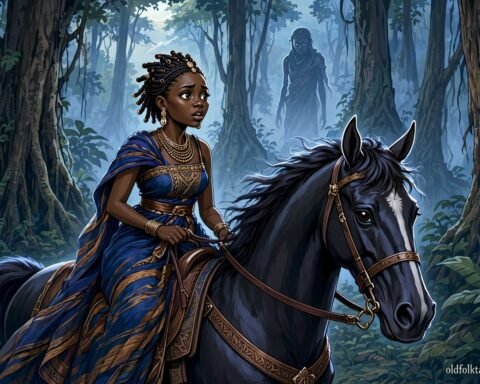
Without hesitation, Songa’nzila stood up. “Come along,” she said with quiet determination. “I will show you the road.”
The three women gathered what they needed and set out immediately. Songa’nzila led them with unwavering certainty, up steep hills and down into valleys, through dense woods where shadows danced between the trees, and across rivers that sang over smooth stones. As the sun began to set on that long day of walking, they arrived at the clearing where Nenpetro lay cold and still.
The Restoration of Life
Fulla Fulla wasted no time. While her sister-wives wept over their husband’s body, she disappeared into the surrounding forest. She gathered roots that grew in secret places, leaves that carried ancient power, and bark from trees that had stood for generations. She crushed and mixed these herbs with practiced hands, speaking words that her grandmother had taught her.
She placed the medicine on Nenpetro’s lips and rubbed it on his chest. Slowly, miraculously, color began to return to his face. His fingers twitched, then his chest rose with a shallow breath. Life was flowing back into his body.
The Quarrel and the Judgment
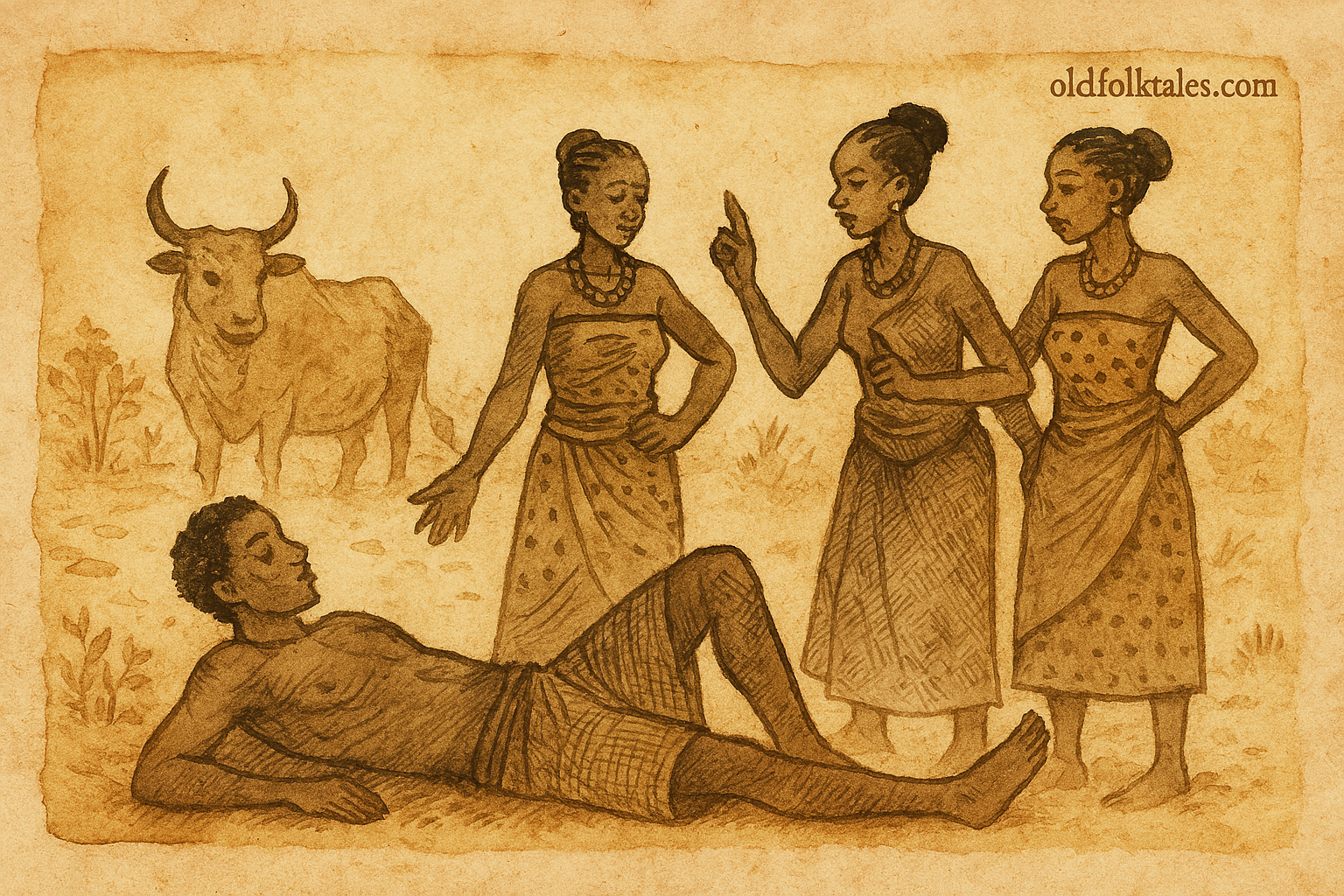
But as joy began to bloom in their hearts, a new conflict arose. The three wives began to argue, each claiming that her contribution was the most important.
“I dreamt that he was dead,” declared Ndoza’ntu. “Without my vision, we would never have known to search for him.”
“But I showed you where he lay,” countered Songa’nzila. “Without my guidance, you would still be wandering lost in the forest.”
“And I have brought him back to life,” said Fulla Fulla firmly. “Without my healing, he would still be a corpse lying on the ground.”
They could not agree on whose shimbec whose house Nenpetro should enter first upon his recovery. Finally, they devised a test.
“Let us each cook a pot of food,” they decided. “When he is strong enough to eat, he will choose whose pot to take his first meal from, and thus we will know whose gift was greatest.”
Ndoza’ntu and Songa’nzila each killed a fowl and prepared it with spices and care. Fulla Fulla cooked pig meat, rich and satisfying. When Nenpetro was finally able to sit up and smell the food, they presented their offerings to him.
The hunter looked at each pot carefully. Then he reached for the pot of pig that Fulla Fulla had prepared.
“When you dreamt that I was dead, Ndoza’ntu,” he said thoughtfully, “you did not give me food, for I was not yet found. And when you, Songa’nzila, showed the others the road, I was still unfit to eat. But when Fulla Fulla gave me back my life, then was I able to receive the pig she gave me. The gift of Fulla Fulla is therefore the most to be prized.”
Most of the people who heard of this judgment agreed that Nenpetro was wise and fair. But the women of the village whispered among themselves that perhaps he should have combined the food from all three pots into one, mixing them together and eating from the collective effort. For all three wives had played essential parts in saving his life, and perhaps no single gift could truly be valued above the others.
The Moral Lesson
This folktale teaches us about the nature of teamwork and the danger of competing for recognition. While each wife possessed a unique and valuable gift, vision, guidance, and healing, it was only through their combined efforts that Nenpetro was saved. The story reminds us that in any great achievement, many contributions matter. Success rarely comes from one person alone, but from many working together. When we seek to elevate one contribution above all others, we risk overlooking the chain of efforts that made success possible. True wisdom lies not in claiming superiority, but in recognizing our interdependence.
Knowledge Check
Q1: Who are the three wives of Nenpetro and what are their special abilities?
A: The three wives are Ndoza’ntu (the Dreamer), who has prophetic dreams and visions; Songa’nzila (the Guide), who can find any path and lead people safely; and Fulla Fulla (the Raiser of the Dead), who has knowledge of healing herbs and plants that can restore life.
Q2: How did Nenpetro die in the African folktale?
A: Nenpetro was killed by an angry ox while hunting. After successfully shooting one ox to feed his hungry wives, he was charged and gored by another ox before he could reload his weapon, resulting in his death.
Q3: What role did each wife play in restoring Nenpetro to life?
A: Ndoza’ntu dreamed that Nenpetro was dead and had killed an ox, revealing what had happened. Songa’nzila led the wives through difficult terrain to find where his body lay. Fulla Fulla gathered herbs and used her knowledge to bring him back to life.
Q4: Why did Nenpetro choose Fulla Fulla’s food after being restored to life?
A: Nenpetro explained that Ndoza’ntu’s dream did not feed him because he was not yet found, and Songa’nzila’s guidance did not feed him because he was still dead. Only Fulla Fulla’s gift of restoration made it possible for him to eat, so he chose her food to honor the gift that directly enabled him to live again.
Q5: What is the symbolic meaning of the three wives’ names in this African story?
A: The names represent different stages of solving a problem: Ndoza’ntu (the Dreamer) symbolizes awareness and knowledge, Songa’nzila (the Guide) represents direction and action, and Fulla Fulla (the Raiser of the Dead) embodies transformation and healing. Together, they form a complete process of rescue and restoration.
Q6: What was the women of the village’s opinion about Nenpetro’s judgment?
A: The women of the village believed Nenpetro should have mixed the food from all three pots together and eaten from the combined offering, suggesting that all three wives’ contributions were equally important and should have been honored equally rather than ranking one above the others.
Source: Central African folktale (Kongo people tradition)