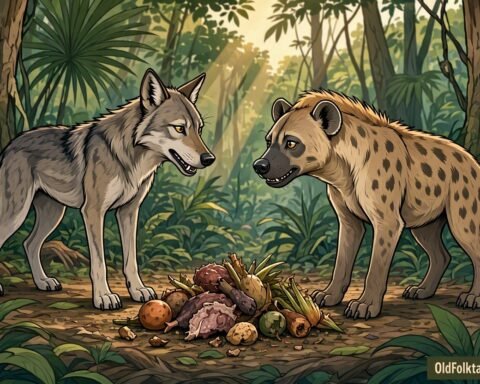
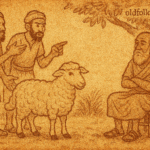
Hyena padded along the Guban plain where thorn trees lean like tired sentries and the wind keeps everyone’s business. His ribs showed like a comb, his eyes shone like coals that forgot to die. Yet Hyena smiled, because he carried a secret that had never failed him, a charm whispered by an old sand witch near Berbera, hide what you want by speaking of it too loudly, and no one will hear the truth.
One season of little rain, the camels coughed dry, the goats chewed tasteless sticks, and the wells dropped their voices to a whisper. Hyena found a cave by a dune’s hip, a cave that breathed cool air and smelled of goat fat. Inside, he discovered sacks of barley, gourds of butter, strips of sun meat, a quiet treasure that belonged to a caravaner who had fled a storm and planned to return. Hyena grinned. The secret wiggled on his tongue like a fish.
He went to the elders’ fire that night, sat just beyond the circle of light, and said, I worry for our people, my cousins, I have heard that someone hides food in a cave near the thorn hill, but be warned, the cave is sacred, whoever goes there will anger the jinn. The elders nodded, fear and hunger mixing in their eyes. A youth asked, Which thorn hill. Hyena laughed, near the one that listens, and he slunk away to eat in the dark until his belly sang.
Days passed, and Hyena’s ribs softened under fat. He smeared ash on his fur so the moon would not gossip. He dragged a little food to different places, leaving goat tracks to confuse hyenas that did not exist. At the well, he groaned, I fear a famine of manners, some thief surely steals from the caravans. People grumbled, thieves, yes, thieves, and Hyena licked his chops when no one watched.
One night a boy named Warsame, thin as a prayer, followed Hyena at a distance. Warsame had learned to walk like wind, to disappear behind thorn and rock, to listen with his skin. He saw Hyena push a rock aside and slip into the cave. The boy waited, then walked into camp and spoke softly to his aunt, who baked flatbread on a pan that smelled like comfort. The aunt spoke to the grandmother, the grandmother spoke to the water seller, the water seller spoke to the man who owned the cave, and soon a net of whispers spread like early light.
The caravaner returned with three men and lanterns. They moved the rock and found Hyena nose deep in a gourd of butter, his mouth shining like a liar’s promise. Hyena tried his trick, he jumped up, laughed, and cried, Cousins, you have saved me from the jinn who wanted to make me their cook. This butter was a test, this barley was a trap, this meat was a spell. He made words fall like rain, loud, quick, bright, hoping no one would taste their dryness.
The caravaner did not shout. He hummed a traveling song and asked the men to sit. He handed Hyena a small bowl of milk and said, If a secret is protection, can it survive silence. Hyena blinked. The caravaner continued, Eat, then hear this, when hunger rules your mouth, your mouth will rule your heart, and the heart will forget the village. The men did not tie Hyena, they did not strike him, they did not curse him. They took only a promise, return what you took with your labor, guard this cave for the season, give meat to the weak.
Hyena agreed, his head low. For many nights he worked, carried water skins, fetched dung for fire, chased jackals from the herd. He gave meat to the weak, butter to the sick, barley to the old. The village watched, some with pity, some with hard eyes that remember bites. Warsame, the boy who walked like wind, brought Hyena a crust wrapped in cloth and said, Secrets die when shared with work. Hyena nodded, tasting a new kind of full.
When the rains finally came, small at first, then proud, the cave emptied not from theft, but sharing. Hyena looked at his paws, cleaner than before, and at the dunes, smoothed by the wind. He learned to keep one secret only, the one that lives inside a changed heart. He kept to the edges still, because a name is a long shadow, yet sometimes at dusk he joined the elders’ fire, silent, the way a promise sits after it has done its job.
Moral, A secret that feeds only one becomes a famine for all
Author’s Note, Somali storytelling lives between wind and water, with the ethics of caravan life, trust, and scarcity. This version makes Hyena’s secret a social trick, speech as camouflage, and resolves it through restorative labor rather than punishment, which reflects mutual dependence on the plain.
Knowledge Check
Setting, Where does Hyena find the food, answer, In a cool cave near a dune and thorn hill
Trick, What is Hyena’s secret method, answer, Hiding truth by speaking loudly in misleading ways
Witness, Who discovers the hiding place, answer, Warsame, a patient, quiet boy
Justice, How is Hyena corrected, answer, He must repay with labor and sharing
Theme, What defeats selfish secrecy, answer, Work, community trust, and sharing
Symbol, What does the elders’ fire represent, answer, Communal truth and memory
Origin, Somali, Horn of Africa