Long before the forest paths were worn by many feet, when the great trees still whispered secrets only a few could hear, there lived a hunter whose name was spoken with respect across the villages of southern Cameroon.
He was known not only for his skill, but for his discipline.
Love this story? Discover our full Southern African folktales collection
From a young age, he had learned the ways of the forest, the subtle bending of grass that revealed hidden trails, the quiet calls of birds that warned of movement, the patience required to wait for the right moment. His arrows flew straight, his aim rarely failed, and he provided well for his household.
Yet what set him apart was not merely his ability to hunt, but the way he carried himself within the forest.
He did not shout or boast beneath its canopy.
He did not take more than he needed.
And before each journey, he paused at the edge of the trees, lowering his head in silent acknowledgment of the unseen forces that dwelled within.
For the forest, as the elders always said, was not empty.
It was alive.
One season, when the rains had passed and the earth was rich with scent and color, the hunter prepared to venture deeper into the forest than he ever had before.
Game had become scarce near the village, and those who relied on him looked to him with quiet expectation. So, he gathered his bow, his arrows, and a small bundle of provisions, and set out at dawn.
As he approached the forest’s edge, he stopped.
The morning air was still. Even the birds seemed to hold their breath.
He bowed his head.
“Spirits of the forest,” he murmured softly, “I enter with respect. I take only what I need, and I honor what you protect.”
Then he stepped forward.
The deeper he walked, the quieter the world became.
The familiar sounds of the outer forest faded, replaced by a stillness that felt heavy and watchful. The trees grew taller, their roots twisting like ancient hands gripping the earth. Light filtered down in thin, golden strands, and the air carried a coolness that did not belong to the open land.
Hours passed.
The hunter saw signs of animals, tracks, broken branches, faint scents, but none revealed themselves. It was as though the forest itself was hiding them.
Still, he did not grow impatient.
He moved carefully, stepping lightly, listening always.
Then, as the sun began its slow descent, he entered a clearing unlike any he had seen before.
It was wide and perfectly still.
No leaves rustled. No insects hummed.
At its center stood a great tree, older than any he had ever encountered. Its trunk was massive, its bark marked with patterns that seemed almost deliberate, as though carved by time, or something beyond time.
The hunter stopped at the edge of the clearing.
He felt it then.
A presence.
Not one, but many.
Watching.
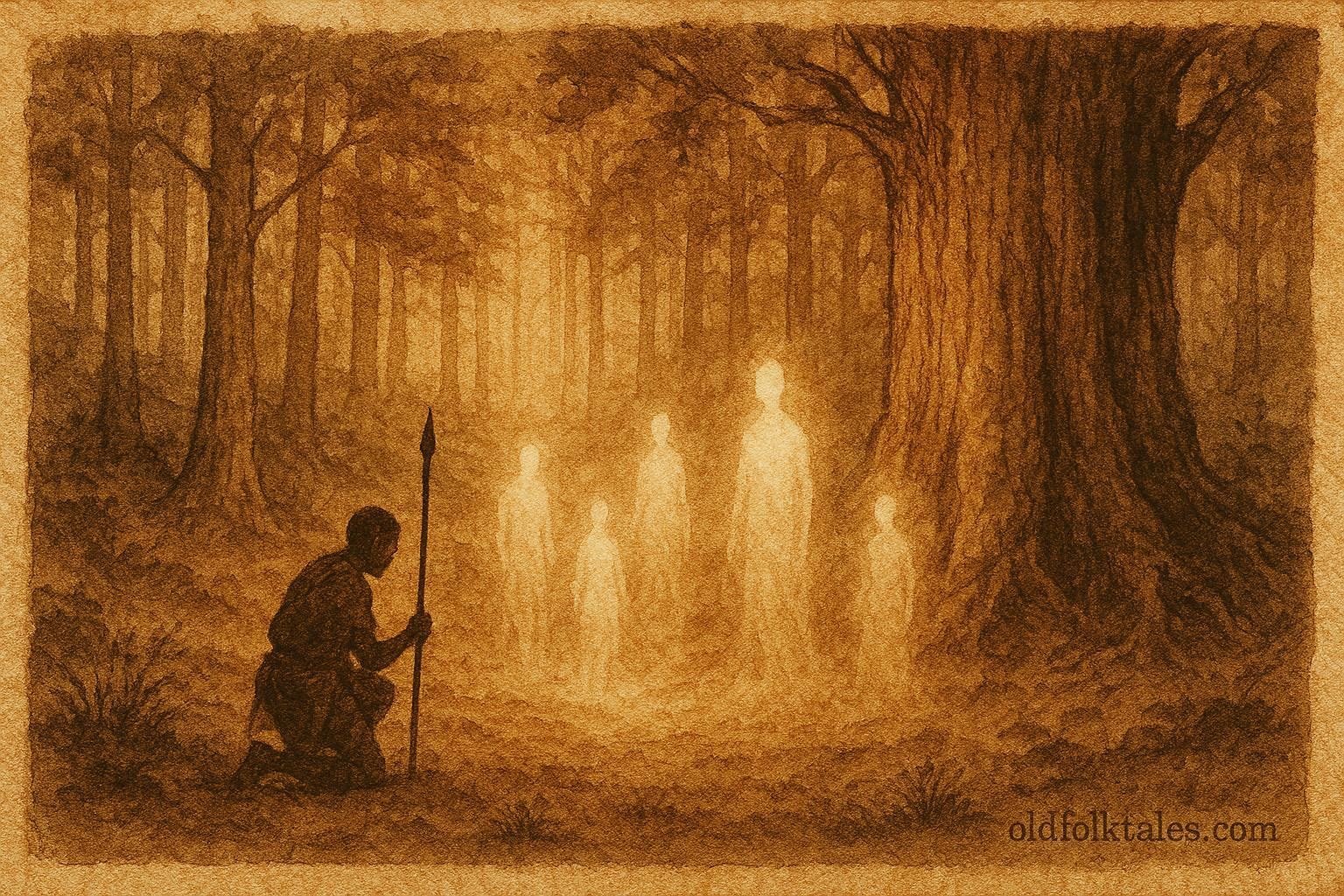
From the shadows between the trees, they emerged.
The forest spirits.
They were not as men described in frightened whispers, nor as children imagined in their dreams. They were something older, something deeper, figures that seemed to shift with the light, neither fully solid nor entirely air.
Some appeared tall and slender, their forms blending with the trunks of trees. Others were smaller, moving like flickers of shadow and leaf. Their eyes, if they could be called that, held a quiet knowing.
The hunter did not reach for his bow.
He did not run.
Instead, he lowered himself slowly to his knees and bowed his head.
“I greet you,” he said calmly. “Guardians of this place.”
The clearing remained silent.
Then one of the spirits moved forward.
Its form shimmered faintly, as though made of mist and bark and shadow woven together.
“You have come far,” it said, its voice soft but carrying through the stillness. “Further than most men dare.”
The hunter kept his head lowered.
“I go where I must,” he replied, “but never without respect.”
The spirit regarded him.
“Many enter this forest,” it continued. “Few remember that it does not belong to them.”
“I remember,” the hunter said.
The spirits circled him, their movements slow and deliberate.
“Why do you hunt?” another voice asked, rising from behind him.
“To live,” he answered simply. “To feed those who depend on me.”
“And if the forest gave you nothing?” the first spirit asked.
The hunter paused.
“Then I would return with empty hands,” he said. “For what is not given cannot be taken.”
A long silence followed.
The air seemed to grow lighter, as though something unseen had shifted.
“You speak with understanding,” the spirit said at last. “But words are easily shaped. It is actions that reveal truth.”
Without warning, the clearing changed.
Before the hunter, a great animal appeared, a magnificent creature, strong and full, its presence unmistakable. It stood within easy reach, as though offering itself.
The hunter’s eyes rested on it.
He felt the familiar instinct stir within him, the readiness to draw his bow, to take the shot.
But something held him still.
The stillness of the clearing.
The watchful presence of the spirits.
The weight of the moment.
Slowly, he lowered his gaze.
“This is not mine to take,” he said.
The animal vanished.
In its place, a pile of food appeared, more than enough to sustain many families. Rich, abundant, inviting.
Again, the hunter did not move.
“What is freely given must be understood,” he said quietly. “And what is offered without reason may carry a cost.”
The food disappeared.
The spirits grew still.
Then, one by one, they drew closer.
“You have shown restraint,” the first spirit said. “You have shown respect, not only in words, but in choice.”
The hunter raised his head slightly, but did not stand.
“I am only a man,” he said. “I know that there are things greater than myself.”
At this, the air seemed to shift once more, not heavy now, but open.
“You will not leave empty-handed,” the spirit said.
What followed was not something that could be held or carried like meat or tools.
The spirits did not give him gold, nor food, nor weapons.
Instead, they gave him something deeper.
They showed him the hidden patterns of the forest, the ways in which life moved and renewed itself, the balance between taking and leaving, the signs that revealed where animals would be without disturbing the harmony of the land.
They taught him when to hunt, and when not to.
Where to walk, and where to turn back.
How to listen, not only with his ears, but with his spirit.
The knowledge settled within him, quiet but certain.
When at last the clearing returned to its natural state, the spirits had vanished.
The hunter stood alone once more.
But he was not the same.
He returned to the village as the sun dipped low.
In the days that followed, something changed.
He no longer wandered in search of game.
He seemed to know.
He moved with quiet certainty, finding what he needed without excess, never disturbing more than necessary. His success grew, not in a way that drew attention, but in a steady, reliable way that brought peace to his household and those around him.
People began to notice.
They asked questions.
Some listened carefully to his answers. Others did not.
Among those who did not were a group of younger hunters, bold and eager, but lacking patience.
They heard the story of his journey and laughed.
“Spirits?” one scoffed. “We have walked the forest all our lives. We have seen nothing.”
“Perhaps they favor him because he fears them,” another said.
“We will go ourselves,” a third declared. “And we will take what we find.”
And so, they set out.
Unlike the first hunter, they did not pause at the forest’s edge.
They did not speak words of respect.
They entered loudly, their voices carrying through the trees, their steps careless.
As they moved deeper, the forest grew quiet, but they did not notice.
They mocked what they could not see.
“Where are these spirits?” one called out. “We have come!”
Another laughed. “Perhaps they hide from us!”
Their laughter echoed, sharp and out of place.
At last, they too came upon the clearing.
The great tree stood as it had before.
The stillness settled around them.
But instead of quieting themselves, they grew bolder.
“Is this the place?” one said, kicking at the ground. “I see nothing special.”
Another stepped forward. “If there are spirits here, let them show themselves!”
The air shifted.
But not in welcome.
What followed was not a lesson of patience.
It was a lesson of consequence.
The forest did not reveal its gifts to them.
Instead, confusion took hold.
Paths twisted where none had before.
Sounds echoed from directions that led nowhere.
The hunters became separated, their voices lost among the trees.
Fear replaced laughter.
By the time they found their way back, if they did at all, they carried no game, no pride, only the memory of something they could not understand.
And from that day, misfortune followed them.
Their hunts failed.
Their steps faltered.
Their confidence broke.
Meanwhile, the first hunter continued as he always had, quiet, respectful, and steady.
He did not boast of what he had seen.
He did not claim favor.
He simply lived by what he had learned.
And the forest, in its silent way, continued to provide.
If you liked this story, see our Central African folktales collection
Moral Lesson
This folktale teaches that true success comes not from force or arrogance, but from humility and respect, especially toward nature and unseen forces. Those who approach life with balance and understanding are rewarded, while those who mock what they do not understand invite hardship.
Knowledge Check
- Why did the hunter enter the deep forest?
He entered the sacred forest to find game during a time of scarcity and to provide for his household. - How did the hunter show respect to the forest spirits?
He spoke humbly, did not take what was not freely given, and showed restraint even when presented with abundance. - What did the forest spirits give the hunter?
They gave him wisdom, teaching him how to hunt in harmony with nature and understand the forest’s balance. - Why did the other hunters fail in the forest?
They were disrespectful, mocked the spirits, and entered the forest without humility, leading to confusion and misfortune. - What is the role of the forest in this folktale?
The forest represents a sacred space governed by spiritual forces that reward respect and punish arrogance. - What lesson does “The Hunter and the Forest Spirits” teach?
It teaches that humility, respect for nature, and spiritual awareness lead to prosperity, while arrogance brings consequences.
Source: Contes et Légendes du Cameroun by Isaac Moumé Etia (1951)
Cultural Origin: Fang and Beti peoples of southern Cameroon