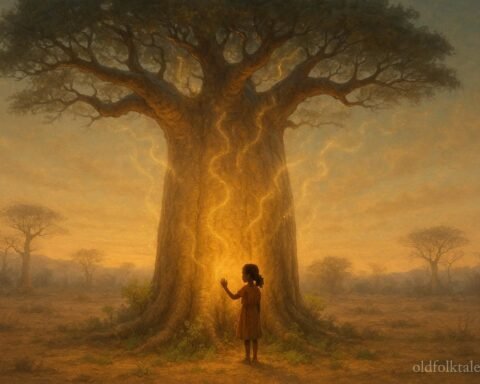
In the heart of a wide and sun-warmed land, where the earth stretched in red tones and the wind carried the scent of dust and leaves, there stood a great baobab tree at the center of a village.
It was no ordinary tree.
Explore more Southern African folktales here
Its trunk was vast and ancient, wide enough that several people joining hands could not encircle it. Its bark bore the marks of time, deep lines and soft scars that spoke of seasons long past. Its branches stretched outward like arms reaching toward the sky, offering shade that cooled the earth beneath it.
The people of the village gathered there often.
It was beneath the baobab that elders sat to speak wisdom, where disputes were brought for resolution, where stories were shared, and where decisions that shaped the lives of many were made.
It was said that the tree listened.
Some believed it remembered.
Others whispered that it knew.
For generations, the village had been guided by fairness.
When disagreements arose, people came before the elders, who listened patiently and judged carefully. Though not every decision pleased everyone, there was trust, trust that the truth mattered, and that justice would be sought with open hearts.
But as seasons passed, that trust began to weaken.
A new leader rose among the people, a man chosen for his strength of voice and confidence. At first, he spoke well, promising unity and prosperity. He stood beneath the baobab and declared that he would protect the village and uphold its traditions.
And for a time, people believed him.
But slowly, things began to change.
Disputes that once ended in balance began to tilt.
Those close to the leader found their words carried more weight. Those who opposed him were often dismissed. Decisions were made more quickly, with less listening, and more certainty, certainty that did not always reflect truth.
Whispers began to spread.
“This is not how it used to be,” some said quietly.
But few spoke openly.
For the leader had grown proud, and his pride made him less patient with disagreement.
One day, a dispute arose that stirred the entire village.
Two families came before the elders, each claiming ownership of the same piece of land. It was a fertile area, rare in those times, and both insisted it belonged to them.
Voices rose.
Accusations were made.
The matter was brought, as always, beneath the baobab tree.
The elders listened, as was their duty. Each family spoke at length, recounting their claims, their histories, their reasons.
When they had finished, the villagers turned to the leader, expecting him to guide the final decision.
He stood tall, looking over the crowd.
Then, without hesitation, he ruled in favor of one family.
The other protested.
“This is not just,” they said. “You did not hear us fully.”
But the leader raised his hand.
“The decision is made,” he declared. “There will be no more debate.”
A heavy silence followed.
Something in the air felt unsettled.
Then, from the great baobab tree, a sound emerged.
At first, it was faint, like the creaking of wood in the wind.
But there was no wind.
The sound grew clearer.
And then,
A voice.
It was deep and steady, neither harsh nor gentle, but unmistakably present.
“The truth has not been spoken.”
The crowd froze.
Eyes turned toward the tree.
Some stepped back in fear.
Others stared in disbelief.
The leader’s face hardened.
“Who speaks?” he demanded.
“I speak,” said the voice. “I have listened longer than any among you. I have heard what was said, and what was not.”
The village fell silent.
The voice continued.
“The land in question does not belong to the one who has been favored. It belongs to the other, whose claim was dismissed too quickly.”
Murmurs spread through the crowd.
The family who had lost their case looked up, hope flickering in their eyes.
The leader stepped forward, anger rising.
“This is nonsense,” he said sharply. “A tree does not speak. This is trickery.”
But the voice did not waver.
“You have not listened,” it said. “And you have not judged fairly.”
The leader’s jaw tightened.
“I am the one chosen to lead,” he replied. “My word stands.”
The tree was silent for a moment.
Then it spoke again.
“Leadership does not make truth. Truth stands whether you speak it or not.”
The people began to shift uneasily.
They looked at one another, uncertain but aware that something important had been revealed.
The elders, too, sat quietly, their faces thoughtful.
For the first time in many seasons, doubt entered the space where certainty had ruled.
The leader could not accept this.
“If this tree continues to spread confusion,” he said, his voice sharp with frustration, “it will divide us. It must be silenced.”
Gasps rose from the crowd.
The baobab was sacred.
To harm it was unthinkable.
But the leader’s pride had grown too strong.
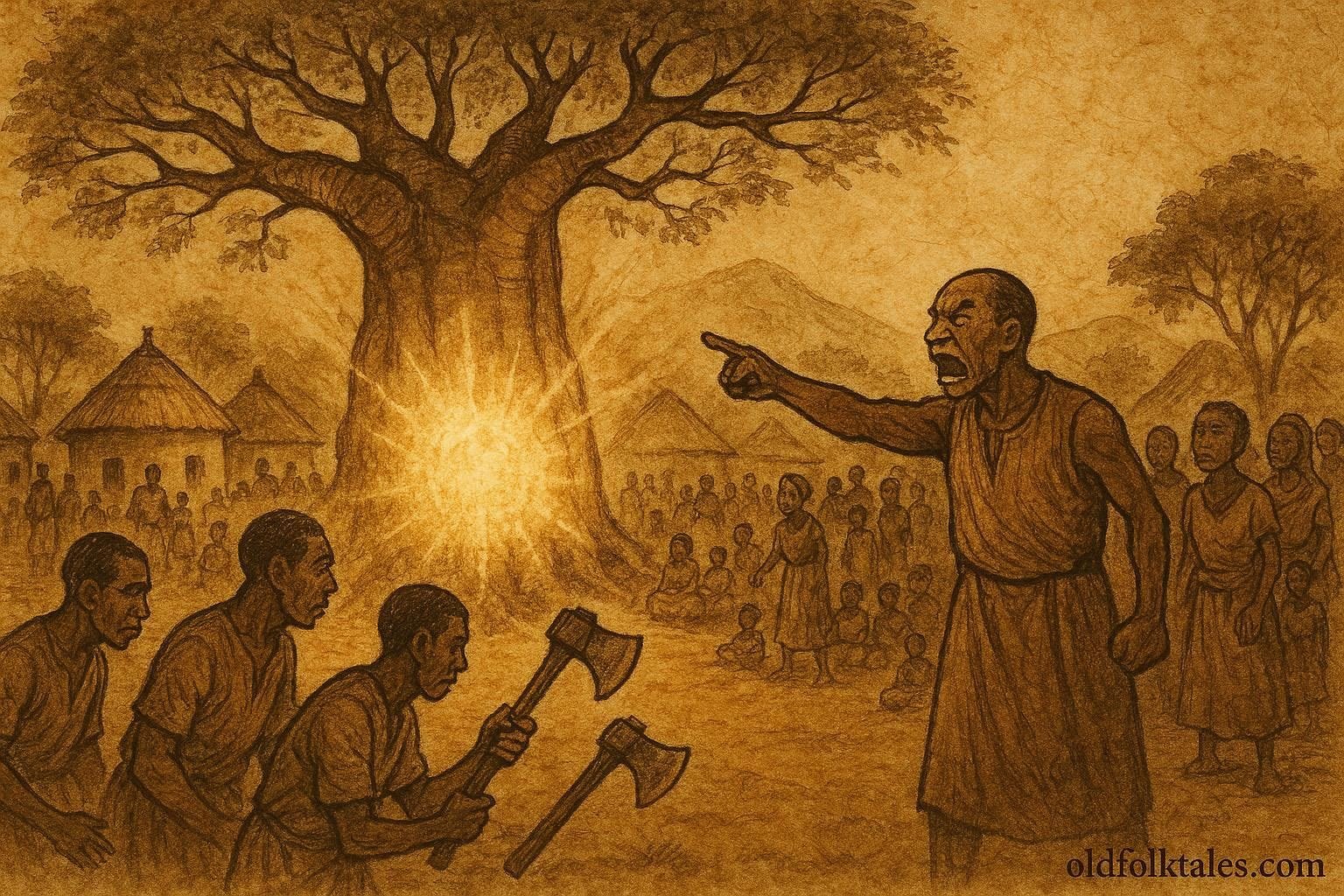
He called for men to bring tools.
“Cut it,” he ordered. “End this foolishness.”
The villagers hesitated.
Some stepped back.
Others whispered in fear.
But a few, loyal to the leader or afraid to oppose him, moved forward.
They approached the tree with axes in their hands.
The air grew heavy.
As the first strike landed against the trunk, the sound echoed, not like wood being cut, but like something deeper, something alive.
And the voice returned.
Stronger now.
Clearer.
“You strike at truth,” it said. “But truth does not fall so easily.”
The men faltered.
But the leader urged them on.
“Continue!” he commanded.
With each strike, the voice grew louder.
And then,
It began to speak not only of the land dispute, but of other matters.
Hidden matters.
Secrets.
“You have taken what was not yours,” the tree said.
The leader froze.
The villagers turned toward him.
“You have favored those who serve your interest,” the voice continued. “You have silenced those who speak against you.”
The leader’s confidence faltered.
“This is lies,” he said quickly. “Do not listen.”
But the tree did not stop.
“You have twisted judgment for your own gain. You have turned leadership into power, and power into control.”
The murmurs grew louder.
People began to remember.
Small moments.
Unfair decisions.
Things they had dismissed before.
Now, they stood together, forming a pattern that could no longer be ignored.
The men with the axes stepped back.
They could not continue.
Not now.
The leader looked around, his authority slipping.
“You would believe a tree over your leader?” he demanded.
But no one answered.
The silence spoke for them.
At last, one of the elders stood.
He walked slowly toward the center, beneath the baobab’s wide branches.
“For many seasons,” he said, “we have trusted that justice would guide us. But we see now that we have allowed imbalance to grow.”
He turned to the people.
“We must listen, not only to those who speak loudly, but to what is true.”
The dispute over the land was reopened.
This time, it was heard fully.
Carefully.
And when all had spoken, the decision matched what the baobab had revealed.
Justice was restored.
As for the leader, he could no longer stand where he once had.
His actions had been exposed, his words weighed and found lacking.
He stepped down, not by force, but because he had lost the trust that gave his voice power.
In the days that followed, the village changed.
Not in grand, visible ways, but in quiet, steady ones.
People spoke more carefully.
Listened more deeply.
The elders returned to their role with renewed purpose.
And beneath the baobab tree, gatherings once again carried the spirit of fairness that had long defined the village.
As for the tree, it did not speak again.
But no one doubted its presence.
Its silence was no longer empty.
It was understood.
Click here to explore more Central African folktales
Moral Lesson
This folktale teaches that truth cannot be silenced, even by power or authority. Leadership must be rooted in honesty and fairness, and when corruption rises, truth, whether from people or unexpected sources, will restore balance and justice.
Knowledge Check
1. What role did the baobab tree play in the village?
The baobab tree served as a sacred place for gatherings, dispute resolution, and ultimately became a voice of truth and justice.
2. Why did the leader’s decisions become unfair?
The leader grew corrupt, favoring certain individuals and ignoring fairness in order to maintain control and power.
3. How did the baobab tree reveal the truth?
The tree spoke during a dispute, exposing the correct claim and later revealing the leader’s hidden corruption.
4. Why did the villagers begin to doubt their leader?
The tree’s revelations aligned with their own experiences of unfair decisions, making them question his authority.
5. What happened when the leader tried to cut down the tree?
The tree exposed his wrongdoing publicly, causing the villagers to lose trust in him.
6. What is the main lesson of this Gbaya folktale?
The story teaches that truth and justice will always prevail over corruption and misuse of power.
Source: Mythes et Traditions d’Afrique Centrale by André Motte (1991)
Cultural Origin: Gbaya people, Central African Republic