When disputes grow beyond simple understanding, there comes a need for judgment that is respected by all. Among the animals of the land, there was a time when such judgment was not easily found, and disagreements often led to chaos rather than resolution.
In those days, the animals lived side by side, sharing the same land, the same water, and the same paths. Yet, as with all communities, conflicts arose. Some were small, others more serious, but all demanded answers.
At first, the animals tried to settle their disagreements among themselves. They argued, defended their positions, and sought support from others. But without a single voice of authority, their disputes often remained unresolved.
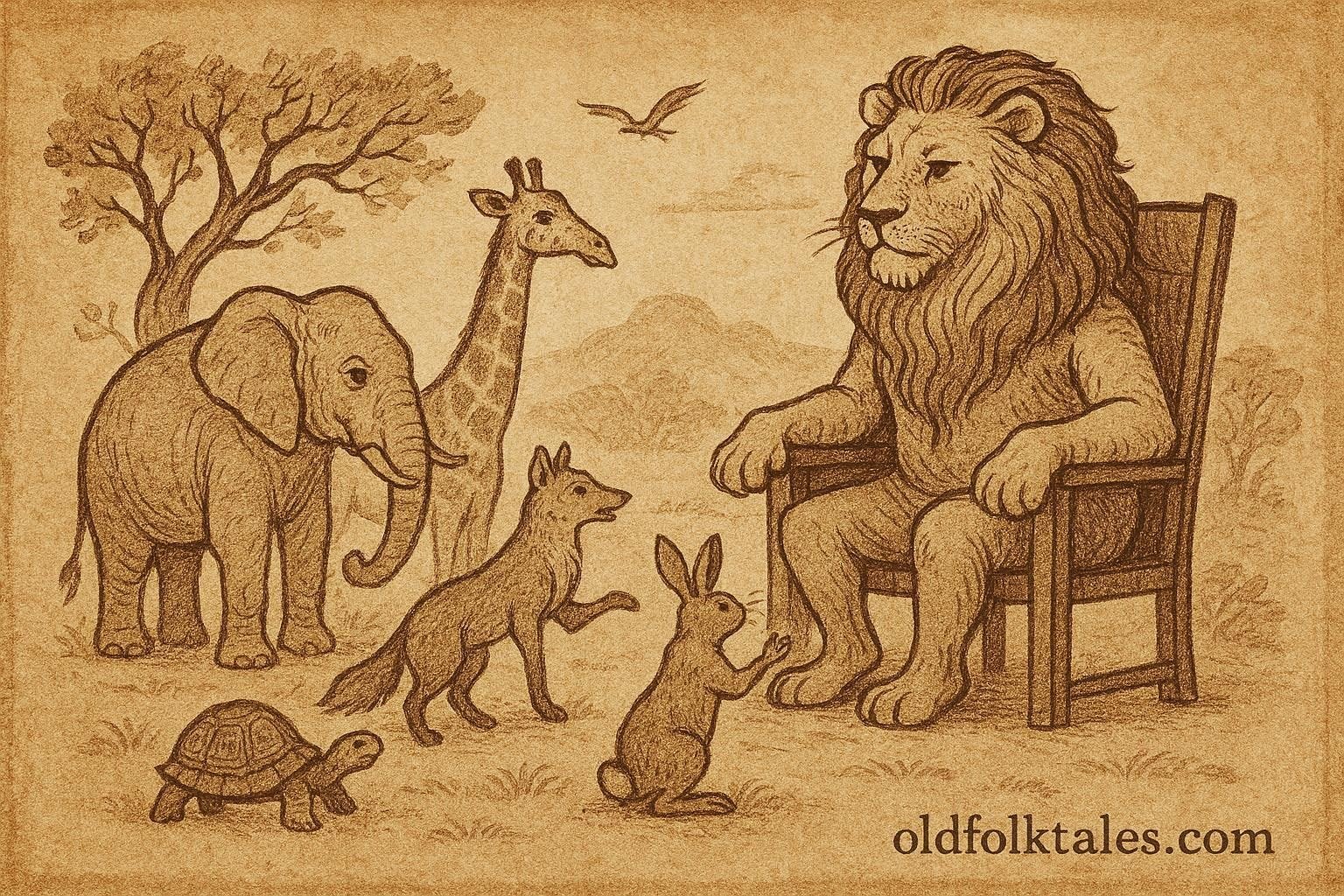
It was then that they turned to the lion.
The lion was known not only for strength, but for presence. His voice carried weight, and his decisions were rarely questioned. He did not speak often, but when he did, others listened.
The animals believed that he alone could bring order where confusion had taken hold.
Keep reading: Discover more Central African folktales
A place was chosen where the lion would hear their cases.
One by one, animals came forward, bringing their complaints, their grievances, and their arguments. The gathering was unlike anything they had known before.
There was silence as each spoke, and attention as each was heard.
The first dispute was brought by two animals who argued over a piece of land.
Each claimed it as their own, each insisting that they had the right to it. Their voices grew loud as they spoke, each trying to overpower the other.
The lion raised his head, and the noise ceased.
“Speak one at a time,” he said.
His voice was calm, but firm.
He listened carefully as each explained their claim. He asked questions, not to confuse them, but to understand their words more clearly.
When both had finished, he remained silent for a moment.
Then he spoke.
“The land does not belong to the one who claims it the loudest,” he said. “It belongs to the one who uses it with care and respects its boundaries.”
He gave his judgment, dividing the land in a way that was fair, ensuring that neither would be left without what they needed.
The two animals accepted his decision, not because it favored one over the other, but because it was just.
More disputes followed.
An animal accused another of taking what was not theirs. Another claimed to have been wronged without cause. Each case brought its own complexity, its own challenge.
Yet the lion listened to them all.
In one case, an animal spoke with great confidence, presenting its argument in a way that seemed convincing. But the lion did not rely only on words. He observed carefully, noticing details others might overlook.
When he gave his judgment, it revealed the truth beneath the surface, exposing what had been hidden behind skillful speech.
The animals began to understand something important.
Justice was not about who spoke best, or who appeared strongest. It was about truth, balance, and fairness.
As time passed, the gatherings became more orderly.
Animals learned to present their cases clearly, knowing that the lion would listen without bias. They came to trust that his decisions would not be influenced by fear, favor, or force.
One day, a particularly difficult case was brought before him.
Two animals accused each other, each claiming that the other had acted unjustly. There were no clear witnesses, no obvious evidence, and no simple answer.
The gathering grew tense.
The lion listened to both sides.
He asked questions, seeking clarity, but the answers did not resolve the matter.
For a moment, it seemed that even he might not be able to decide.
Then he did something unexpected.
Instead of giving an immediate judgment, he instructed both animals to return the next day.
When they returned, the lion observed them carefully as they spoke once more.
This time, something became clear.
One spoke with consistency, while the other’s words shifted. One remained steady, while the other showed signs of uncertainty.
The lion gave his judgment.
“The truth does not change,” he said. “It remains the same, no matter how often it is spoken. What shifts is not truth, but the attempt to hide it.”
The animals accepted his decision.
They had seen how patience and careful observation could reveal what was not immediately visible.
Over time, the lion’s role as judge became firmly established.
Disputes no longer led to chaos. Instead, they were brought before him, where they could be resolved with fairness and clarity.
The animals lived with greater understanding, knowing that justice was available to all who sought it honestly.
The story of the lion’s judgment was told throughout the land.
It reminded all who heard it that authority is not measured by strength alone, but by the ability to listen, to understand, and to decide with fairness.
And so, the animals continued to live under a system where disputes were not feared, but addressed. Where voices were heard, and truth was given its place.
Looking for more? Explore the magic of East African folktales here
Moral Lesson
True justice comes from fairness, patience, and the willingness to listen to all sides before making a decision.
Knowledge Check
- Why did the animals choose the lion as judge?
Because he was respected for his authority, wisdom, and fairness. - How did the lion handle disputes?
He listened carefully, asked questions, and made balanced judgments. - What did the animals learn about justice?
That it is based on truth and fairness, not strength or loudness. - What made the lion a good judge?
His patience, observation, and ability to remain unbiased. - How did the lion solve difficult cases?
By observing consistency and uncovering hidden truths. - What is the main message of the story?
Justice requires wisdom, fairness, and careful listening.
Source
Eritrean folktale, Tigrinya narrative. Collected by Enno Littmann in Publications of the Princeton Expedition to Abyssinia (1910).