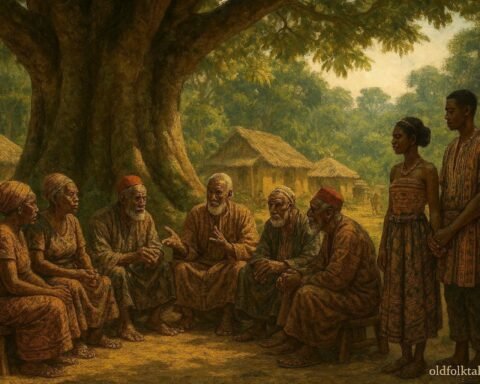
In the dense forests of Gabon, where the Fang and Myene people lived close to the rhythms of the land, life was shaped not only by survival but by cooperation. The forest gave generously, but it required unity. No one lived entirely for themselves, for what one gathered or harvested was understood to belong, in part, to all.
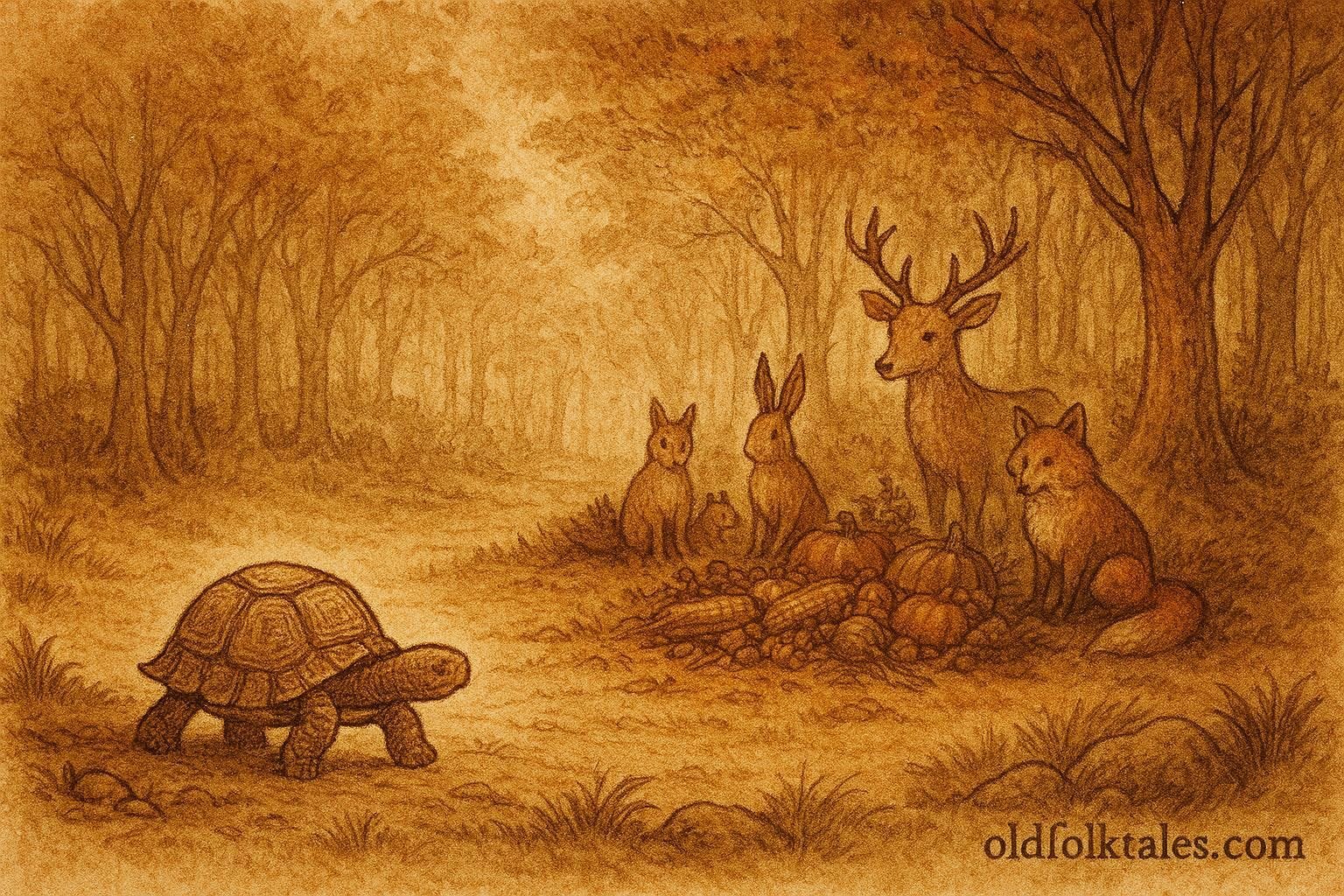
During seasons of abundance, the animals worked together.
Fascinated by this tale? Discover more North African folktales
They cleared small patches of land, planted crops, gathered fruits, and shared what the forest provided. Each played a role, Elephant with his strength, Antelope with her speed, Monkey with his agility, and Bird with her watchful eye.
And among them was Tortoise.
Tortoise was not strong.
He was not fast.
But he was clever, cleverer than most.
He watched.
He listened.
And he thought constantly about how to gain more with less effort.
When the planting season came, the animals gathered to prepare the land.
They worked together, turning soil, clearing roots, and sowing seeds. It was hard work, but they did it side by side, knowing that the harvest would feed them all.
Tortoise came too.
But he did not work as the others did.
He moved slowly, pausing often, sighing heavily as though each task weighed on him.
“My friends,” he said one day, lowering himself to the ground, “I wish to help, but my body is weak.”
The others looked at him.
“You have always been slow,” Monkey said. “But you have managed before.”
Tortoise shook his head.
“It is worse now,” he replied. “I cannot keep up.”
Elephant, kind and thoughtful, stepped forward.
“Then do what you can,” he said. “And when the harvest comes, you will share with us as we share with you.”
Tortoise lowered his head.
“I am grateful,” he said.
And so, the work continued.
The animals labored under the sun, day after day, tending to the fields. Tortoise remained among them, but always just at the edge of effort. He lifted little, carried less, and often rested while others worked.
Yet he watched everything.
When the harvest season arrived, the fields were full.
Golden crops stretched across the land, fruits hung heavy from branches, and the forest seemed to hum with abundance.
The animals gathered to divide the harvest.
As agreed, each would receive a share.
Tortoise came forward slowly.
“My friends,” he said, his voice soft, “I have little strength to gather for myself. I ask that you remember my condition.”
The animals exchanged glances.
Elephant spoke again.
“We will not forget,” he said.
And so, they gave him a share.
A generous one.
Tortoise accepted it with gratitude.
Or so it seemed.
But something was not right.
Days passed.
The animals returned to their work, tending what remained, preparing for the next cycle.
But they began to notice.
Tortoise did not seem weak.
He moved more quickly when he thought no one was watching.
He carried more than he claimed he could.
And his store of food seemed larger than what he had been given.
One evening, Monkey climbed a tree near Tortoise’s home.
From above, he watched.
And what he saw confirmed his suspicion.
Tortoise was not weak.
He was hiding food.
Gathering more in secret.
And storing it where no one could see.
Monkey returned to the others.
“What we believed is not true,” he said.
The animals listened.
At first, some doubted.
But as they watched more closely, the truth became clear.
Tortoise had deceived them.
The feeling that followed was not just anger.
It was something deeper.
A break in trust.
“We must act,” Antelope said.
“But not with anger,” Bird added. “With understanding.”
And so, they made a plan.
The next time Tortoise came to them, speaking of his weakness, they did not argue.
They agreed.
“Yes,” Elephant said. “We will help you again.”
Tortoise bowed his head, hiding his satisfaction.
But this time, things were different.
When the harvest came, the animals gave him exactly what he asked for.
No more.
No less.
And when he tried to gather more in secret, he found that nothing remained unguarded.
Every path was watched.
Every store was shared openly.
There was no place for hidden gain.
Still, Tortoise tried.
He moved quietly.
He searched for opportunity.
But each time, he found nothing.
At last, he approached the animals.
“My share is small,” he said.
Elephant looked at him.
“It is what you have earned,” he replied.
The words struck deeper than any punishment.
“You do not trust me,” Tortoise said.
Monkey stepped forward.
“You broke that trust,” he answered.
Silence followed.
Tortoise looked around.
The same animals.
The same forest.
But something had changed.
Where once there had been openness, there was now distance.
Where once he had been included, he now stood apart.
No one drove him away.
No one shouted.
But no one welcomed him as before.
Days passed.
Tortoise moved through the forest alone.
He gathered what he could, worked when he had to, and ate only what he found himself.
There were no shared meals.
No laughter.
No quiet understanding between companions.
Only silence.
And in that silence, he began to understand.
Cleverness had given him advantage.
But greed had taken something greater.
His place.
From that day on, Tortoise walked alone.
Not because he was forced to.
But because he had separated himself from those who once walked beside him.
And so, when people see the tortoise moving slowly through the forest, alone and apart, they remember:
That gaining more at the expense of others may bring momentary reward, but it can cost the one thing that cannot be easily regained.
Click here to explore more Central African folktales
Moral Lesson
This folktale teaches that greed and deception can lead to isolation. While cleverness may bring short-term gain, trust and community are far more valuable and once broken, are difficult to restore.
Knowledge Check
- Why did the tortoise pretend to be weak?
He wanted to avoid work while still receiving a share of the harvest from others. - How did the animals discover his deception?
They observed his behavior and saw that he was secretly gathering and storing extra food. - Why didn’t the animals punish the tortoise harshly?
They chose a fair response by limiting his share and protecting their resources instead of reacting with anger. - What consequence did the tortoise face?
He lost the trust and companionship of the community, leading to isolation. - How did the tortoise’s life change after the truth was revealed?
He had to fend for himself and live without the support of others. - What is the main lesson of this Fang and Myene folktale?
It teaches that selfishness and deceit can destroy relationships and lead to loneliness.
Source: Central African oral storytelling traditions documented in ethnographic folklore collections (1975)
Cultural Origin: Fang and Myene communities, Gabon