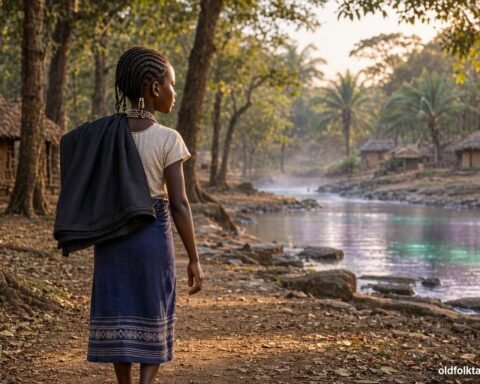
In a village nestled at the edge of a vast and ancient forest in Gabon, there lived a young hunter whose name was spoken with a mixture of admiration and concern. He was strong, swift, and sharp-eyed, gifted with skills that many older hunters respected. Yet, beneath his talent burned a restless hunger, not just to hunt, but to be known, to be celebrated, to be remembered.
The elders often warned the young men of the village about the forest beyond the familiar hunting grounds. It was not merely a place of trees and animals, they said, but a sacred space, an ancient realm watched over by unseen forces. This part of the forest was forbidden. No hunter entered it, no matter how skilled or brave. It was not fear that kept them away, but reverence.
Continue your journey: Read more East African folktales
But the young hunter did not see it this way.
To him, the warnings sounded like limitations, stories told to keep the bold from rising above the ordinary. He believed that true greatness lay beyond the boundaries others feared to cross. And so, as whispers of his ambition grew, so did his desire to prove himself, to return from the forbidden forest with a story so powerful that even the elders would have no choice but to honor him.
One morning, before the village had fully awakened, he gathered his tools, his bow, his arrows, and the confidence that had never failed him. Without seeking counsel, without asking permission, he stepped quietly past the edge of the known paths and entered the sacred forest.
At first, the forest seemed no different.
Tall trees stretched toward the sky, their leaves forming a canopy that filtered the sunlight into soft, shifting patterns. The air was thick with the scent of earth and life. Birds called from unseen branches, and insects hummed their endless songs. The hunter moved with ease, his feet light against the forest floor, his senses alert.
But as he walked deeper, something began to change.
The sounds of the forest softened, as if muffled by an unseen presence. The air grew heavier, pressing gently but firmly against his skin. The paths he followed seemed to twist and shift, leading him not where he intended, but where the forest willed.
Still, he pressed on.
Hours passed, and though he saw signs of animals, tracks in the soil, broken branches, distant movements, he could not catch anything. His arrows remained unused. His confidence, though not yet broken, began to waver.
Then, as the sun reached its highest point, he came upon a clearing.
It was unlike any place he had ever seen.
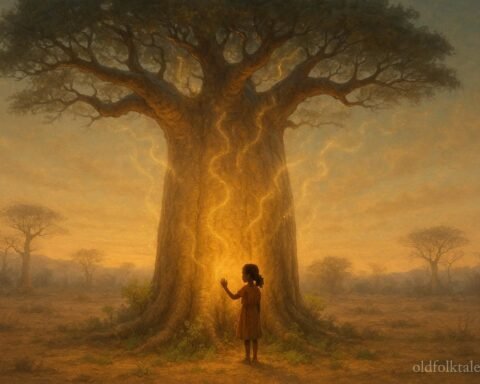
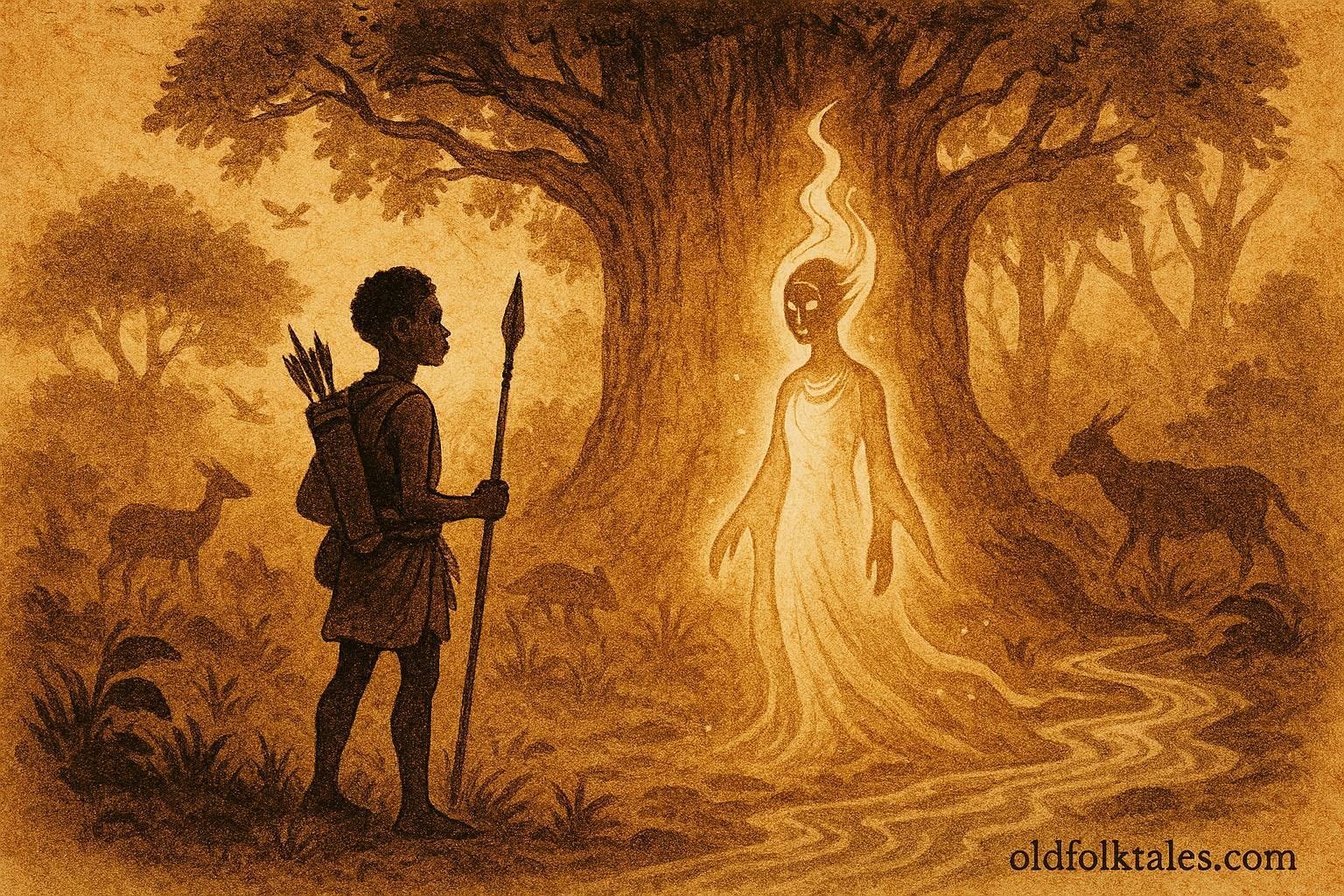
At the center stood a towering tree, its trunk wide and ancient, its roots stretching like veins across the earth. The light here was different, softer, almost golden, and the air carried a stillness that felt alive.
The hunter stepped forward, drawn by something he could not name.
And then, he was no longer alone.
A figure stood near the great tree.
At first, it seemed like a trick of light and shadow, but as his eyes adjusted, the form became clearer. It was neither fully human nor entirely something else. Its presence was calm yet powerful, like the forest itself made visible.
The hunter’s breath caught in his throat.
“Why have you come?” the spirit asked.
The voice was gentle, but it carried a weight that made the ground beneath his feet feel unsteady.
The hunter straightened, forcing confidence into his voice. “I have come to hunt,” he said. “To prove my strength. To show that I am worthy of greatness.”
The spirit regarded him in silence for a moment.
“Worthy?” it repeated softly. “And what is it you believe makes you worthy?”
The question unsettled him, but he answered quickly. “My skill. My courage. My ability to take what I seek.”
The forest seemed to grow quieter still.
The spirit stepped closer, its presence neither threatening nor welcoming, simply undeniable.
“If you seek to prove yourself,” it said, “then you must first understand what you stand upon, what you walk through, and what you take from.”
The hunter frowned, not fully understanding, but unwilling to appear uncertain.
“Then test me,” he said.
The spirit inclined its head.
“So, it shall be.”
The first trial began without warning.
The hunter found himself alone once more, standing at the edge of a dense thicket. He could hear the sound of movement within, an animal, perhaps wounded, perhaps weak. It was the perfect opportunity.
He nocked an arrow and moved forward.
But as he pushed through the undergrowth, the path became difficult. Branches snagged at his clothing, roots tripped his steps. The sound of the animal grew fainter, then louder, then disappeared altogether. Frustration rose within him.
Finally, he saw it, a small creature, trembling, its leg caught beneath a fallen branch.
He raised his bow.
This would be an easy victory.
But as he took aim, something held him back.
The creature did not run. It did not fight. It simply looked at him, its eyes wide, not with defiance, but with something else.
Vulnerability.
The hunter hesitated.
The arrow trembled in his hand.
Slowly, he lowered his bow.
Instead of striking, he stepped forward and lifted the branch, freeing the creature. It did not linger. It fled into the forest, disappearing as quickly as it had appeared.
The moment it was gone, the forest shifted again.
The thicket vanished.
And the spirit stood before him once more.
“You chose not to take,” the spirit said.
The hunter said nothing, unsure of what that meant.
The second trial came as the sun began to lower in the sky.
This time, the hunter found himself thirsty.
The air was dry, the heat pressing down on him. His throat burned, and his steps grew heavy. After wandering for what felt like hours, he came upon a stream.
The water was clear, cool, inviting.
He rushed forward and knelt to drink.
But as he cupped his hands, he saw something in the water, a reflection that was not his own. The surface shimmered, and the image shifted, showing the forest, the animals, the trees, all connected, all flowing together like the water itself.
He paused.
Instead of drinking immediately, he sat back and watched.
For the first time, he did not act out of need or desire. He simply observed.
After a while, he drank, not greedily, but with care.
Again, the world shifted.
The stream faded, and the spirit returned.
“You begin to see,” it said.
The final trial came with the coming of night.
Darkness settled over the forest, deep and complete. The hunter stood alone, the sounds of the night surrounding him. Every instinct told him to light a fire, to assert control, to push back against the unknown.
But he remembered.
Instead, he sat.
He listened.
He allowed the darkness to exist without trying to conquer it.
Time passed, he did not know how long.
And then, slowly, the fear that had gripped him began to loosen. The forest was not his enemy. It was not something to be overcome.
It simply was.
When the first light of dawn touched the trees, the spirit appeared for the last time.
“You have walked through the forest,” it said. “But more importantly, you have begun to understand it.”
The hunter bowed his head, not out of obligation, but out of something deeper.
Respect.
“I did not come here to learn,” he admitted quietly. “But I leave with more than I sought.”
The spirit regarded him with something like approval.
“Then you may return.”
When the hunter emerged from the forest, the village gathered around him.
They expected tales of conquest, of bravery, of triumph.
But what they received was something different.
He spoke not of what he had taken, but of what he had learned. Not of victory, but of balance. Not of power, but of respect.
And in time, the young hunter became something more than a skilled tracker.
He became a protector.
Where once he sought glory, he now guarded the boundaries of the sacred forest, ensuring that others would not enter with the same ignorance he once carried.
And the elders, who had watched him with concern, now spoke his name with quiet pride.
If you liked this story, see our Central African folktales collection
Moral Lesson
True strength is not found in domination, but in understanding. When humans approach nature with humility and respect, they discover harmony rather than conflict.
Knowledge Check
- What is the main lesson in “The Spirit of the Sacred Forest” folktale?
The story teaches that humility and respect for nature are greater than pride and conquest. - Why is the forest considered sacred in this Gabonese folktale?
The forest is protected by a spirit and represents a spiritual space requiring reverence, not exploitation. - What trials did the young hunter face in the sacred forest?
He faced three trials: compassion toward a vulnerable creature, patience and awareness at the stream, and acceptance of the forest’s darkness. - How does the hunter change by the end of the story?
He transforms from a glory-seeking hunter into a respectful protector of the forest. - What role does the spirit play in the story?
The spirit acts as a guide and tester, helping the hunter understand the deeper meaning of harmony with nature. - What cultural themes are reflected in this Bwiti-influenced folktale?
Themes include spirituality, rites of passage, respect for sacred spaces, and the interconnectedness of life.
Source: Recorded in studies of Bwiti spiritual traditions and oral narratives (1988)
Cultural Origin: Bwiti-influenced communities in Gabon