In a land shaped by thick forests and winding waters, there once lived a woman known throughout her village for her gentle heart. She was neither the richest nor the most powerful among her people, yet she carried something far more enduring, kindness that showed itself in small, consistent acts.
Her home stood not far from a river that had, for generations, sustained the lives of the Nzebi and Punu people. The river was more than water. It was a source of life, a path for movement, a presence woven into the rhythm of daily existence. Children learned its currents, elders spoke of its mysteries, and all treated it with quiet respect.
Fascinated by this tale? Discover more North African folktales
But one year, the rains did not come.
The skies remained clear day after day, and the land began to change. The soil cracked under the weight of dryness. Crops withered before they could mature. The river, once full and flowing, shrank slowly, its edges pulling inward as though retreating from the world.
The village grew restless.
Water became scarce, and with it came worry. People gathered what little remained, careful not to waste even a drop. The elders spoke in low voices, recalling past droughts and the ways they had endured them.
Yet even in hardship, the woman continued her quiet routines.
Each day, she would walk to the river’s edge with a small calabash. She took only what she needed, never more. But unlike others, she lingered. She would sit beside the weakened current, watching its slow movement, listening as though it still had something to say.
One afternoon, as the sun hung heavily in the sky, she noticed something unusual.
At a bend in the river where the water pooled slightly deeper than elsewhere, there was a faint shimmer. At first, she thought it was simply the reflection of light. But as she drew closer, the shimmer held its form.
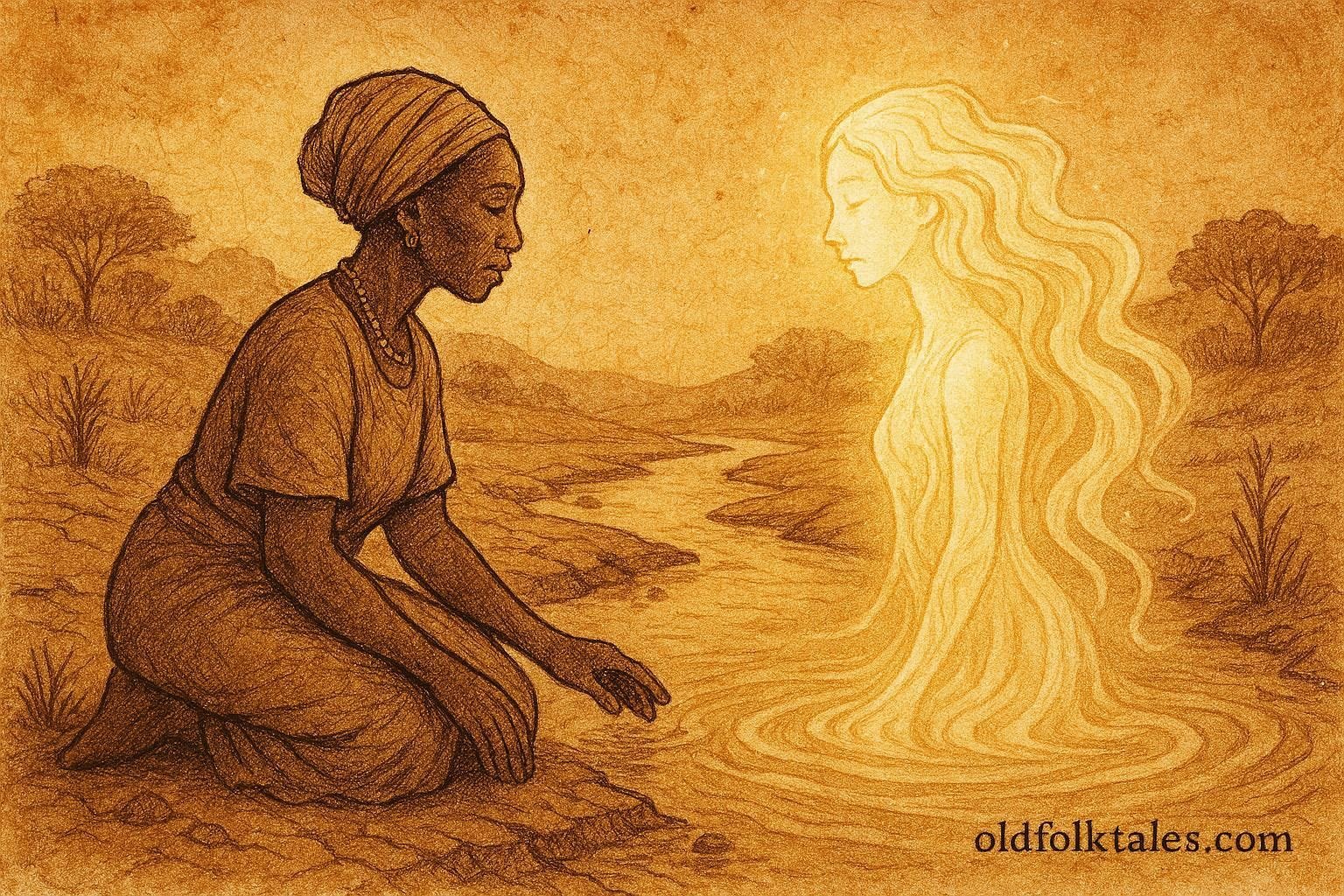
Curious, she knelt by the water.
“Are you still there?” she asked softly, not entirely sure why she spoke.
The surface trembled.
Then, slowly, the water shifted, not with the randomness of a current, but with intention.
From the river emerged a presence.
It was not fully human, yet it carried a form she could recognize. Its shape was fluid, its edges blending with the water itself. Its presence was calm, yet powerful, like the river in its fullest strength.
The woman did not run.
Though her heart beat faster, she remained where she was, her voice steady.
“You have been here all along,” she said.
The spirit regarded her.
“Yes,” it replied, its voice like the sound of water moving over stone. “And you are one of the few who have not forgotten how to see.”
The woman lowered her gaze respectfully.
“The river is part of us,” she said. “Even now.”
The spirit was silent for a moment.
“Even now,” it repeated.
In the days that followed, the woman returned to the same place.
Each time, she brought something small, not out of obligation, but out of care. Sometimes it was a portion of her water, poured gently back into the river. Other times, it was simply her presence, her quiet attention.
She spoke little, but she listened.
And the spirit came to know her.
“You give when there is little to give,” the spirit said one day.
“I give because there is still something left,” she replied.
The spirit studied her words.
“Many take,” it said. “Few remember to return.”
The woman did not answer. She simply continued as she had always done.
As the drought deepened, the village’s hardship grew more severe.
The river dwindled further, its once steady flow now reduced to scattered pools. People traveled farther in search of water. Tension began to rise, and worry settled into every conversation.
Yet the woman remained calm.
One evening, as the sky softened into the colors of dusk, the spirit appeared once more.
“You have shown kindness without expectation,” it said. “You have honored what others have overlooked.”
The woman listened quietly.
“For this,” the spirit continued, “the river will not abandon you.”
The woman’s eyes lifted slightly.
“What do you mean?” she asked.
The spirit gestured toward the water.
“Come tomorrow,” it said. “Bring your calabash as you always do.”
Then, without further explanation, it dissolved back into the river.
The next day, the woman returned.
The river appeared no different at first glance, still shallow, still strained by the absence of rain. But when she approached the place where the spirit had spoken to her, she noticed something.
The water there was deeper.
Not by much, but enough to matter.
She knelt and dipped her calabash into it. The water was cool, clear, unchanged in its purity.
She filled her calabash once.
Then she paused.
She remembered the spirit’s words.
She filled it again.
And again.
No matter how many times she drew from that place, the water remained.
Her breath caught softly, but she did not call out. She did not draw attention. Instead, she stood, balanced the water carefully, and returned to her home.
From that day on, the woman’s household did not go without water.
Quietly, she began to share what she could.
When neighbors came in need, she offered small portions, careful not to reveal too much. She did not speak of the spirit. She did not explain the source. She simply gave, as she always had.
The village began to notice.
“How do you still have water?” some asked.
She would only smile gently.
“I take what I need,” she would say. “And I am careful with it.”
Her answer satisfied some, but not all.
Curiosity grew.
One day, a group of villagers followed her.
They watched from a distance as she approached the river. They saw her kneel, dip her calabash, and fill it again and again from the same place.
When she left, they rushed forward.
But when they reached the spot, they found nothing unusual.
The water there was shallow, no different from the rest of the river.
They returned to the village confused.
“There is nothing there,” they said. “And yet, she has water.”
Suspicion began to take root.
The pressure grew.
“Tell us your secret,” some demanded.
The woman remained calm, but her silence became more difficult to maintain.
She remembered the spirit’s presence. The quiet trust that had formed between them.
She knew what had been given to her was not meant to be revealed.
And so, she said nothing.
Time passed, and the drought began to ease.
Clouds gathered once more. The first rains fell lightly, then steadily. The river began to rise, reclaiming its strength, its voice returning to its flow.
The village rejoiced.
Water was no longer scarce. The tension that had filled their days began to lift.
And with the return of the river’s fullness, the special place where the woman had drawn her water became indistinguishable from the rest.
The spirit did not appear again.
But the woman understood.
The gift had never been about abundance alone.
It had been about trust.
She had been given something precious, not only water, but a responsibility. And she had carried it with care.
Though the river returned to its natural state, the bond remained, not visible, not spoken, but deeply felt.
From that time on, the woman was known not just for her kindness, but for her wisdom.
For she had shown that true generosity is not loud, and true trust is not easily given.
If you liked this story, see our Central African folktales collection
Moral Lesson
Kindness offered without expectation can bring unseen rewards, but such gifts come with responsibility. Trust must be honored, and not every blessing is meant to be shared openly.
Knowledge Check
- What is the main lesson of “The Woman Who Befriended the River” folktale?
The story teaches that generosity and kindness can bring unexpected blessings, but they must be handled with responsibility and trust. - Why did the river spirit reward the woman?
The spirit rewarded her because she showed consistent kindness and respect even during hardship. - What condition did the river spirit place on its gift?
The woman had to keep their relationship a secret and not reveal the source of the water. - How did the woman help her village during the drought?
She shared water quietly with others without exposing the secret of its source. - What happened when the villagers tried to discover her secret?
They could not find the special water source, as it only appeared for her. - What cultural themes are reflected in this Gabonese folktale?
Themes include trust, generosity, spiritual relationships with nature, and respect for unseen forces.
Source: Documented in West and Central African folklore compilations (1983)
Cultural Origin: Nzebi and Punu peoples of Gabon