Along the winding estuaries of the Ogooué River in Gabon, where fresh water from the land meets the restless tides of the sea, there once lived a widow known for her quiet life and steady endurance. Her days were simple, shaped by hardship but held together by resilience.
She had once known the warmth of companionship, but that life had passed like a receding tide. In its place remained solitude, and the need to survive.
Want to dive deeper? Read more North African folktales today
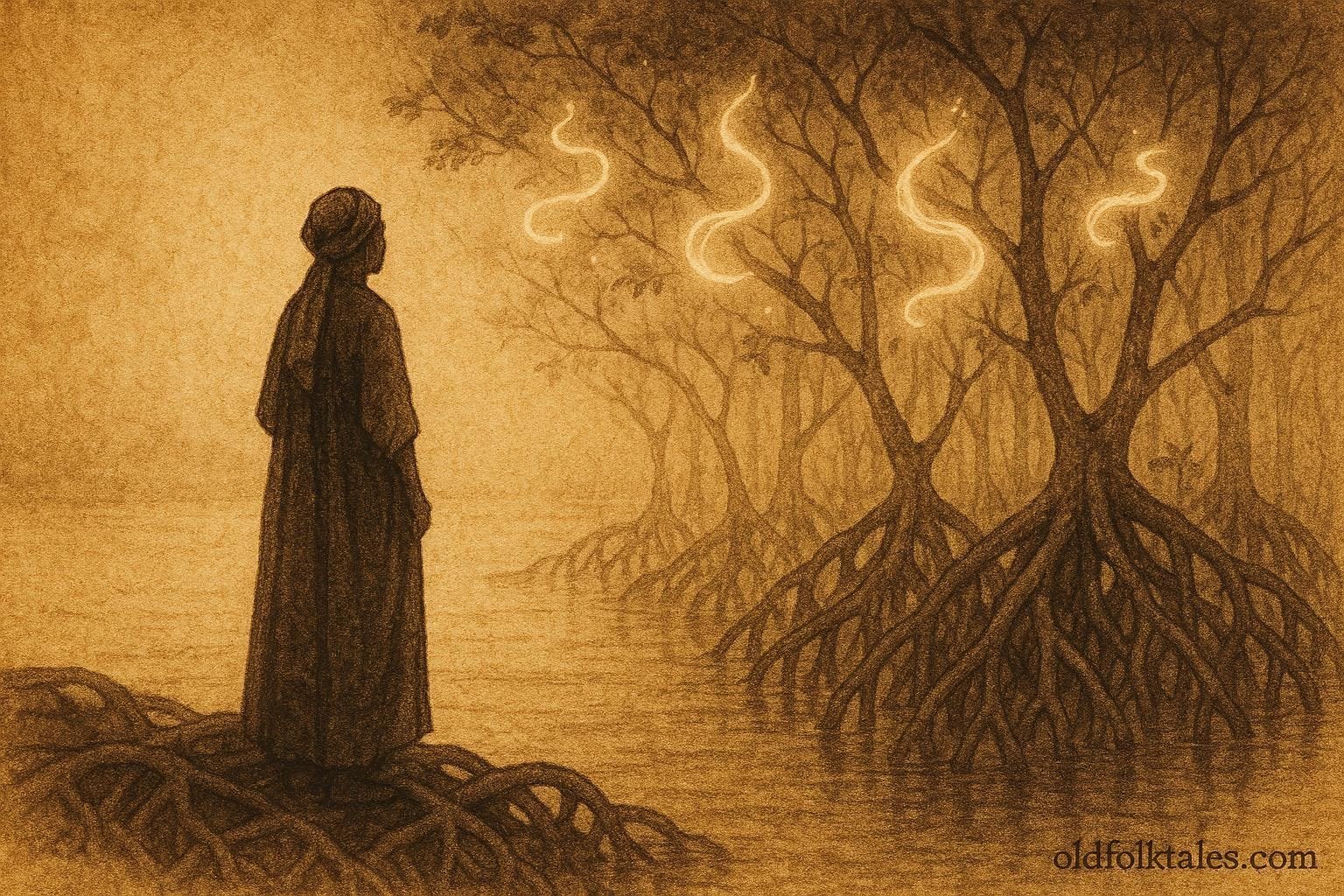
Her small home stood near a dense mangrove forest. The mangroves grew thick and tangled, their roots rising like twisted fingers from the water, their branches forming a green canopy that seemed to breathe with the movement of the tides. The villagers respected the forest but rarely entered it. It was said to be alive in ways that could not always be seen.
The widow, however, had no choice but to pass near it each day.
She gathered shells, collected firewood drifted by the tide, and fished in the shallow waters where the mangroves met the river. It was not an easy life, but it was hers.
At first, she saw the mangroves as nothing more than trees shaped by water and wind. But slowly, something began to change.
It started with sound.
Not the usual sounds of rustling leaves or shifting tides, but something softer. Something intentional.
One morning, as she worked near the roots of the mangroves, she paused.
There it was again.
A whisper.
She looked around, expecting another person nearby, but there was no one. Only the forest, the water, and the slow movement of the tide.
She dismissed it.
But the next day, it returned.
And the next.
Each time she came near the mangroves, the whispers grew clearer, still faint, but no longer just noise. They felt like words forming beneath the surface of the wind.
The widow did not speak of it. In her world, strange things were not always meant to be shared.
Instead, she listened.
One evening, as the tide pulled gently through the roots of the mangrove forest, she heard it again, but this time, it was unmistakable.
“Why do you carry sorrow so quietly?” the voice asked.
The widow froze.
Her hands stilled in the water.
She looked around, her breath tightening.
“Who is there?” she asked softly.
There was no human presence.
Only the mangroves.
Then the voice returned.
“We are here.”
She did not understand, yet she did not run.
Instead, she sat slowly at the edge of the water.
And listened.
From that day forward, the mangroves spoke to her.
Their voices came not like a single being, but many, layered and flowing, like the river itself. They spoke in whispers that rose from the roots, in tones carried by the wind through tangled branches.
At first, she feared she might be imagining it. But the voices grew consistent, familiar.
They warned her when tides would rise too high. They told her where fish would gather. They guided her toward safer paths through the swampy forest. Slowly, her life began to change.
What had once been a struggle softened into stability.
She no longer returned home empty-handed. She no longer feared the shifting waters.
And yet, the voices always made one thing clear.
“Do not speak of us.”
The widow understood.
And she obeyed.
As time passed, her fortune grew.
Her baskets filled more easily. Her fishing became more precise. Even during difficult tides, she found what she needed. The village began to notice.
“How do you always know where to go?” they asked.
She only smiled faintly.
“I listen carefully,” she would say.
But she never explained further.
For she knew that what she had been given was not meant for everyone’s ears.
It was a trust.
But trust, like water, can be difficult to hold.
One day, during a gathering in the village, the conversation turned to hardship. The river had become unpredictable. Fishing was difficult. Many were struggling.
The widow listened quietly.
Then, without thinking fully of the weight of her silence, she spoke.
“The mangroves can guide you,” she said gently.
The words fell into the air.
At first, no one understood.
“The mangroves?” someone asked.
“Yes,” she continued. “They speak. They help those who listen.”
A hush followed her statement.
Some laughed softly, dismissing her words as grief talking through loneliness. Others exchanged uneasy glances.
But the widow had already said too much.
That night, she returned to the mangrove forest.
The tide was low. The roots stood exposed, dark against the pale water. She waited, as she always did.
But something felt different.
She called softly.
No answer came.
She waited longer.
Still, there was silence.
The wind moved through the branches, but it carried no voice. The water shifted gently, but it held no message.
For the first time in many seasons, the mangroves did not speak.
The widow’s chest tightened.
“Please,” she whispered. “I did not mean to break your trust.”
But the forest remained silent.
Days passed.
She returned again and again.
Each time, she listened. Each time, she waited.
But the voices were gone.
Without their guidance, the world became uncertain once more. The tides confused her. The safe paths were no longer clear. The abundance she had known slowly faded.
She returned to what she once was, careful, uncertain, reliant only on her own judgment.
The villagers noticed the change.
“You no longer seem so fortunate,” some said.
She only nodded quietly.
“I am learning again,” she replied.
But in her heart, she understood the truth.
She had lost something rare.
Not because it was taken from her.
But because it had been entrusted, and that trust had been broken.
One evening, as she stood alone at the edge of the mangroves, she finally understood what the spirits had been teaching her all along.
It was not only about guidance.
It was about restraint.
About knowing when to speak, and when to remain silent.
About honoring what is given without exposing it to those who cannot understand its weight.
She lowered her head.
“I will listen without asking for more,” she said softly. “Even if you do not speak again.”
The wind moved through the mangroves.
But no voice returned.
From then on, the widow continued her life without the guidance of the spirits. She worked the waters as others did. She learned again through patience, observation, and humility.
And though the mangroves never spoke to her again, she never spoke of them either.
Not because she forgot.
But because she finally understood.
If you liked this story, see our Central African folktales collection
Moral Lesson
Some gifts depend on trust and silence. When sacred confidence is broken, even the deepest connections can fade. True wisdom is knowing when to speak, and when to protect what is not meant for all.
Knowledge Check
- What is the main lesson of “The Woman Who Heard the Mangrove Speak”?
The story teaches that trust and secrecy are essential, and breaking sacred confidence can lead to loss. - How did the widow communicate with the mangrove spirits?
She heard their voices through whispers carried by the mangrove forest near the Ogooué River. - What benefits did the widow receive from the mangrove spirits?
She was guided to safe fishing spots, warned of dangers, and helped to improve her livelihood. - Why did the mangrove spirits stop speaking to her?
They stopped after she broke their condition of secrecy by telling others about their existence. - What role does silence play in the story?
Silence represents both protection and respect, serving as a form of spiritual discipline and strength. - What cultural themes are reflected in this Gabonese folktale?
Themes include spiritual connection to nature, trust, secrecy, and respect for unseen forces.
Source: Recorded in oral narratives compiled by André Raponda-Walker, Contes Gabonais (1967)
Cultural Origin: Mpongwe communities along the estuaries of the Ogooué River, Gabon