Along the coastal waters near what is now Libreville, where the Atlantic winds meet the thick green edges of the forest, there lived a fisherman known for his patience and quiet strength. His life was shaped by the rhythm of tides, rising, falling, giving, and taking. Each day, he cast his nets into the sea and trusted the water to provide what it would.
He was not a man of great wealth, but he was steady. The village respected him not for abundance, but for consistency. He took only what he needed and left the rest to the sea.
Don’t miss out: Read more Southern African folktales
One evening, as the sun dipped low and the sky turned the color of burning copper, the fisherman went further inland than usual to repair his damaged net. The forest near the coast was dense, alive with sound and shadow. It was not a place he often entered, but that day, necessity led him deeper than comfort.
As he walked, he heard a strange sound.
At first, it was low and uneven, like breath caught in pain. Then it came again, sharper, more urgent.
He followed it cautiously.
Through tangled roots and thick undergrowth, he found it.
A leopard.
It lay partially trapped beneath a fallen tree, its body wounded, its strength reduced. Its golden coat was stained with dust and earth, and its breathing was heavy.
The fisherman froze.
Instinct told him to leave. To turn away. To return to the safety of the shore.
But something else held him in place.
The leopard was not attacking. It was not growling in threat. It was suffering.
Slowly, carefully, the fisherman approached.
He worked in silence, using his hands and a branch to shift the weight of the fallen wood. The leopard watched him closely, its eyes alert but no longer wild with aggression.
When at last the pressure lifted, the leopard tried to move, but could not fully stand.
The fisherman tore a strip of cloth from his clothing and bound the injured leg as best he could.
All the while, neither spoke. But something passed between them, an unspoken recognition of vulnerability.
When he finished, the fisherman stepped back.
The leopard rose slowly.
It looked at him for a long moment.
Then, to the fisherman’s surprise, it bowed its head.
“I will not forget this,” the leopard said.
The fisherman froze.
He had heard many things in the forest, the rustle of leaves, the calls of birds, the distant cries of animals, but never had he heard one speak so clearly.
The leopard continued.
“You have saved my life. In return, I swear this: I will not harm any human again.”
The words were solemn, deliberate.
Then it turned and disappeared into the forest.
The fisherman returned to his village changed, though he said little of what had occurred. Some dismissed his silence as imagination. Others noticed a subtle shift in him, a quiet awareness that lingered in his gaze.
Days passed.
Then weeks.
Life continued as it always had. Nets were cast. Fish were caught. The sea remained generous and unpredictable.
And the fisherman believed, in time, that the moment in the forest had been just that, a moment.
Until it was not.
It began with a cry.
A villager had been attacked near the forest edge. Not killed, but injured, deep scratches, signs of a struggle.
Then another report followed. And another.
The pattern became clear.
A leopard was near the village.
Not just any leopard, but one that avoided direct confrontation unless provoked or hungry. It moved with caution, but it did not attack indiscriminately.
Still, fear spread.
The villagers began to speak of danger returning to their lands.
And the fisherman understood.
He did not need to be told.
He already knew.
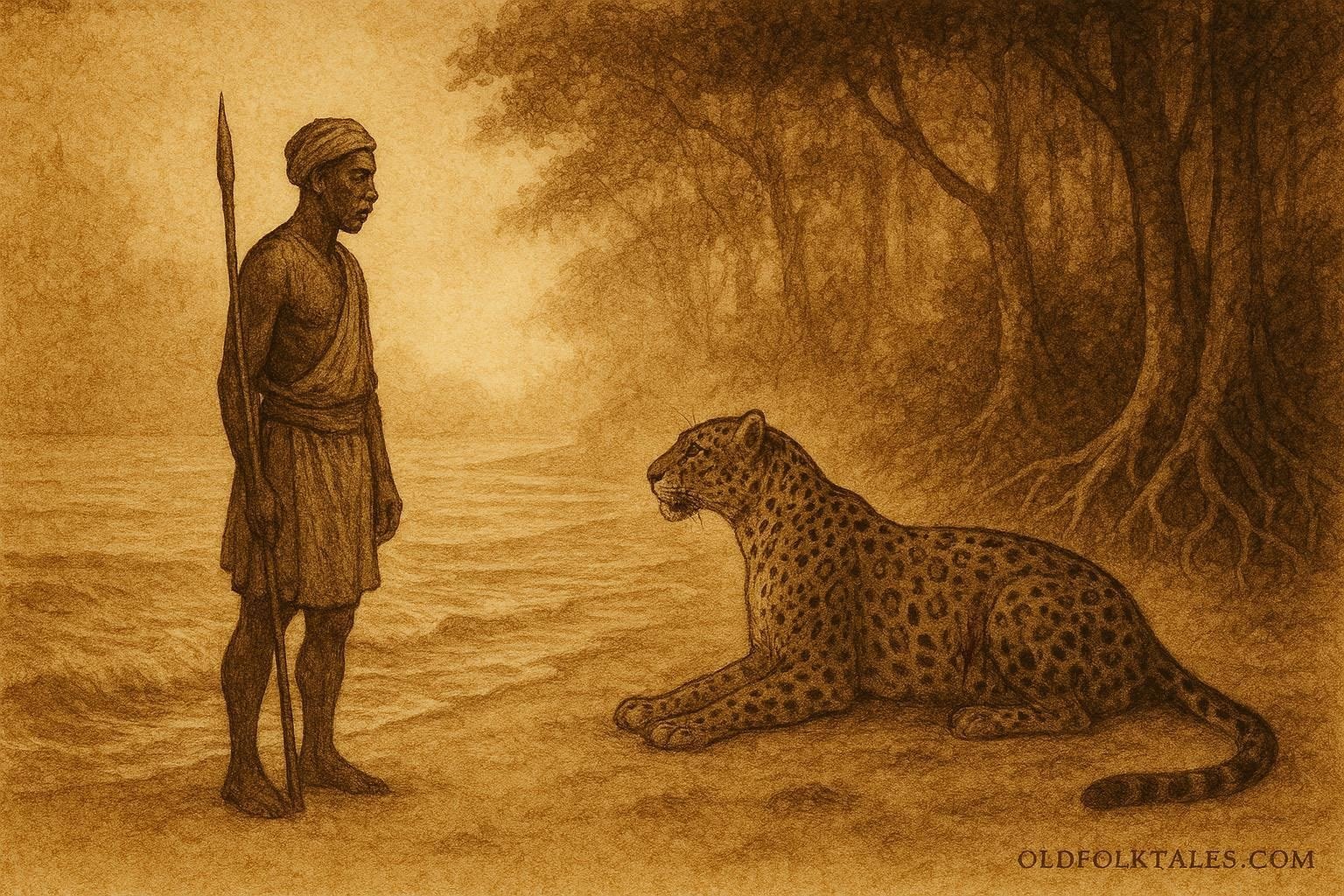
One evening, as he walked near the boundary between forest and shore, he saw it again.
The leopard stood at a distance, partially hidden among the trees.
They regarded each other in silence.
Then the fisherman spoke.
“You made an oath,” he said calmly.
The leopard stepped forward slightly.
“I did,” it replied.
The fisherman’s voice remained steady.
“And you have broken it.”
The leopard did not deny it.
“I did not break it lightly,” it said. “Hunger is not patient. The forest is not always enough.”
The fisherman’s expression tightened, but he did not answer immediately.
He remembered the moment he had lifted the fallen tree. The trust that had formed in silence. The promise that had followed.
“And the people you harmed?” he asked.
The leopard looked away briefly.
“I did not intend to harm them,” it said. “I intended only to survive.”
The fisherman understood something in that moment that troubled him deeply.
Survival did not always ask permission from morality.
The matter could not remain between them.
The village gathered.
Elders, hunters, fishermen, all came together near the edge of the forest where sea breeze met leaf shadow. The air was heavy with tension.
The fisherman stood before them.
He told them everything.
The rescue. The oath. The broken promise.
When he finished, silence followed.
Some were angry.
Some were afraid.
Some were uncertain.
“How can we trust a creature that breaks its word?” one man asked.
Others nodded.
But the fisherman raised his hand.
“It was not a man,” he said. “It was a leopard. And it is bound by hunger as we are bound by need.”
The debate deepened.
What should be done when trust is broken between species?
Was the oath ever truly binding?
Or was it only hope placed upon nature’s unpredictability?
That night, the village made its decision.
They would not hunt the leopard immediately.
Instead, they would mark boundaries between forest and settlement. They would take precautions. And the fisherman would be the one to speak with the creature again.
He alone understood both sides.
The next time he met the leopard, the air between them was different.
He did not approach as a savior.
Nor did the leopard approach as a debtor.
They met as two beings bound by a broken understanding.
“You cannot live among us as you are,” the fisherman said.
The leopard listened.
“And I cannot change what I am,” it replied.
A long silence followed.
Then the fisherman spoke again.
“Then we must both change how we live beside each other.”
From that time on, the forest and the village adjusted to a new balance.
Paths were shifted.
Warnings were respected.
And the leopard, though still wild and hungry at times, kept its distance from human life more carefully than before.
The fisherman continued his work, but he was never again simply a man casting nets into the sea.
He became a reminder.
That mercy has consequences.
That trust is fragile.
And that survival and promise do not always walk the same path.
If you liked this story, see our Central African folktales collection
Moral Lesson
Trust is powerful but fragile. Even sincere promises can be tested by survival, and when broken, they reshape relationships forever. True balance between humans and nature requires understanding, not expectation.
Knowledge Check
- What is the main lesson of “The Leopard and the Fisherman’s Oath”?
The story teaches that trust and promises are fragile, especially when survival conflicts with moral commitments. - Why did the fisherman save the leopard?
He saved the leopard out of compassion when he found it injured and trapped under a fallen tree. - What promise did the leopard make to the fisherman?
The leopard swore not to harm any human again in return for being saved. - Why did the leopard break its oath?
The leopard broke its oath due to hunger and the need for survival. - How did the village respond to the conflict?
The village gathered to deliberate and chose to create boundaries and caution rather than immediate retaliation. - What cultural themes are reflected in this Gabonese folktale?
Themes include trust, survival, human-animal relationships, moral responsibility, and balance with nature.
Source: Collected in early missionary records by Mary Kingsley, Travels in West Africa (1897)
Cultural Origin: Mpongwe-influenced coastal societies in Libreville, Gabon