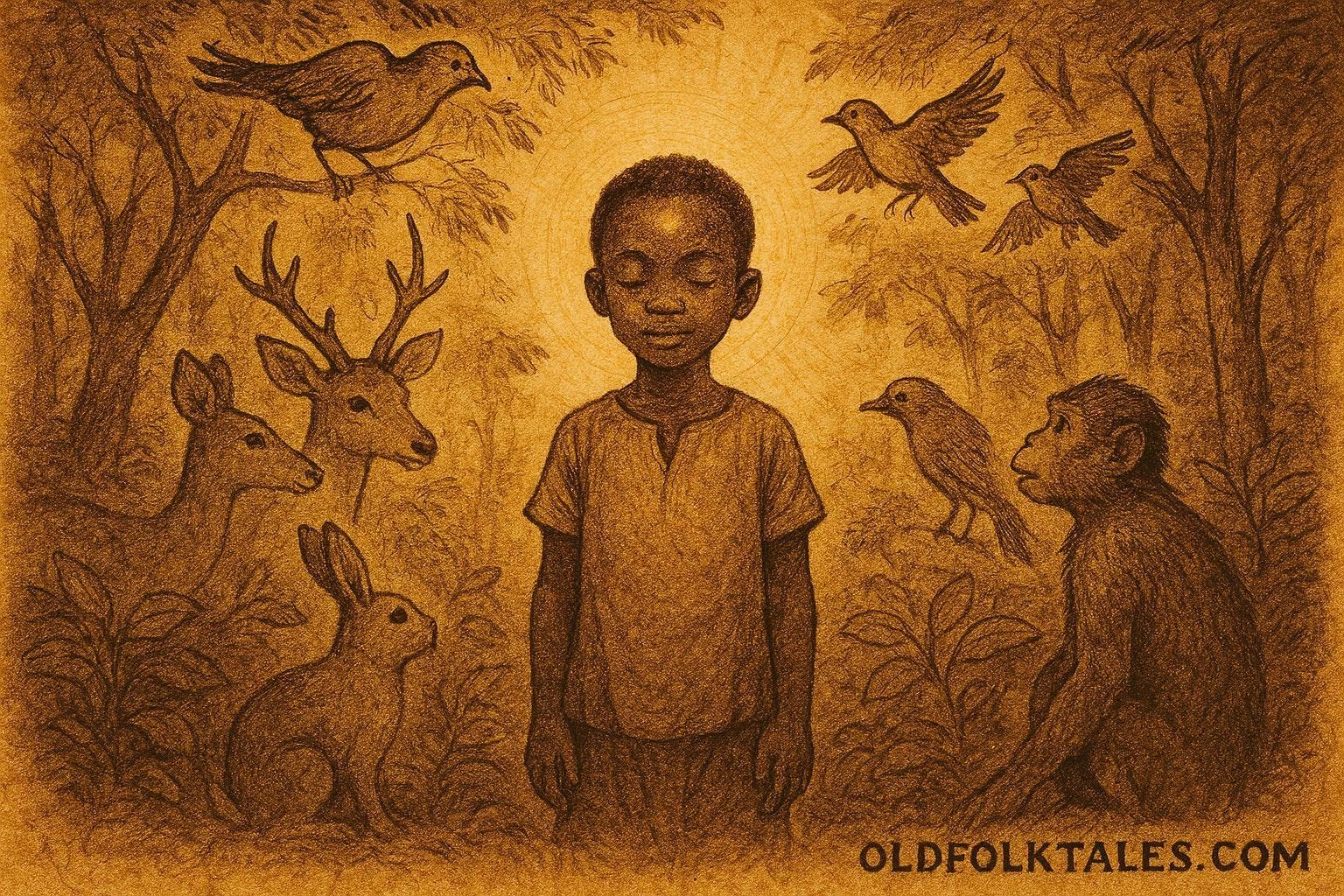
In the forest-adjacent hills of Burundi, where mist clings to the treetops and villages rest quietly between valleys and woodland, there once lived a boy who felt more at home among animals than among people.
He was not unkindly treated, but he was often alone.
Want more? Read more West African folktales now
The other children ran and played in groups, laughing across open fields. The boy, however, preferred the edges of the village, the places where grass grew taller, where birds gathered, where the forest began to speak in softer sounds.
He watched animals closely. Not as a hunter, but as a listener. He noticed how birds called to one another, how ants moved in organized lines, how even the wind seemed to carry patterns through the trees.
But he did not understand them.
Not yet.
One morning, as he walked near the forest boundary, he heard a faint, distressed sound.
It was not loud, but urgent.
He followed it carefully, pushing through low branches and stepping over roots until he found a small bird caught in a snare.
Its wing was tangled, and it struggled weakly, unable to free itself.
The boy knelt immediately.
Without hesitation, he worked gently at the trap, careful not to harm the fragile creature further. The bird trembled as he freed it, but did not try to escape at once. It simply lay still, breathing quickly.
The boy cupped it in his hands.
“It is alright,” he whispered. “You are safe now.”
He set it down softly.
The bird remained still for a moment longer, then slowly lifted its head and looked at him.
And then something strange happened.
The boy heard a voice.
Not from the air.
Not from another person.
But from the bird itself.
“Why did you help me?” the bird asked.
The boy froze.
His eyes widened.
He looked around quickly, but there was no one else.
He looked back at the bird.
“Did you… speak?” he asked softly.
The bird tilted its head.
“Of course,” it replied. “You understand me now.”
The boy stepped back in shock.
“I don’t understand animals,” he said quickly.
But even as he spoke, he realized something had changed.
He understood every word.
Not through thought or guessing, but clearly, directly, as if it had always been possible and he was only now noticing it.
The bird stretched its wings carefully.
“You saved me,” it said. “And so you have been given hearing.”
The boy did not fully understand what had happened, but he could no longer deny it.
When he walked through the forest that day, the world was different.
The rustling leaves were no longer just movement, they carried meaning.
The birds in the trees were speaking to each other.
The insects in the grass exchanged warnings and directions.
Even distant animals communicated through calls he could now interpret.
The forest was no longer silent to him.
It was alive with conversation.
At first, the boy was overwhelmed.
He did not know where to look or what to listen to.
So many voices.
So many meanings.
But gradually, he began to understand patterns.
Warnings about danger.
Calls for food.
Messages of territory.
The forest was not chaotic, as humans sometimes believed.
It was organized.
Balanced.
Communal.
The boy kept his ability secret.
Not out of fear, but out of caution.
He knew that not everyone would understand what it meant.
Some might call it impossible.
Others might try to use it.
So, he listened quietly, learning more each day.
One season, tension began to grow between the villagers and the forest creatures.
Hunters returned with stories of lost traps, scattered game, and unusual resistance from animals. Some said the forest was becoming hostile. Others believed the animals were becoming smarter, more coordinated.
Fear spread.
Talk of conflict began.
Plans were made to enter deeper into the forest to “restore balance.”
But the boy, listening carefully to both sides, understood something others did not.
The animals were not preparing for war.
They were preparing for survival.
Because they believed humans were invading their home more aggressively than before.
Misunderstanding was growing on both sides.
And misunderstanding, left unchecked, becomes conflict.
One evening, as hunters prepared their expedition, the boy stepped forward.
“I can help,” he said quietly.
The hunters looked at him with doubt.
“You?” one asked. “What can a child do?”
But the boy did not argue.
“I understand them,” he said simply.
There was silence.
Then laughter.
But one elder, who had observed the boy’s connection to the forest over time, raised a hand.
“Let him speak,” the elder said.
Reluctantly, the hunters agreed.
The boy went into the forest alone.
But he was not truly alone.
As he walked, he listened.
Animals spoke urgently now, sensing the movement of hunters approaching.
Predators warned prey.
Birds relayed messages across the canopy.
The forest was preparing for confrontation.
The boy called out, not with force, but with understanding.
“I hear you,” he said softly. “All of you.”
The animals paused.
For the first time, something unusual happened.
They listened back.
The boy spoke carefully, relaying what each side feared.
To the animals, he explained that humans were not seeking destruction, but food and protection.
To the humans, he would later explain that animals were not attacking, they were reacting to fear and intrusion.
He moved between both worlds, carrying messages no one else could hear.
Slowly, tension began to shift.
The hunters waited at the forest edge, uncertain.
When the boy returned, he did not bring weapons or trophies.
He brought understanding.
“The forest does not want war,” he said.
“They are afraid,” he continued. “Just as we are.”
The hunters frowned.
“And you know this… how?” one asked.
The boy hesitated only briefly.
“Because I listened,” he said.
Over time, his words began to change how both sides acted.
Humans adjusted their hunting paths, avoiding sacred feeding grounds.
Animals, in turn, began to avoid villages more carefully, reducing accidental encounters.
The forest did not become silent.
But it became balanced again.
Not through force.
But through understanding.
Eventually, the boy became known not as a hunter, nor a child, but as something else entirely.
A bridge.
Between two worlds that had once misunderstood each other.
He moved between forest and village, speaking when needed, listening always.
He did not command animals.
He did not command humans.
He translated between them.
And though many still found it difficult to believe that such communication existed, they could not deny the results.
Conflicts reduced.
Loss decreased.
Harmony slowly returned.
The boy never claimed his ability as power.
He treated it as responsibility.
Because he understood something important:
Hearing is not the same as listening.
And listening is not the same as understanding.
Don’t stop yet! See our complete East African folktales collection
Moral Lesson
Compassion creates connection, and understanding prevents conflict. When humans listen deeply to nature, harmony becomes possible between all living beings.
Knowledge Check
- What is the main lesson of “The Boy Who Understood Animals”?
The story teaches that empathy and understanding can prevent conflict between humans and nature. - How did the boy gain his ability to understand animals?
He gained it after saving a trapped bird in the forest. - What problem was developing between humans and animals?
Misunderstandings led both sides to believe the other was becoming aggressive, risking conflict. - How did the boy help prevent war?
He communicated between humans and animals, explaining each side’s fears and intentions. - What role does the forest play in the story?
The forest is a living community where animals communicate and maintain their own balance. - What cultural themes are reflected in this Burundian folktale?
Themes include harmony with nature, empathy, communication across worlds, and respect for wildlife.
Source: Recorded in East African oral tradition anthologies focusing on animal-spirit communication tales (1974)
Cultural Origin: Forest-adjacent communities of Burundi, where wildlife and human life are closely intertwined