In the ancient town of Awe, in what is now Nasarawa State, natural brine springs had sustained communities for generations. Long before modern roads connected distant regions, traders traveled from village to village carrying valuable blocks of salt produced from the mineral-rich waters. Salt was more than a commodity; it was essential for preserving food, preparing meals, and supporting trade throughout the region.
Among the families involved in this important trade was that of a young man named Akolo. His father and grandfather had both earned their living transporting salt from the brine springs to neighboring communities. From an early age, Akolo learned how to prepare the salt, load it onto pack animals, and navigate the winding paths that connected towns and markets.
Although he respected the family business, Akolo possessed a curiosity that set him apart from other traders. He loved listening to stories told by elders and often asked questions about events that had taken place long before his birth.
Don’t stop yet! See our complete East African folktales collection
One dry season, Akolo was entrusted with a journey larger than any he had undertaken before. Several communities had requested salt, and he was responsible for delivering a valuable shipment across a wide trading route.
Before his departure, his grandmother gave him a small leather pouch.
“Keep this with you,” she said. “It belonged to your grandfather.”
Akolo accepted the pouch respectfully, though he found it unusually light.
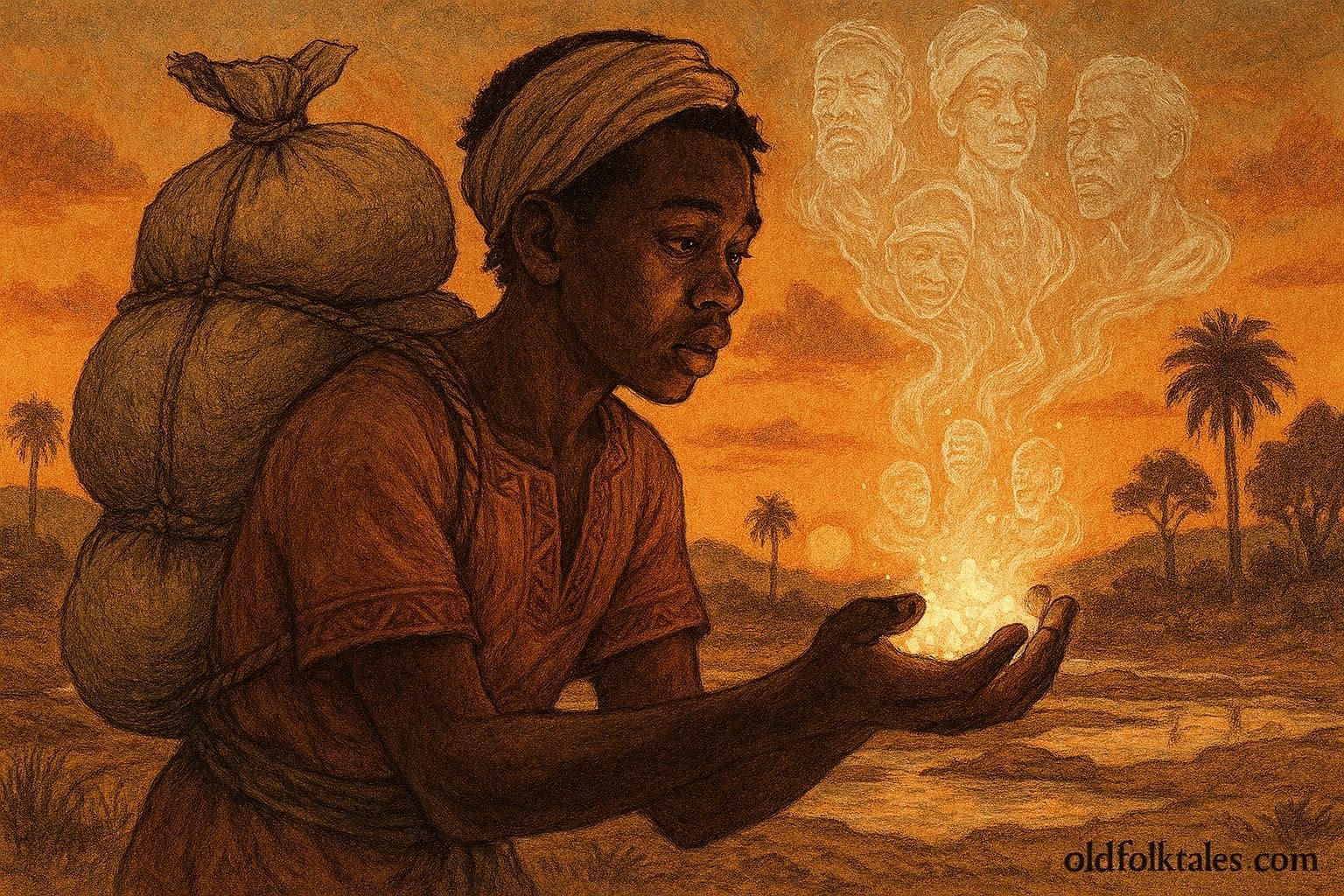
Inside were several small salt crystals unlike any he had seen before. They were clear and faintly sparkling, almost as if tiny stars had been trapped within them.
His grandmother offered no further explanation.
“The road will teach you what you need to know,” she said.
Curious but puzzled, Akolo placed the pouch among his belongings and began his journey.
For several days, everything proceeded normally. He traveled through grasslands, crossed streams, and visited small settlements where traders exchanged goods and news.
One evening, while resting beside a fire, Akolo removed one of the unusual crystals from the pouch.
As he turned it in the light, he heard something unexpected.
A voice.
It was faint and distant, like a whisper carried by the wind.
Startled, he looked around, but no one was nearby.
The voice continued.
It seemed to tell a story about travelers crossing the region many years earlier.
Akolo listened in amazement.
When the voice faded, silence returned.
The next morning, he wondered whether exhaustion had caused him to imagine the experience.
Yet the following night, another crystal revealed a different voice.
This time, he heard an elderly woman describing how communities had cooperated during a severe drought.
The details were vivid and precise.
The speaker sounded as though she were standing beside him.
Night after night, the crystals revealed new voices.
Some belonged to hunters.
Others belonged to farmers, traders, craftsmen, and village elders.
Each voice shared memories of events, traditions, and experiences that had shaped the lives of previous generations.
Akolo soon realized that the crystals seemed to preserve fragments of the past.
The discovery fascinated him.
Instead of merely transporting salt, he found himself carrying stories.
As his journey continued, he began sharing some of what he heard with the people he met.
Elders listened carefully.
Many recognized names, places, and events mentioned by the voices.
Some were moved to tears by memories of ancestors they had only heard about through family stories.
In one village, an elderly chief listened to a crystal and became deeply emotional.
The voice belonged to his grandfather.
The recording described an agreement between neighboring communities that had prevented conflict many decades earlier.
Although the agreement had been forgotten over time, hearing the story again inspired local leaders to strengthen old friendships and renew cooperation.
Word of the remarkable crystals spread throughout the region.
People became eager to hear the voices preserved within them.
Some hoped to learn more about their ancestors.
Others wished to recover forgotten knowledge about farming, trade, and community life.
As Akolo continued his travels, he noticed a pattern.
The voices never spoke of treasure, wealth, or power.
Instead, they focused on lessons, experiences, and values.
They spoke about honesty, patience, generosity, and unity.
They preserved memories that might otherwise have disappeared.
Eventually, Akolo returned to Awe and shared everything he had learned with his grandmother.
The old woman smiled knowingly.
“There is a reason your grandfather treasured those crystals,” she said.
She explained that elders once believed the brine springs carried more than minerals from the earth.
According to tradition, the springs flowed through layers of history, collecting fragments of memory from the generations that lived nearby.
Most people regarded the belief as a legend.
Yet the crystals seemed to suggest there was truth hidden within the story.
Inspired by his experience, Akolo devoted himself to preserving oral histories. He traveled throughout the region collecting stories from elders and recording traditions before they could be forgotten.
He encouraged young people to value the knowledge of previous generations.
He reminded communities that their heritage was as precious as any material wealth.
Years later, Akolo became known not only as a trader but also as a keeper of memories.
Whenever people asked about the mysterious crystals, he would hold one up to the light and smile.
“The voices remind us who we are,” he would say.
“They teach us that the past still has something to offer the future.”
To this day, stories about the Salt Carrier of Awe continue to be shared. Some believe the crystals truly preserved ancestral voices. Others see them as a symbol of oral tradition itself.
Whatever the explanation, the lesson remains the same.
A community that remembers its history carries a treasure that can never be lost.
Want more? Read more West African folktales now
Moral Lesson
Preserving the stories and wisdom of previous generations helps communities maintain their identity and learn valuable lessons for the future.
Knowledge Check
1. Where is the story set?
The story is set in Awe, Nasarawa State, Nigeria.
2. Who was Akolo?
Akolo was a young salt trader from a family involved in the traditional salt trade.
3. What made the crystals unusual?
The crystals seemed to preserve voices and memories from the past.
4. What kinds of stories did the voices share?
They shared ancestral memories, community histories, and lessons about life.
5. How did Akolo use what he learned?
He helped preserve oral histories and encouraged communities to value their heritage.
6. What is the main lesson of the story?
Remembering and preserving history helps strengthen identity and cultural continuity.
Source
Adapted from oral traditions associated with the historic salt-producing communities of Awe and cultural heritage narratives preserved in Central Nigerian ethnographic studies.