In the fertile lands of Idemili in present-day Anambra State, stories of the sacred python had been passed from one generation to another for centuries. The people believed the great serpent was not an ordinary animal but a respected messenger connected to the spiritual heritage of the community. Because of this belief, harming a python was strictly forbidden.
Among the villagers lived a young maiden named Adaeze. She was known for her intelligence and curiosity. Unlike many of her friends, she constantly asked questions about the customs and traditions practiced by the elders.
Whenever ceremonies were held, Adaeze listened carefully to the stories told around evening fires. Yet one tradition continued to puzzle her.
Why was the python treated with such reverence?
The elders always replied respectfully.
Keep reading: Discover more Central African folktales
“The python is part of our history,” they would say. “To understand its importance, one must first understand the bond between our people and the spirit of Idemili.”
Although Adaeze listened, she struggled to fully understand their words.
One planting season, unusual events began occurring throughout the community. Several farmers reported seeing a large python moving peacefully through their farmlands. Rather than damaging crops, the serpent seemed to travel quietly between fields before disappearing into nearby forests.
The sightings quickly became the subject of conversation throughout the village.
Some believed the python’s appearance carried an important message.
Others suggested it was simply following its natural path.
Curious as ever, Adaeze decided she wanted to see the mysterious creature for herself.
One morning, before sunrise, she followed a narrow footpath leading toward a sacred grove on the outskirts of the community. The grove was rarely visited except during important ceremonies.
As she approached the towering trees, she noticed an unusual stillness surrounding the area.
Birdsong seemed softer.
The air felt calm.
The forest itself appeared to be waiting.
Then she saw it.
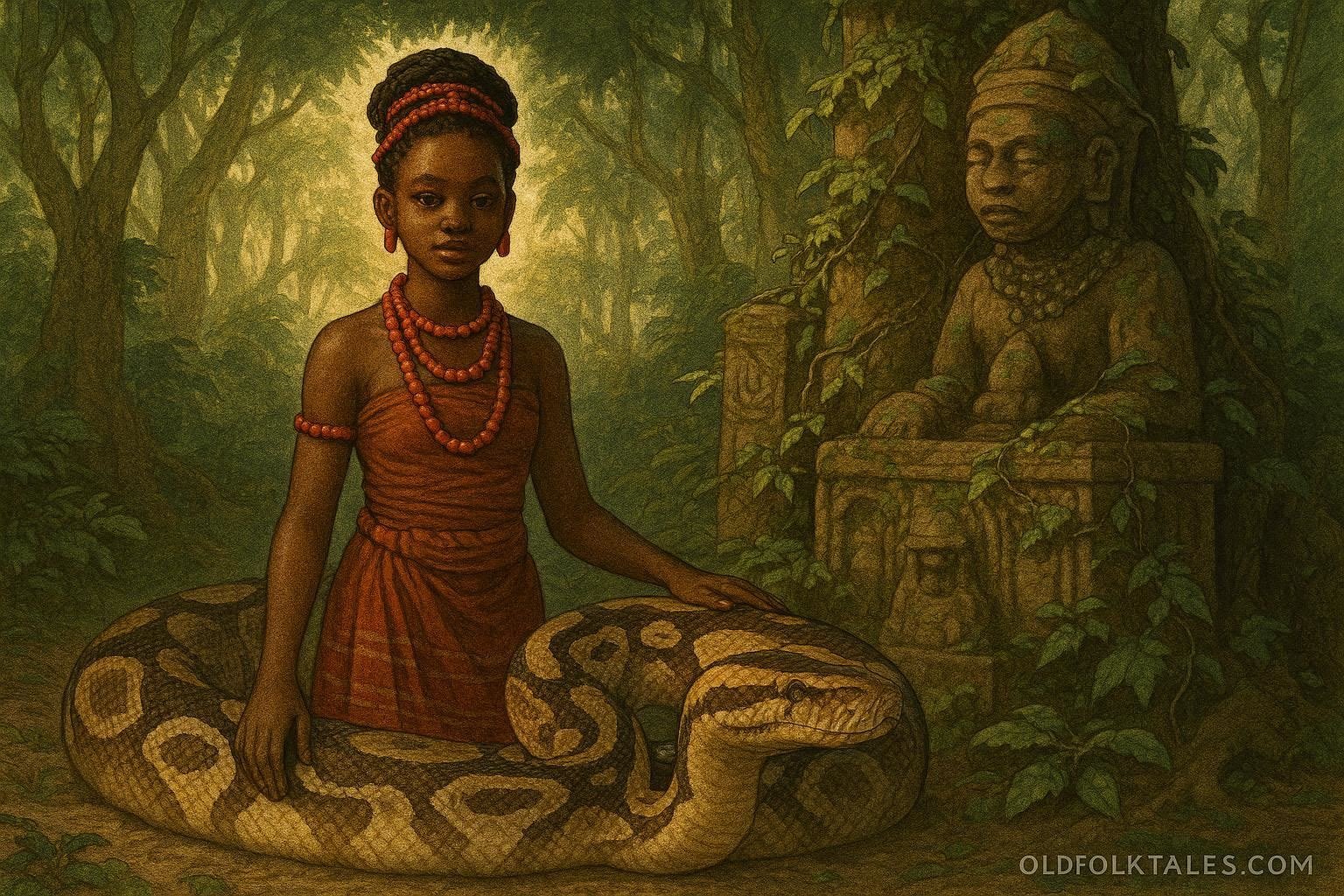
Coiled beneath a large tree rested an enormous python.
Its patterned scales reflected the morning light, creating the appearance of moving designs across its body.
For a moment, Adaeze froze.
She had never seen such a magnificent creature.
The python remained calm.
It neither threatened nor pursued her.
Instead, it slowly raised its head and looked toward the young woman before gliding deeper into the grove.
Overcome by curiosity, Adaeze followed at a safe distance.
The serpent led her to a small clearing she had never seen before.
At the center stood an ancient stone shrine covered with vines and moss.
The place seemed untouched by time.
As Adaeze examined the shrine, she noticed carvings depicting villagers, rivers, farmlands, and pythons woven together in a single story.
The images appeared to tell of a partnership between the people and the natural world.
Before she could study them further, she heard footsteps approaching.
Several elders had arrived.
Rather than scolding her, they smiled gently.
One elder stepped forward.
“You have found what many seek but few discover,” he said.
The elders explained that the shrine preserved memories of the community’s origins.
According to tradition, during a period of hardship generations earlier, the people had settled near lands protected by the spirit of Idemili. The python became a symbol of that protection and of the balance that existed between humans and nature.
Over time, the serpent came to represent respect, wisdom, and peaceful coexistence.
The elders pointed toward the carvings.
“Our ancestors taught that prosperity comes when people respect both the visible world and the unseen forces that sustain it.”
Adaeze listened carefully.
For the first time, she understood that the python’s importance was not based on fear.
It was based on respect.
The sacred animal reminded the community that they were part of something larger than themselves.
Weeks later, a group of traders traveling through the region encountered a python crossing the road.
Unfamiliar with local customs, some prepared to harm the animal.
When news reached the village, Adaeze quickly informed the elders.
Together, they met the travelers and explained the significance of the python within Idemili tradition.
The visitors listened respectfully and agreed to leave the animal unharmed.
The incident sparked many discussions throughout the community.
Younger villagers became eager to learn more about their heritage.
Elders shared stories that had not been told publicly for many years.
Ceremonies celebrating community history gained renewed importance.
Adaeze herself became one of the strongest advocates for preserving traditional knowledge.
She encouraged children to learn from their grandparents and to understand the meaning behind cultural practices rather than simply following them without question.
As the years passed, she became known as a bridge between generations.
Whenever people asked how she developed such respect for tradition, she would smile and remember the morning she followed the python into the sacred grove.
The experience had taught her an important lesson.
True wisdom is not found in rejecting the beliefs of the past or accepting them blindly.
It is found in understanding their deeper meaning.
The story of the Maiden and the Python of Idemili continued to be shared throughout the region.
For some, it was a tale about a sacred serpent.
For others, it was a reminder that communities thrive when they honor their heritage, protect nature, and respect the values that connect generations.
And so the python remained a symbol of harmony, carrying the memory of an ancient bond between the people of Idemili and the world around them.
Click here to discover more legendary tales from West Africa
Moral Lesson
Respecting cultural heritage and living in harmony with nature helps preserve community values and strengthen future generations.
Knowledge Check
1. Who was Adaeze?
Adaeze was a curious young maiden from the Idemili community.
2. Why was the python considered sacred?
The python symbolized protection, wisdom, and the spiritual heritage of the community.
3. Where did the python lead Adaeze?
It led her to an ancient shrine hidden within a sacred grove.
4. What did the carvings at the shrine represent?
They showed the historical bond between the people, nature, and the spirit of Idemili.
5. What lesson did Adaeze learn?
She learned the importance of understanding and respecting cultural traditions.
6. What does the python symbolize in the story?
The python symbolizes harmony, heritage, wisdom, and respect for nature.
Source
Adapted from Igbo religious traditions and oral narratives associated with the sacred python of Idemili, preserved in cultural heritage and folklore studies from Anambra State, Nigeria.