Many generations ago, along the waterways and mangrove forests of the Niger Delta, the Brass Kingdom flourished as an important center of trade and culture. Canoes traveled across winding rivers, merchants exchanged goods with distant communities, and the kingdom’s leaders worked to maintain peace and prosperity among the coastal settlements.
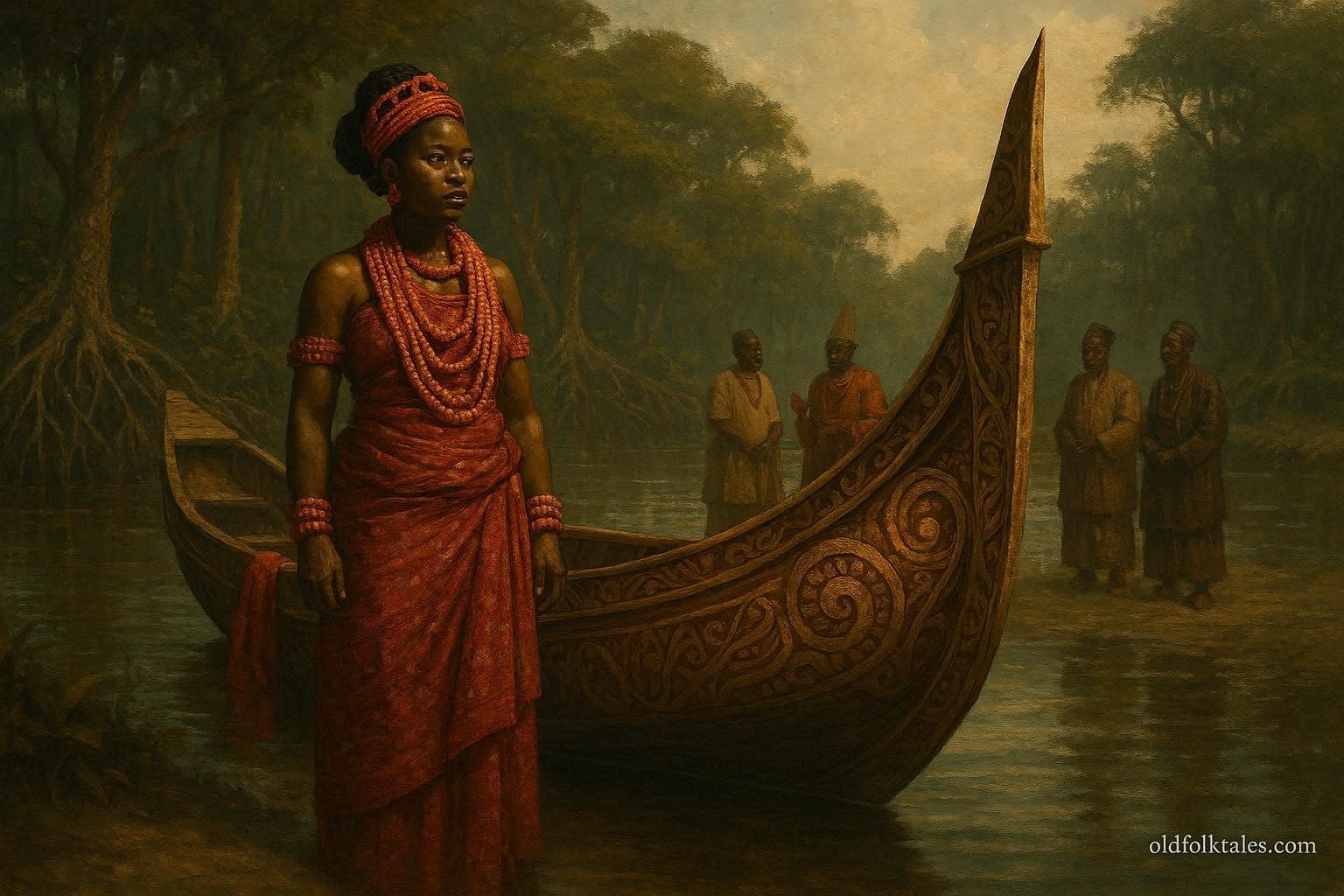
Among the royal family was a young princess named Ebiere. She was admired throughout the kingdom for her intelligence, confidence, and independent spirit. Unlike many royal children who preferred palace life, Ebiere enjoyed learning about the world beyond the royal court.
She spent time speaking with fishermen, traders, craftsmen, and canoe builders. She listened to their stories and learned about the challenges faced by ordinary people living along the waterways.
As she grew older, Ebiere developed a dream that few expected.
She wanted to travel beyond the kingdom and explore distant regions she had only heard about through merchants and visitors. She wished to learn new ideas, experience unfamiliar cultures, and build relationships with communities far from the Niger Delta.
Keep reading: Discover more Central African folktales
The princess believed that such knowledge would help her better understand the world.
However, events soon unfolded that threatened to change the course of her life.
One year, a series of disputes emerged among several coastal settlements connected to the Brass Kingdom. Competition over fishing grounds and trading routes created tensions that gradually weakened relationships between neighboring communities.
What had begun as minor disagreements slowly developed into larger concerns.
Village leaders struggled to find common ground.
Trade became less predictable.
Trust began to erode.
The king and his council worked tirelessly to resolve the situation, but progress remained slow.
As the challenges continued, many elders became concerned about the future.
They feared that if cooperation broke down completely, the prosperity enjoyed by the kingdom for generations could be placed at risk.
During one important council meeting, respected chiefs and advisers gathered to discuss possible solutions.
After hours of discussion, an elder stood and addressed the assembly.
“Our people need more than rules and agreements,” he said. “They need a symbol of unity that everyone can trust.”
The council members listened carefully.
The elder then proposed a plan.
Princess Ebiere, widely respected throughout the kingdom, could serve as a representative tasked with strengthening relationships among the coastal communities. Her leadership, diplomacy, and understanding of different groups made her uniquely suited for the responsibility.
Many council members agreed.
The proposal quickly gained support.
When the king later discussed the matter with his daughter, Ebiere found herself facing an unexpected dilemma.
Accepting the responsibility would require years of commitment.
It would mean postponing her dream of traveling to distant lands.
The choice weighed heavily on her mind.
For several days, she walked along the riverbanks, reflecting on her future.
Part of her longed to pursue her personal ambitions.
Another part understood the importance of the task before her.
During one of these walks, she met an elderly canoe builder who had known her since childhood.
Sensing her concern, the old man asked what troubled her.
After listening to her explanation, he smiled thoughtfully.
Then he pointed toward a large canoe resting near the shore.
“A canoe moves forward because every part serves a purpose,” he said. “The paddles, the wood, the builder, and the person guiding its direction all contribute to the journey.”
Ebiere listened quietly.
“Leadership is much the same,” the old man continued. “Sometimes the path we choose for ourselves differs from the path that benefits the people around us.”
His words remained in her thoughts long after their conversation ended.
In the days that followed, Ebiere visited several communities affected by the growing tensions.
She spoke with fishermen concerned about their livelihoods.
She listened to traders worried about declining cooperation.
She met families whose futures depended upon peaceful relationships between neighboring settlements.
The experience changed her perspective.
For the first time, she fully understood how deeply the kingdom’s well-being depended upon unity.
When she finally returned to the palace, her decision was made.
Standing before the king and the council, Ebiere accepted the responsibility.
She would dedicate herself to strengthening cooperation among the coastal communities.
The work was not easy.
She traveled extensively throughout the region, meeting leaders, mediating disagreements, and encouraging dialogue where distrust had taken root.
She promoted fair agreements.
She encouraged shared celebrations and cultural exchanges.
She reminded communities of the history and traditions they held in common.
Gradually, relationships improved.
Trade routes reopened.
Partnerships strengthened.
Old rivalries gave way to renewed cooperation.
Over time, the kingdom experienced a period of stability that benefited people throughout the region.
Years later, Ebiere’s efforts became widely respected.
Her leadership helped preserve peace and prosperity during a difficult chapter in the kingdom’s history.
Although she never completely abandoned her desire to explore distant lands, she came to understand that her greatest journey had been the one she undertook in service of her people.
Future generations remembered her not only as a princess but as a leader who placed the needs of her community above personal ambition.
Storytellers throughout the Niger Delta shared her tale as an example of responsible leadership and selfless service.
They taught that true leadership often requires difficult choices.
It is not measured by personal achievement alone but by the positive impact one leaves on others.
And so the story of the Princess of the Brass Kingdom endured, reminding generations that sacrifice made for the common good can shape the future of an entire people.
Click here to discover more legendary tales from West Africa
Moral Lesson
True leadership requires responsibility, sacrifice, and a willingness to place the welfare of the community above personal ambition.
Knowledge Check
1. Who was Princess Ebiere?
She was a royal daughter of the Brass Kingdom known for her intelligence and leadership.
2. What dream did Ebiere have?
She wanted to travel beyond her kingdom and learn about distant cultures and communities.
3. What challenge faced the Brass Kingdom?
Disputes among coastal communities threatened trade, unity, and stability.
4. Why was Ebiere chosen to help?
She was respected throughout the kingdom and possessed strong leadership and diplomatic skills.
5. What decision did Ebiere make?
She chose to serve her people and help restore unity among the coastal settlements.
6. What is the main lesson of the story?
Great leaders often make sacrifices for the benefit of their communities.
Source
Adapted from Niger Delta royal traditions and oral history motifs associated with the Brass Kingdom, preserved in Ijaw cultural heritage narratives and regional folklore studies.