In the cool highlands of central Mauritius lay the town of Curepipe, surrounded by green forests, flowering gardens, and rolling hills. The region was known for its pleasant climate and vibrant community life. Throughout the year, families gathered for weddings, religious festivals, harvest celebrations, and cultural events that brought people together.
Among the Indo-Mauritian communities of the area, stories were often shared about a remarkable peacock unlike any ordinary bird.
Its feathers were said to shine with colors brighter than gemstones.
Its presence was considered a sign of blessing and good fortune.
According to local tradition, the peacock appeared only before important occasions that would strengthen the bonds of the community.
Many people had heard the legend.
Few claimed to have seen the bird themselves.
Yet generation after generation, the story endured.
If you enjoyed this story, explore our full West African folktales collection
Many years ago, a young girl named Kavita lived with her family near the outskirts of Curepipe. She enjoyed helping her parents, tending flowers in the garden, and listening to the stories told by her grandmother.
Of all the tales she heard, her favorite was the legend of the sacred peacock.
Her grandmother described the bird as graceful and majestic.
“It never appears without reason,” she would say.
“Whenever it visits, something good follows.”
Kavita dreamed of seeing the peacock one day.
As the years passed, an important event approached.
Several neighboring communities planned a grand cultural celebration that would bring together families from across the region. The festival would feature music, dancing, traditional foods, and ceremonies honoring the island’s rich heritage.
Excitement spread quickly.
People spent weeks preparing decorations and rehearsing performances.
Yet as the festival drew closer, disagreements began to emerge.
Different groups argued about how the event should be organized.
Some wanted changes to long-standing traditions.
Others insisted that customs should remain exactly as they had always been.
The disputes gradually created tension.
Instead of working together, people became increasingly divided.
Concerned elders worried that the celebration might lose its true purpose.
The festival was meant to unite the community, not separate it.
One misty morning, just days before the event, Kavita was walking through a garden near her home when she noticed movement among the trees.
Stepping quietly toward the sound, she stopped in amazement.
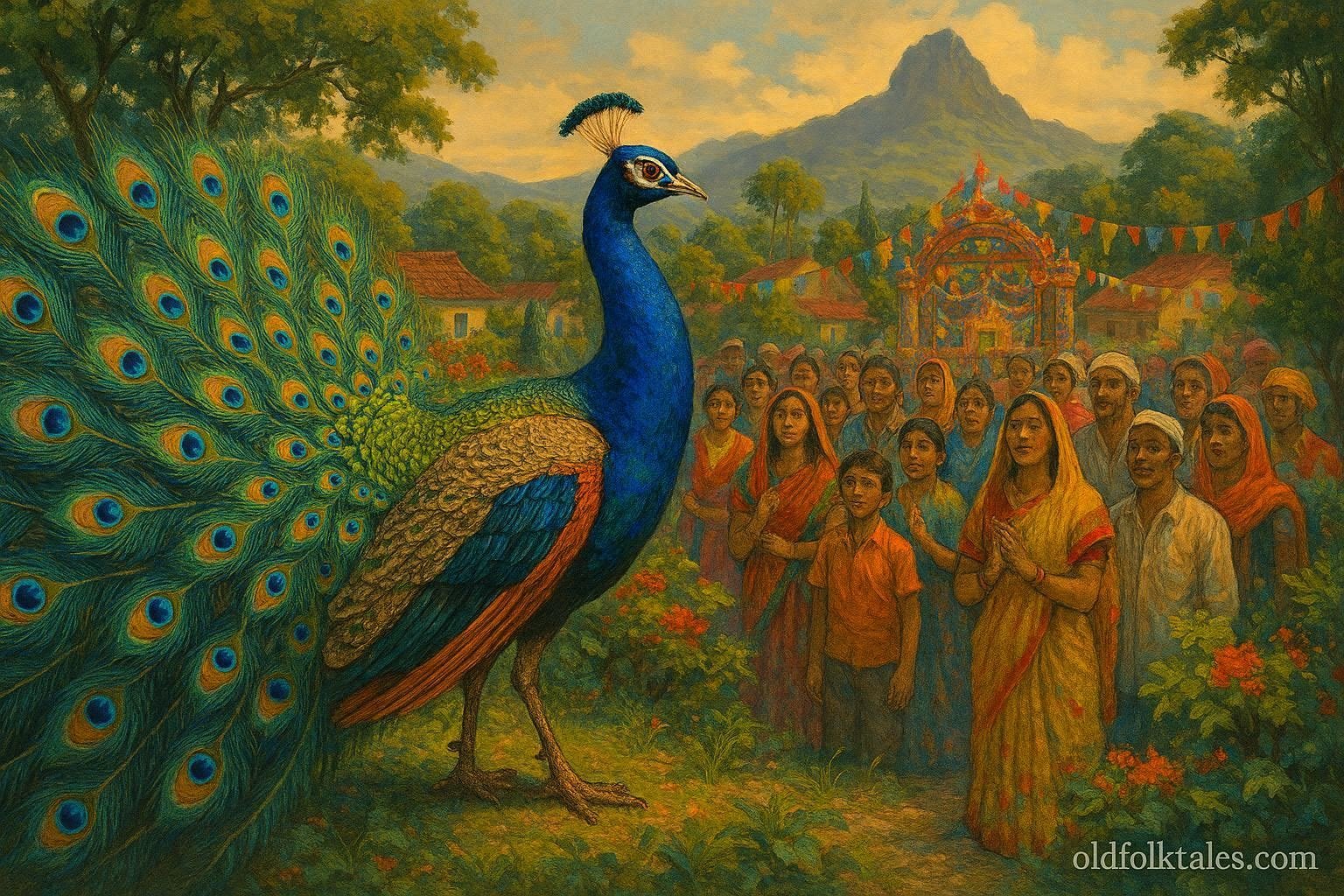
Standing in a patch of sunlight was the most beautiful peacock she had ever seen.
Its feathers shimmered with brilliant shades of blue, green, and gold.
The bird appeared almost radiant.
For several moments, Kavita simply stared.
The peacock calmly opened its magnificent tail, displaying a dazzling pattern that seemed to glow in the morning light.
Then, without making a sound, it began walking toward the center of town.
Curious, Kavita followed.
As the bird moved through Curepipe, more people noticed it.
Shopkeepers stepped outside.
Children ran alongside the road.
Farmers paused their work.
News spread quickly that the legendary peacock had appeared.
Before long, a crowd gathered behind the bird.
The peacock continued its journey until it reached the large field where preparations for the festival were underway.
There, it stopped.
The bird slowly turned in a circle, displaying its feathers to everyone present.
The crowd watched in complete silence.
Then something unexpected happened.
People who had been arguing days earlier found themselves standing side by side.
The beauty of the moment seemed to dissolve their disagreements.
For a brief time, everyone shared the same feeling of wonder.
An elder stepped forward.
“The peacock reminds us why we celebrate,” he said.
His words resonated with those gathered.
The purpose of the festival was not to prove whose ideas were best.
It was to strengthen relationships, honor traditions, and create joyful memories together.
Many people lowered their heads thoughtfully.
They realized how easily they had lost sight of what truly mattered.
The following days brought a remarkable change.
Community leaders worked together.
Volunteers cooperated willingly.
Differences were discussed respectfully.
The spirit of unity returned.
When the festival finally began, it became one of the most successful celebrations in local memory.
Music filled the air.
Families shared meals.
Dancers performed traditional routines.
Visitors from neighboring communities joined the festivities.
The event strengthened friendships and created new connections.
Throughout the celebration, people occasionally searched the crowd for the mysterious peacock.
But the bird was nowhere to be found.
It had disappeared as quietly as it had arrived.
Years later, the story became even more famous.
The peacock appeared again before a wedding that united two families after years of disagreement.
It appeared before a harvest celebration following a difficult season.
It appeared before community projects that required cooperation and trust.
Each time, its arrival seemed to inspire people to work together.
As generations passed, the legend became an important part of local folklore.
Some believed the peacock was a sacred messenger.
Others believed it represented the values that communities needed most.
Regardless of the explanation, everyone agreed on the lesson it carried.
Prosperity grows when people support one another.
Celebrations become meaningful when they bring people together.
And true blessings often appear when communities choose unity over division.
Kavita eventually grew old and became a storyteller like her grandmother before her.
Whenever children gathered around to hear tales from the past, she always included the story of the Peacock of Curepipe.
She wanted future generations to remember that the greatest blessings are not wealth or possessions.
They are harmony, friendship, and the ability to celebrate together.
And so the legend of the Peacock of Curepipe continued to spread across Mauritius, bringing hope and joy wherever its story was told.
Don’t stop yet! See our complete East African folktales collection
Moral Lesson
Unity, cooperation, and mutual respect bring lasting prosperity and happiness to a community.
Knowledge Check
1. Where does the story take place?
The story takes place in Curepipe, a town in central Mauritius.
2. Who was Kavita?
Kavita was a young girl who dreamed of seeing the legendary peacock.
3. What made the peacock special?
Its appearance was believed to bring blessings, prosperity, and unity.
4. Why did the peacock appear before the festival?
It appeared when disagreements threatened the spirit of the celebration.
5. How did the community change after seeing the peacock?
People set aside their disputes and worked together to make the festival successful.
6. What is the central lesson of the story?
Communities thrive when people cooperate and value unity over conflict.
Source
Adapted from Indo-Mauritian oral traditions, sacred bird folklore motifs, and community celebration narratives preserved in central Mauritius folklore collections.