Along the southeastern coast of Mauritius, where turquoise waters met sandy shores and fishing boats dotted the horizon, stood the historic settlement of Mahébourg. For generations, the sea shaped the lives of its people. Fishermen relied on its bounty, traders crossed its waters, and families built their futures along its coastline.
Among the oldest stories told in the community was the legend of the Coral Crown.
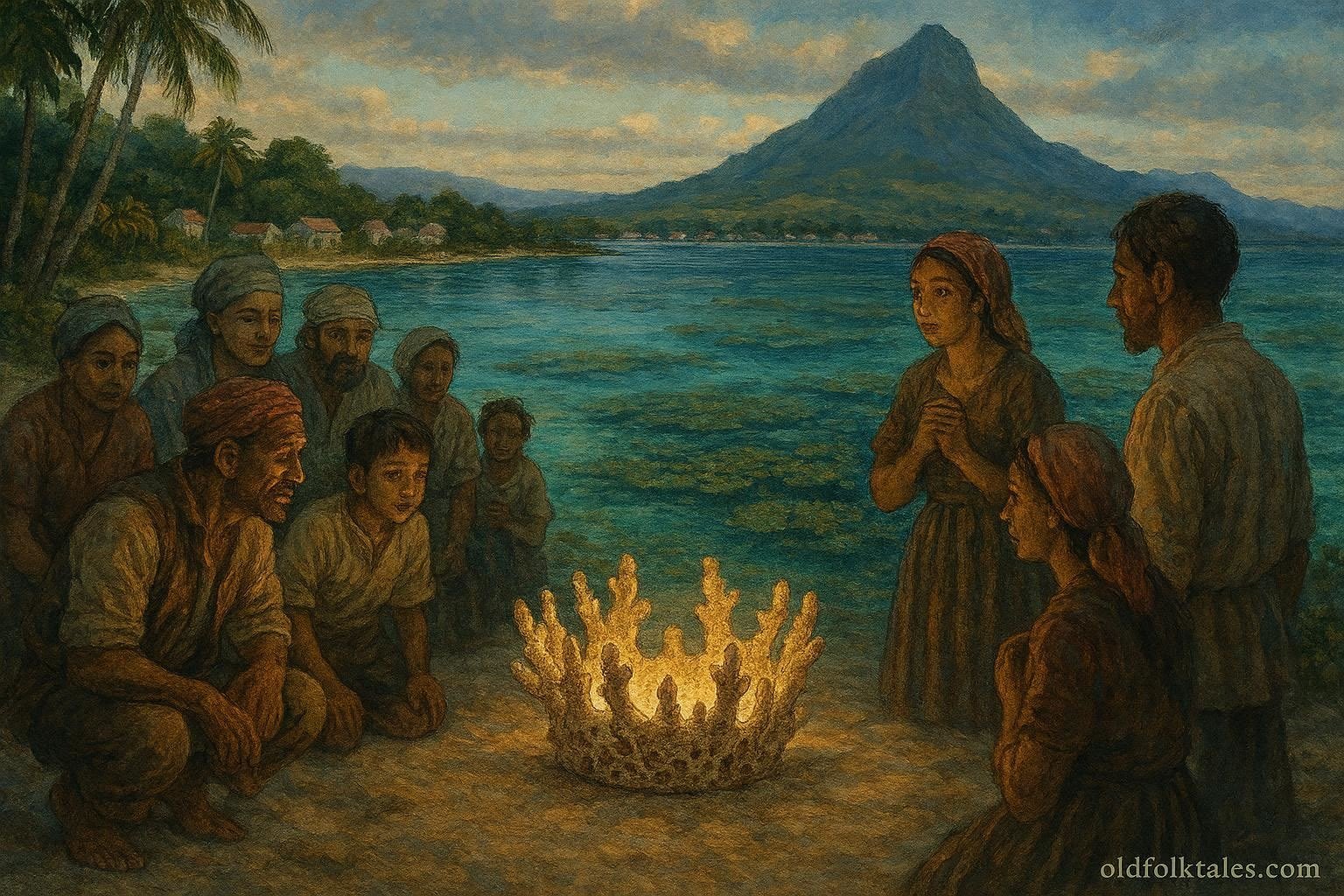
According to tradition, the crown had belonged to a respected leader who lived many generations before. Unlike crowns made of gold or precious jewels, this one had been crafted from rare coral gathered from the surrounding lagoons.
Skilled artisans spent years shaping and polishing the coral pieces.
The finished crown was said to glow softly in sunlight, displaying shades of red, pink, and white unlike anything else on the island.
The crown symbolized more than authority.
It represented wisdom, fairness, and service to the community.
Legends claimed that every leader who wore it understood that power carried responsibilities as well as privileges.
Love this story? Discover our full Southern African folktales collection
For many years, the Coral Crown remained a treasured symbol of unity.
Then, during a violent storm that struck the coast, it disappeared.
Some believed it had been swept into the sea.
Others believed it had been hidden for protection during a period of uncertainty.
Despite countless searches, the crown was never found.
As time passed, it became part of local folklore.
Generations grew up hearing stories about the lost artifact.
Many doubted it had ever existed at all.
Years later, Mahébourg faced a difficult challenge.
The community needed to choose a new leader after the retirement of a respected elder.
Several candidates sought the position.
Among them were two individuals with very different approaches.
The first was Victor, a wealthy merchant known for his ambition and influence.
He promised prosperity and development.
Many people admired his confidence.
The second was Élise, a teacher respected for her fairness, patience, and dedication to helping others.
She had spent years supporting families, educating children, and resolving community disputes.
As discussions continued, disagreements began to divide the community.
Supporters of each candidate argued passionately.
Friendships became strained.
Families found themselves on opposite sides of the debate.
The tension grew with each passing week.
One morning, a young fisherman named Daniel set out before sunrise.
While checking his nets near a coral reef just beyond the harbor, he noticed something unusual beneath the clear water.
A strange object rested among the rocks.
Curious, he dove into the lagoon.
As he approached, he realized the object resembled a crown.
Carefully lifting it from the seabed, he returned to shore.
News spread quickly.
Elders gathered to examine the discovery.
Despite years beneath the sea, the crown remained remarkably intact.
Its coral surface still displayed beautiful colors.
Ancient carvings decorated its edges.
Several elders immediately recognized the descriptions preserved in old stories.
The legendary Coral Crown had returned.
Excitement swept through Mahébourg.
Many believed the crown’s reappearance was connected to the ongoing leadership dispute.
Some argued that whoever possessed the crown should automatically become the next leader.
Others disagreed.
They insisted that leadership required more than ownership of an artifact.
The debate intensified.
To settle the matter, the elders organized a public gathering.
The crown was displayed for everyone to see.
Community members shared their opinions.
For hours, discussions continued.
Eventually, one of the oldest elders stood and addressed the crowd.
“Our ancestors did not value this crown because it granted power,” he said.
“They valued it because it reminded leaders of their duty.”
The gathering fell silent.
The elder continued.
“If the crown truly represents wisdom and responsibility, then we must choose a leader who already demonstrates those qualities.”
His words encouraged people to reflect more carefully.
Instead of focusing on wealth, influence, or symbols, they began discussing the qualities that mattered most.
Who listened to others?
Who served the community?
Who acted with fairness and integrity?
Over the following days, many residents reconsidered their positions.
They looked beyond promises and appearances.
They evaluated actions rather than words.
When the final decision was made, the community chose Élise.
People believed she best embodied the values represented by the Coral Crown.
During the ceremony welcoming her into leadership, something unexpected happened.
Rather than placing the crown upon her own head, Élise placed it in a special display within the community hall.
She explained that the crown belonged to everyone.
“It should remind all leaders of their responsibilities,” she said.
“It should never belong to a single person.”
Her decision earned widespread respect.
The crown became a symbol of shared values rather than personal authority.
Visitors traveled from neighboring regions to see the famous artifact.
Children learned its story in school.
Families passed the legend from one generation to the next.
Over time, the Coral Crown became even more meaningful than before.
Its rediscovery had helped unite a divided community.
Its message continued to guide future leaders.
The people of Mahébourg never forgot the lesson hidden within the ancient artifact.
Authority gained through symbols alone is fragile.
True leadership is earned through wisdom, service, fairness, and responsibility.
And so the legend of the Coral Crown of Mahébourg endured, reminding all who heard it that the greatest measure of a leader is not the crown they wear but the character they demonstrate.
Continue your journey: Read more East African folktales
Moral Lesson
True leadership comes from wisdom, integrity, and service to others rather than titles, wealth, or symbols of power.
Knowledge Check
1. What was the Coral Crown made from?
The crown was crafted from rare coral gathered from the lagoons surrounding Mauritius.
2. Why was the crown important?
It symbolized wisdom, fairness, responsibility, and good leadership.
3. Who discovered the lost crown?
A young fisherman named Daniel found it near a coral reef.
4. Why did the crown reappear at an important time?
It resurfaced during a dispute over who should become the community’s next leader.
5. Who was chosen as leader?
Élise, a respected teacher known for fairness and service, was selected.
6. What is the main lesson of the story?
Leadership should be based on character and responsibility, not symbols of power.
Source
Adapted from Mauritian coastal folklore, leadership traditions, and artifact legends preserved in Mauritian historical folklore archives and oral storytelling heritage.