A man once had a wife who was beautiful as the moon. The woman was proud of her beauty, but her pride changed when she had a daughter.
The child grew into a girl whose beauty surpassed that of her mother.
The mother could not bear it.
One day, she asked the moon, “Who is more beautiful, you or me?”
The moon answered that they were equal.
The woman was pleased.
But when she asked again after her daughter had grown older, the moon gave a different answer.
“The girl is more beautiful than both of us.”
The mother was filled with jealousy.
She moved her daughter from one place to another, hoping that distance would somehow change the answer. First, the girl was kept near the window. Then she was moved near the water conduit. Each time, the mother asked the moon who was more beautiful.
Each time, the answer remained the same.
The girl was more beautiful.
The mother’s jealousy continued to grow.
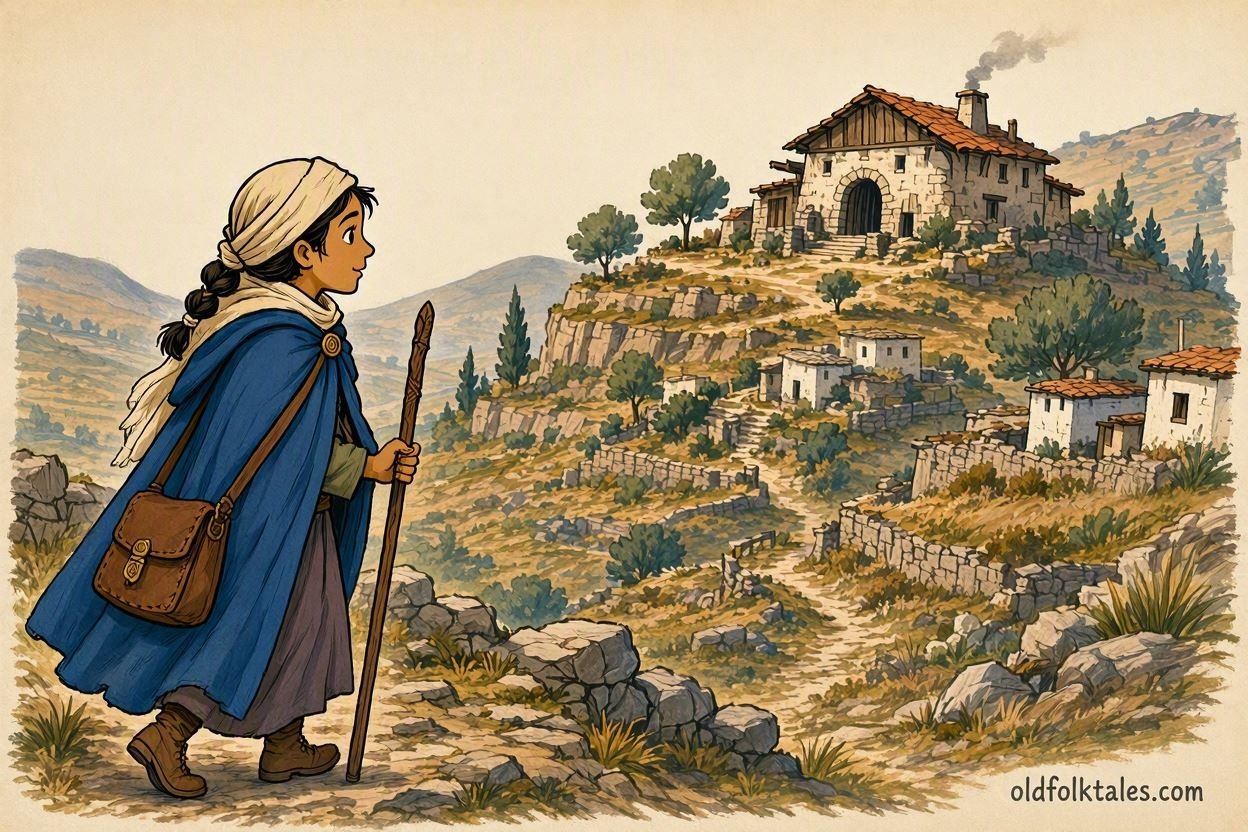
One Tuesday, the girl was playing with a ball of thread. As she followed it, she wandered farther and farther from home.
Before long, she became lost.
While searching for her way back, she encountered an ogress who threatened to eat her. Frightened, the girl ran.
She followed the thread until she reached a house. Seeing a window, she climbed through it and hid among the provisions inside.
If you enjoyed this story, explore our full West African folktales collection
The house belonged to a man who lived there with five children.
When the children returned, one of them noticed the girl.
Thinking she was someone who belonged in the house, the child told her to prepare their evening meal.
The girl answered that it was not yet time.
She stayed hidden until the children fell asleep.
Then she came out.
Her name was Thizourith Imellah.
She began preparing food. She ground grain, prepared couscous and cooked partridges. While working, she discovered some makeup and placed it on the hand of one of the sleeping children.
When the children woke, they found the food prepared and noticed the makeup on their hands.
The master of the house became suspicious.
He pretended to sleep while keeping one eye open.
Thizourith Imellah began preparing the food again.
This time, she put some of the makeup on his hand.
The man immediately caught her.
“Who are you?” he asked.
“I am a creature like you,” she answered.
“What is your name?”
“Thizourith Imellah.”
The man asked who would marry her.
She answered that she would marry the first person who had touched her.
The man decided to marry her.
After the marriage, Thizourith Imellah remained with him and his children.
But her troubles were not over.
One day, she took a bean.
A cat demanded that she give it the bean, threatening to put out the fire if she refused.
Thizourith Imellah offered the cat other beans, but the animal wanted that particular one.
She refused.
The cat extinguished the fire.
Thizourith Imellah went to an ogre named Lamara and asked him for help.
The ogre instructed her to bring small spoons, a large spoon, a pot, a dish, a vessel, wood and fire.
She brought everything he requested.
The following day, Lamara came to her.
He asked what the old Lamara had been doing.
Thizourith Imellah answered that he had been sitting on a sofa, wearing a beautiful cap and eating partridges.
This happened repeatedly.
Her husband noticed that she had become unhappy.
He asked what was troubling her.
Thizourith Imellah told him about the cat, the bean, the extinguished fire and the ogre she had visited for help.
Her husband then told her what to say when the ogre came again.
When Lamara returned, Thizourith Imellah asked him why he kept coming.
The ogre shut the door.
Then he broke it and prepared to attack her.
But her husband was ready.
He shot the ogre and killed him.
After this danger had passed, Thizourith Imellah, her husband and the children left the place and travelled toward her father’s house.
Eventually, they came to a house.
They knocked and asked for alms.
When Thizourith Imellah looked at the man who opened the door, she noticed that he resembled her father.
She asked him whether he had ever had a daughter.
The man said that he had once had a daughter, but he had lost her.
“What was her name?” Thizourith Imellah asked.
“Thizourith Imellah,” he answered.
She revealed herself.
She was his daughter.
The man had just given food and grain to his own daughter without knowing who she was.
The family welcomed her, and the story of her life was told.
Her mother learned that her daughter had survived and was living in a prosperous household, dressed in beautiful clothes of gold and silver.
Instead of being happy, the mother’s old jealousy returned.
She asked her husband to bring her daughter some clothes.
Before he left, she gave him an opium pill and instructed him to make Thizourith Imellah swallow it.
When the father arrived, he gave his daughter the clothes.
Then he tricked her into opening her mouth by asking her to show him her teeth.
As she opened her mouth, he put the pill inside.
Soon, Thizourith Imellah fell into a deep sleep.
Her husband and the children discovered her.
The children were frightened when they could not wake her.
They suggested burying her, but her husband refused.
Instead, he placed her inside a chest and loaded the chest onto a camel.
The camel wandered away and eventually entered the lands of a sultan.
The sultan saw the animal and took it.
When the chest was opened, he discovered Thizourith Imellah inside.
She appeared lifeless, and the pill was still in her mouth.
The sultan ordered his female servants not to approach the chest.
But curiosity eventually led them to look inside.
They admired the girl’s beautiful hair, her teeth and her hand.
One of the women noticed the pill in her mouth.
She removed it.
At once, Thizourith Imellah woke.
She had returned from her strange sleep.
Her first thought was of home.
She asked to be taken near the camel.
Then she spoke to the animal as though it understood her.
She instructed the camel to carry her home.
She promised it couscous and broth and told it that, once they reached home, its hump would be cut and the door opened quietly.
Then it should neigh loudly.
The camel carried her away.
When it finally reached home, the children heard its cry.
They rushed toward it and discovered that Thizourith Imellah had returned.
Their joy was overwhelming.
The family celebrated her return for seven days and seven nights.
After everything she had endured, Thizourith Imellah was home again.
She had escaped the dangers of the ogre’s world, survived betrayal, and returned from a sleep that seemed like death.
Her journey had taken her far from the home she knew, but neither danger nor jealousy could keep her away forever.
Fascinated by this tale? Discover more North African folktales
Moral Lesson
Thizourith Imellah’s journey shows that courage and perseverance can carry a person through terrible danger. The tale also warns against jealousy and betrayal, especially when they come from those who should offer love and protection. Despite everything done against her, Thizourith Imellah survives and eventually finds her way home.
Knowledge Check
1. Why did Thizourith Imellah’s mother become jealous of her?
She became jealous because the moon declared that her daughter was more beautiful than she was.
2. How did Thizourith Imellah become separated from her family?
She followed a ball of thread while playing and eventually became lost.
3. How did Thizourith Imellah first enter the ogre’s household?
She found a house after becoming lost, climbed through a window and hid among the provisions.
4. How did Thizourith Imellah’s husband save her from the ogre Lamara?
He followed her instructions and killed the ogre with a gun when Lamara attacked her.
5. How did Thizourith Imellah’s father recognize her?
When she asked about his lost daughter, he revealed that her name had been Thizourith Imellah, allowing her to reveal her identity.
6. How did Thizourith Imellah finally return home?
After waking from the poisoned sleep, she used the camel to carry her back home, where the children welcomed her.
Source
Adapted from Joseph Rivière, Recueil de contes populaires de la Kabylie du Djurdjura, 1882, “Thizourith immellih’,” in the section on ogres and ogresses, pp. 215 to 221.