In a quiet village nestled between the Atacora mountains and winding forest paths, there lived a girl named Ameyo. She was known for her honesty, her calm voice, and the way she always carried herself like someone listening to something others could not hear.
Her village honored the Sacred Fire—a small but eternal flame kept burning at the heart of the shrine, tended by elders and watched over by chosen girls. The Fire was said to have been gifted by the ancestors to light their path, protect their crops, and keep misfortune away. Every seven years, the firekeeper was chosen anew.
This year, the choice was Ameyo.
“Are you ready to carry the fire in your hands and in your heart?” asked the village priestess, Nana Koto.
Ameyo bowed. “Yes, Nana. I will not fail it.”
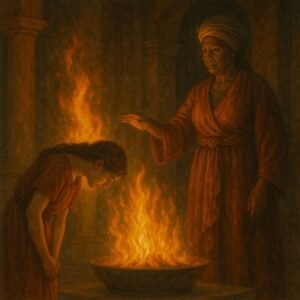
For thirty days, Ameyo was to live in the firehouse, keeping the flame alive with sacred oil and prayer. She was not to speak to anyone except Nana Koto, not to eat food touched by others, and never to leave the firehouse at night.
At first, it was peaceful. The fire flickered softly, warm like a lullaby. Ameyo would whisper to it as if it were alive, and she felt it listened.
But outside, not everyone was pleased with her role.
There were whispers. “Why her?” asked Fati, a girl from the west edge of the village, known for her boldness and sharp tongue. “She’s too quiet. Too strange.”
“She doesn’t even speak at festivals,” said another girl.
Fati had once dreamed of being the firekeeper. Her heart stirred with jealousy that she dared not speak aloud.
On the fifteenth day, a stranger came to the village—a merchant with gold rings and a voice like a drum. He sold mirrors that shimmered even in the shade, spices that burned sweet, and perfumes that made people turn twice.
Fati saw him and had an idea.
That night, dressed in red and gold, she approached the firehouse and called softly.
“Ameyo. Come to the door.”
Ameyo opened it a crack. “I cannot. It is forbidden.”
“But only for a moment,” Fati coaxed. “The merchant has mirrors from beyond the river. They say if you look into them by firelight, you see your future husband’s face.”
Ameyo hesitated. The fire behind her hummed, almost like it was breathing.
“I cannot,” she said again, and closed the door.
But Fati returned the next night. This time, she left a bowl of food outside—spiced millet and roasted yam, steaming hot.
Ameyo smelled it and her stomach twisted. She had eaten nothing but bland porridge for days.
“No one will know,” whispered a voice in her mind. “Just a taste.”
She reached for the bowl. But as she did, the fire behind her flared—high and blue. A sudden gust blew through the firehouse, and the bowl flew from her hands.
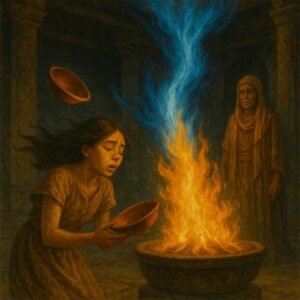
Ashes touched her fingers.
The next morning, Nana Koto arrived. She looked at Ameyo and the scattered food, and she said only, “The Fire sees what we hide.”
Ashamed, Ameyo fell to her knees. “I did not eat it. But I wanted to.”
Nana Koto was silent. Then she nodded slowly. “The Fire tests even the purest heart. This was your trial.”
Word of the trial spread. Some mocked. Some admired.
But Ameyo stayed. She fasted for three days in silence. On the fourth, the Fire burned even brighter.
The seven years passed like wind through palm leaves. Ameyo grew into a woman of great wisdom, and when her time as firekeeper ended, she was chosen to become a priestess.
As for Fati, she left the village one day with the merchant and was never seen again.
The Sacred Fire still burns. And they say it still tests those who come too close.
✧ Commentary
This tale from Benin explores themes of temptation, jealousy, and the quiet strength of self-control. Ameyo’s inner conflict is deeply human—wanting to do right, yet wrestling with desire. The story teaches that sacred duties demand discipline, but also compassion for imperfection. Fati represents envy turned to manipulation, while the fire itself becomes a symbol of divine conscience.
✧ Moral
True strength is not in never being tempted, but in choosing what is right when no one is watching.
✧ Questions & Answers
1. Q: Who was chosen as firekeeper, and why? A: Ameyo, for her honesty and quiet wisdom.
2. Q: What were the rules of keeping the Sacred Fire? A: No speaking to outsiders, no eating shared food, and no leaving at night.
3. Q: How did Fati try to sabotage Ameyo? A: By tempting her with forbidden food and luring her with curiosity.
4. Q: Did Ameyo break her vow? A: No—but she was tempted, and she admitted her weakness.
5. Q: What does the fire symbolize? A: Truth, discipline, and the inner voice of conscience.