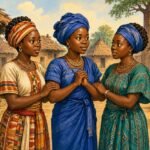
In a quiet fishing village nestled along the rocky shores of Santiago, one of the islands of Cabo Verde, lived a boy named Kadu. From the moment he could walk, Kadu was unlike the other children. Where they feared the wild sea and the howling wind that swept across the islands, Kadu was filled with restless curiosity. He would sit for hours watching the waves crash against the cliffs and listen intently to the stories the elders told of the mighty winds that shaped their lives.
The wind was no ordinary breeze in this village. It was a powerful force, fierce and untamed. Sometimes, it would roar through the narrow streets, tearing tiles from rooftops and tossing fishing nets like feathers. The elders believed the wind was a living spirit—a messenger of the ancestors, a guardian, and sometimes a tester of the people’s courage.
Kadu’s father, a seasoned fisherman, often warned him, “Respect the wind, son. It gives life, but it can also take it away.”
But Kadu’s heart was not satisfied with fear or respect alone. He wanted to understand the wind. To know if the tales were true, if the wind truly had a spirit, if it could be reasoned with or challenged.
One bright morning, as the village prepared for the annual fishing festival—a day of thanks for the sea’s bounty—Kadu wandered to the shore. The wind was unusually strong, whipping up clouds of sand and sea spray. The elders had cautioned everyone to stay close to their homes and avoid the beach until the gale passed.
Yet Kadu stood firm, facing the howling gusts with a daring smile. He shouted above the roar, “Wind! I challenge you! Show me your strength, but do not harm my village or the people I love!”
His voice was barely a whisper against the wind’s fury. Suddenly, a powerful gust lifted Kadu’s straw hat, knocked him off his feet, and sent him sprawling onto the sand. Bruised and breathless, he picked himself up, staring at the turbulent sky.
The wind seemed to listen.
For days after, Kadu found himself watching the wind differently. He noticed the way it bent the tall grasses and how the birds flew carefully between gusts. He saw fishermen adjust their sails and how farmers planted their crops with the wind’s patterns in mind.
Kadu sought wisdom from Nana Mari, the village wise woman, who was known for her deep connection to the land and sea. She welcomed Kadu’s questions warmly.
“The wind,” she explained, “is a spirit. It is neither good nor evil but a balance—bringing storms and calm, destruction and life.”
She told him stories of how the wind carried the voices of ancestors across the islands, how it whispered secrets to those who would listen, and how the people of the islands must live in harmony with it, not against it.
Kadu absorbed every word and began practicing patience and observation. He learned to read the signs—the sudden drop in bird songs, the swirl of leaves, the smell of salt in the air—that foretold changes in the wind.
Weeks passed, and the next festival approached. This time, the wind was fierce again, threatening to cancel the celebrations. But Kadu stood at the shore, arms outstretched, not in defiance, but in welcome.
“Wind,” he called, “we honor you. Blow where you will, and we will bend with you.”
The wind swirled around him gently and then calmed. The villagers rejoiced, knowing that Kadu had forged a new understanding—a bridge between human courage and nature’s power.
Years later, Kadu became a respected elder, teaching new generations to respect the wind, to listen, and to live in harmony with the forces that shape their lives.
✧ Commentary
This tale from Cabo Verde beautifully captures the delicate balance between human courage and the natural world. Kadu’s journey from reckless defiance to humble respect shows how true strength comes from understanding and cooperation. The wind, as a symbol of nature’s unpredictable power, teaches that survival depends on listening deeply, adapting wisely, and honoring ancestral wisdom. This story warmly conveys cultural values of respect for environment and community.
✧ Moral
True bravery is not in battling nature’s forces but in learning to live with them in respect and harmony.
✧ Questions & Answers
1. Q: What made Kadu different from the other children in the village? A: He was curious and brave, wanting to understand the powerful wind instead of fearing it.
2. Q: What did the elders believe about the wind? A: That it was a living spirit carrying the voices of ancestors, both powerful and unpredictable.
3. Q: How did Nana Mari help Kadu understand the wind? A: She taught him that the wind is neither good nor bad but a balance that must be respected.
4. Q: What changed in Kadu’s attitude toward the wind by the next festival? A: He welcomed the wind and promised to live in harmony with it, rather than challenge it.
5. Q: What lesson does the story teach about nature? A: That respecting and adapting to nature’s forces is wiser and stronger than trying to fight them.