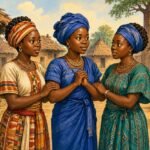
In a small village nestled near the rolling hills of Burkina Faso, there lived a young weaver named Amadou. He was known far and wide not just for his skillful hands but for his clever mind. Amadou had learned the art of weaving from his mother, who had inherited the craft from generations before her. Their family’s cloth was the finest in the region, adorned with patterns that told stories of the land, the animals, and the people.
Amadou’s village was peaceful, but like all villages, it had its share of troubles. One day, a mysterious visitor arrived—a tall man wrapped in shimmering robes, his eyes shining like stars. He carried an ancient loom unlike any the villagers had ever seen.
“I am Baaka, the traveler,” the man said with a voice that rumbled like thunder but softened like the evening breeze. “I bring a gift to the village: this enchanted loom. It weaves cloth that can change colors with the sun, and patterns that tell truths and lies alike. But there is a catch—you must prove your worth to use it.”
The village elders gathered, curious and cautious. They invited Amadou forward. “You are the finest weaver here,” the chief said. “If anyone can unlock the loom’s secrets, it is you.”
Amadou nodded, humbled but determined. “I accept the challenge.”
Baaka smiled and placed the loom in Amadou’s small hut. “This loom is alive,” he said. “It will reveal your character through the cloth you weave. Be truthful, be clever, and it will reward you.”
That night, Amadou sat before the loom. The wooden frame pulsed softly under his fingers. He began weaving, choosing threads dyed with the colors of the earth—reds like the clay, greens like the leaves, gold like the morning sun.
As he worked, the patterns shifted and changed. Suddenly, the cloth showed images—faces of the villagers, scenes of the forest, the river winding through the land. Then the images turned darker—storms brewing, animals fleeing, shadows creeping.
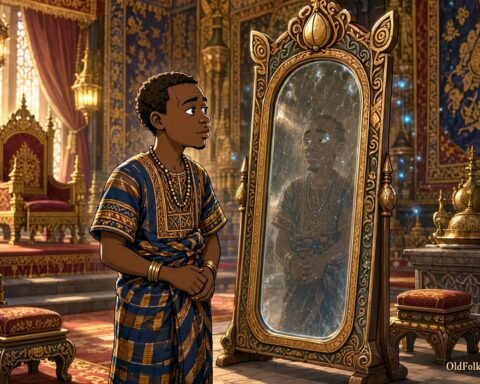
Amadou realized the loom was revealing the village’s hidden fears and secrets. He paused, thinking deeply. The cloth was a mirror not just of the village but of himself.
The next day, Baaka returned. “Show me your work.”
Amadou unfolded the cloth. The elders gasped as they saw the woven story. “This is not just cloth,” one whispered. “It is a warning.”
Baaka nodded. “The loom shows truth. What will you do with this knowledge?”
Amadou gathered the villagers. “We must face these fears. The storms, the shadows—they are real dangers. But united, we can protect our home.”
The villagers worked together, repairing homes, planting new trees, and guarding the forests. Each full moon, Amadou wove new cloth, revealing the changing fortunes of the village.
One evening, Amadou’s younger sister, Amina, came to him with a worried face. “Brother, the river is rising. The storms are worse than before.”
Amadou took the enchanted cloth and studied it. The patterns showed a great flood. He rallied the villagers to build barriers and prepare for the worst.
When the rains came, fierce and relentless, the village was ready. The barriers held, and though the floodwaters tested their resolve, they survived.
Baaka returned once more. “You have proven your worth. The loom is yours.”
Amadou bowed. “I am grateful. But the true power is not in the loom alone. It is in the courage and unity of our people.”
Baaka smiled, then vanished into the night, leaving the enchanted loom behind.
From that day, Amadou’s village flourished. The cloth they wove was known far and wide, not just for its beauty but for the stories it told—of hope, wisdom, and the strength found in truth.
✧ Commentary
This folktale from Burkina Faso highlights the power of truth, courage, and community. The enchanted loom symbolizes the ability to see beyond the surface, to confront fears and secrets for the betterment of all. Amadou’s journey teaches that true strength lies not only in skill but in integrity and unity. It also reflects the rich weaving traditions of West Africa, where cloth carries stories and meanings far beyond decoration.
✧ Moral
Facing the truth with courage and working together in unity can overcome even the darkest challenges.
✧ Questions & Answers
1. Q: What does the enchanted loom represent in the story? A: It symbolizes truth and the power to reveal hidden fears and realities.
2. Q: How does Amadou respond to the loom’s revelations? A: He chooses to face the village’s fears and unite the people to prepare for dangers.
3. Q: What lesson does the village learn through Amadou’s leadership? A: That courage and unity can protect and strengthen the community.
4. Q: How is the theme of storytelling reflected in the folktale? A: The cloth woven tells stories and warnings, showing how art preserves culture and wisdom.
5. Q: Why is the tale culturally significant for Burkina Faso? A: Because weaving is a valued traditional craft and the story celebrates the role of community and truth in West African culture.