Long ago, when the Ngbaka people of the Congo still lived close to the great rivers and forests, the water was not only for fishing and drinking. The river was alive, carrying secrets and spirits beneath its surface. Parents taught their children to respect it, for among its creatures lived those who could change the destiny of a person with a single glance.
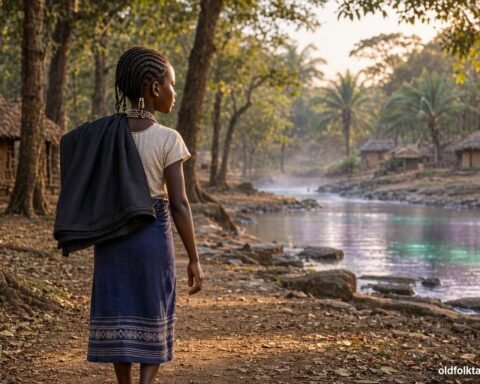
In a small riverside village, there lived a young woman named Balia. She was admired for her beauty and her gentle voice, which rose like birdsong during the evenings when the women pounded grain. Many young men came to her father, asking for her hand in marriage, but Balia refused them all. “I will not choose a husband until my heart is certain,” she told her mother. Her words worried her parents, for they feared she might wait too long.
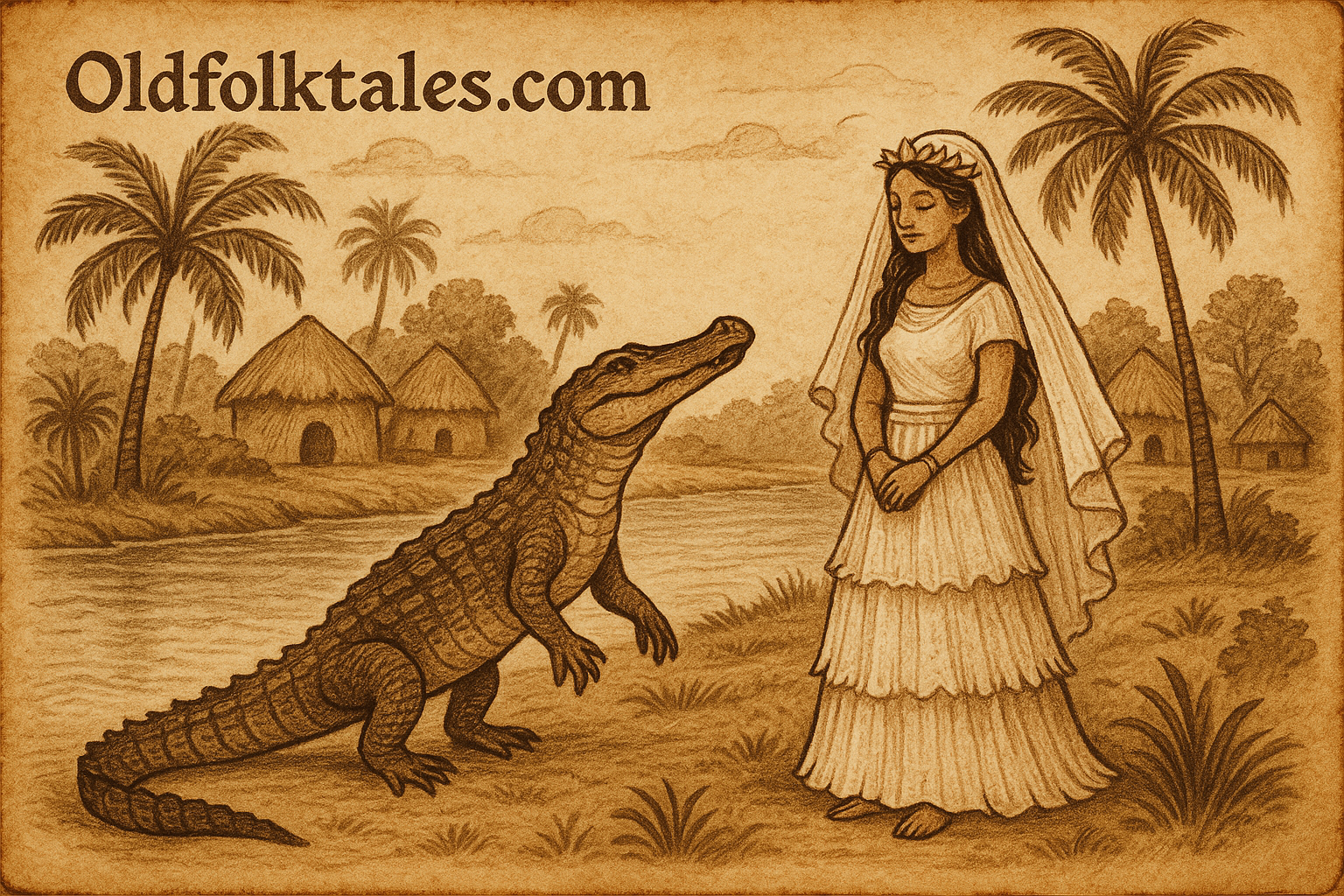
One afternoon, while fetching water at the riverbank, Balia noticed something unusual. A crocodile lay on the far side, watching her with eyes that seemed almost human. Instead of fear, she felt curiosity. Each day, when she came to draw water, the crocodile was there. At first, she said nothing, but as the days passed, she whispered greetings into the wind. “I see you, river one,” she murmured, and the crocodile would lift its head, as if in answer.
One evening, as the sun bled red across the horizon, Balia heard a voice. It was deep, yet gentle. “Do not fear, Balia. I am no ordinary crocodile. I am Nguma, son of the river spirits. I have watched your kindness, your patience, your strength. Come to me, and you shall be my bride.”
Balia’s heart trembled. She ran home, but she could not sleep. That voice returned in her dreams, filling her with both dread and wonder. By the next moon, she confided in her mother. “The crocodile has spoken to me. He says he is Nguma, and he wishes to make me his bride.”
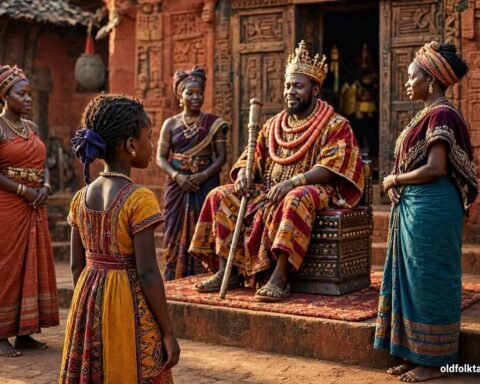
Her mother gasped. “Child, do not speak of such things! A crocodile cannot be your husband.” But her father, an old hunter, grew thoughtful. “We cannot ignore the words of spirits. If the river has chosen her, perhaps it is destiny.”
The village gathered, debating long into the night. Some warned that marrying a spirit would bring curses. Others argued that rejecting him would anger the river. In the end, Balia herself stood and said, “I will go. If Nguma speaks truth, I will be his bride. If he deceives me, the river will know my tears.”
The next day, dressed in beads and cloth, Balia walked to the riverbank. The crocodile emerged, but before the people’s eyes, he transformed. The scales fell away, revealing a tall young man with skin the color of river clay and eyes as bright as water under the moon. The villagers gasped, for Nguma stood not as beast, but as spirit. He took Balia’s hand. “Come with me, and you will see wonders beneath the river.”
Together, they disappeared into the water. Days passed. The people wondered if Balia had drowned, but her father assured them, “She lives, for I dream of her smiling.”
After many moons, Balia returned to the village. She carried gifts: fish that never spoiled, shells that shone like stars, and beads no craftsman could match. “Nguma is kind,” she told her parents. “He cares for me, and in his world beneath the river, I am honored.”
Yet, Balia carried sorrow too. “I may not stay,” she explained, “for my place is with Nguma. But know this: whenever the river gives more fish than you expect, it is my husband’s gift. When the river runs gentle after storms, it is his care for you.” With tears and embraces, she returned to the water, never again to live among mortals.
From then on, the Ngbaka people told their children: respect the river, for it holds more than fish. It holds the power of spirits, and once, it even claimed a bride.
Moral Lesson:
The Crocodile Bride teaches that the natural world is bound with mystery and power, and those who live close to it must show respect. Love and destiny can take unexpected forms, and humility before nature ensures harmony. The story reminds us that the rivers are not just waters to use, but living forces that watch, choose, and sometimes claim their due.
Knowledge Check
- What is the main lesson of The Crocodile Bride folktale?
The story teaches respect for nature and the unseen spirits, showing that destiny and love may appear in mysterious forms. - Why did Balia choose to marry Nguma, the crocodile spirit?
She felt drawn by his voice and presence, and she accepted her destiny as chosen by the river spirits. - How did Nguma reveal his true form to the Ngbaka villagers?
Nguma shed his crocodile skin and appeared as a tall young man with eyes bright as moonlit water. - What gifts did Balia bring back from the Spirit River?
She brought fish that never spoiled, shining shells, and beads more beautiful than any made by human hands. - How did the Ngbaka people interpret Balia’s fate in the folktale?
They understood it as a reminder that the river is sacred and must always be respected, for it holds powerful spirits. - What cultural values of the Ngbaka people are reflected in The Crocodile Bride?
The tale reflects values of respect for spirits, acceptance of destiny, reverence for natural forces, and harmony between humans and the river.
Cultural Origin: Ngbaka folktales, Democratic Republic of Congo