Long ago, before the towns of Tizi Ouzou and Bejaia stretched wide with houses and roads, the Kabylie Mountains stood tall and proud, clothed in pine, olive, and almond trees. The people who lived there told stories that carried the breath of their ancestors, for in Kabyle tradition, the mountains are not silent. They are alive, watching, and remembering.
This is the tale of The Singing Stones of Kabylie, a Kabyle folktale whispered by elders beside the fire, with children listening, wide-eyed and trembling at the thought of stones that could sing.
The Village of Aït Irhil
In the village of Aït Irhil, a small Kabyle settlement clung to the mountainside. Life was not easy. The land was rocky, and the winters were cold, but the people were proud and resilient. Among them lived a young shepherd named Amir, whose heart was full of songs but whose voice was often silenced by fear.
Amir was unlike the other boys who wrestled and laughed loudly. He was quiet, often walking alone with his sheep, humming melodies he never dared to sing in front of others. His grandmother, Tazrart, used to tell him, “Amir, the mountains hear even the songs you hide. Do not be afraid. Every voice has its place under the sun.” But Amir did not believe her.
The Hidden Stones
One summer evening, as Amir led his flock higher than usual, the sun slipped behind the ridges, painting the sky in fire. He rested near a cliff where the wind carried strange sounds. At first he thought it was the whistling of the breeze through the rocks, but soon he realized it was not wind at all. It was singing.
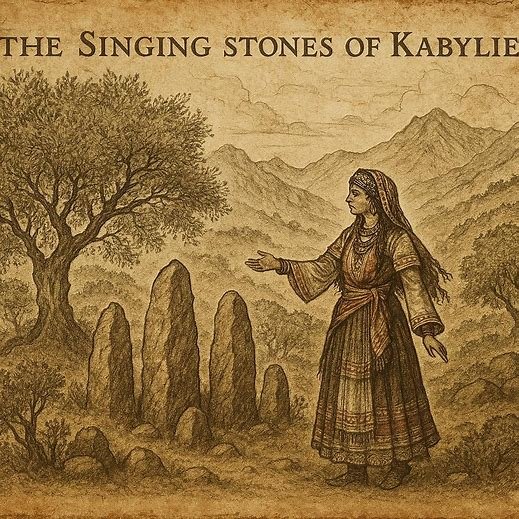
The voice rose and fell like a flute, weaving words he could not understand but felt deep in his heart. Startled, Amir looked around. Then he saw them: three stones, large and ancient, half-buried in the earth, glowing faintly as if holding the light of the setting sun.
Amir knelt and placed his ear close. The stones sang stories of long-forgotten battles, of women grinding grain by the river, of children laughing among olive groves, and of ancestors who once roamed the valleys.
Terrified, Amir ran home. When he told his grandmother, Tazrart’s eyes widened, and she whispered, “The mountain has chosen you. Those are the Singing Stones. They hold the voices of our forefathers. Few are granted the gift of hearing them.”
The Test of Courage
Days passed, and Amir could not sleep. The songs haunted him. He longed to return but feared what he might discover. At last, his grandmother urged him, “Do not fear the gift. Fear only silence. The mountains have trusted you. Go back.”
Amir returned to the cliff. The stones welcomed him with their voices, louder this time. Suddenly, they spoke in words he understood:
“Sing with us.”
Amir’s heart pounded. His throat tightened, and shame rose in him. “I cannot,” he whispered. “My voice is weak.”
The stones replied, “The strength of a song is not in its power but in its truth. Give us your truth, and we will carry it.”
With trembling lips, Amir began to sing. At first, his voice cracked like a broken reed, but as the stones echoed him, the sound grew rich and deep, rising into the sky. His song flowed with the spirit of the mountains.
That night, villagers in Aït Irhil heard a melody floating down the valleys. Some thought it was the wind, others a spirit, but Amir knew the truth: his voice had joined the eternal choir of the mountains.
The Greedy Chief
News of the Singing Stones spread. The village chief, Aderfi, a man greedy for power, grew envious. He thought, If I control the stones, I will control the hearts of the people.
He sent men to seize the stones and bring them to the village square. But when they tried to move them, the earth shook, and the stones wailed like mourners. A storm swept across the mountains, and the men fled in terror.
That night, the chief dreamed of an old spirit wrapped in white wool. The spirit said, “The stones are not for chains or crowns. They belong to those who listen with humility, not those who command with greed.”
When Aderfi awoke, he trembled and dared not touch the stones again.
The Legacy of the Song
From that day, Amir visited the stones often. He sang with them, learning the songs of his people’s past. With time, he grew confident and began to share those songs in the village. His voice, once hidden, became a gift that reminded the Kabyle people of who they were and where they came from.
Amir never claimed the songs as his own. He always said, “It is the mountains who sing. I am only their echo.”
And so, the tale of The Singing Stones of Kabylie lived on, reminding generations that voices, no matter how small, carry the power of memory, identity, and truth.
Moral Lesson
The Kabyle folktale teaches that the mountains remember, and so should we. Every person carries a voice, and no voice is too weak when it speaks the truth. Pride silences, but humility awakens the echoes of history. To listen is to honor, and to sing is to keep the spirit of a people alive.
Knowledge Check
1. What is the Kabyle folktale of The Singing Stones of Kabylie about?
The folktale tells the story of a young shepherd named Amir who discovers magical stones that sing the voices of ancestors in the Kabylie Mountains of Algeria.
2. Who are the Kabyle people in Algerian folklore?
The Kabyle are a Berber-speaking people from the Kabylie Mountains of northern Algeria, known for their strong oral tradition, music, and storytelling.
3. What lesson does The Singing Stones of Kabylie teach?
The Kabyle folktale teaches that every voice has value, truth carries power, and humility allows one to connect with ancestral wisdom.
4. Why are the Singing Stones important in Kabyle folklore?
The Singing Stones symbolize the memory of ancestors, the spirit of the mountains, and the importance of preserving cultural identity through oral tradition.
5. What role does Amir play in the Kabyle folktale?
Amir is the chosen one who learns to sing with the stones, overcoming fear and becoming the echo of his people’s memory and songs.
6. How does the Kabyle folktale connect to Berber oral tradition?
The folktale reflects Berber oral tradition by preserving history, spirituality, and cultural values through storytelling, song, and symbolic imagery of nature.