Listen, children of the desert wind. Listen to the whispers that rise from the red sand when the sun walks high. This is the story the dust devils tell, the story the mirages remember…
In the time when the desert was younger but no less wise, there lived among the ǀXam people a hunter called Xabbu-taa, He-Who-Never-Misses. Tall, tall he stood, straight as a shepherd’s tree, with eyes sharp as the morning star and arrows that flew true as the wind’s breath. Pride lived in his chest like a second heart, beating strong and loud.
Xabbu-taa, could track the smallest springbok across the hardest ground. He could find water where others saw only stones. He could read the desert’s face like his own mother’s stories, knowing where the game would run before, they knew it themselves. The people praised him, the children followed him, the maidens watched him with bright eyes.
But pride, pride is a hungry thing. It eats and eats and is never full.
“There is no hunter like me,” Xabbu-taa, would boast when the fires burned low and the stories began. “I have outwitted the cunning jackal, outrun the swift antelope. Show me the creature I cannot catch, and I will prove you wrong.”
The old ones, the wise ones who had seen many seasons, would shake their heads and make the warning sounds deep in their throats. “Pride walks before the fall,” they would murmur. “The desert teaches humility to all who live upon her face.”
But Xabbu-taa, laughed at their warnings. What did old ones know? Their eyes were dim, their arrows shook. He was young, he was strong, he was the greatest hunter who had ever walked beneath the burning sky.
Then came the day when the sun stood highest, when the heat shimmered like water above the red earth. Xabbu-taa, had been hunting since before dawn, following a great kudu bull whose tracks spoke of meat enough to feed the whole band. But the tracks had grown strange, doubling back, crossing themselves, leading in circles that made no sense.
Frustrated, angry, Xabbu-taa, stood in the blazing noon and looked around for sign of his quarry. And there, there on the ground beside him, he saw movement a dark shape that moved when he moved, stopped when he stopped.
“Aha!” he cried. “So this is the creature that mocks me! This shadow-thing that copies my every step!”
Now, children of the listening wind, you know what Xabbu-taa, saw. You know the dark companion that follows every person beneath the sun. But the heat, the frustration, the pride burning in his chest like desert fire these things had clouded his hunter’s wisdom. In his anger, he saw not his own shadow but some clever animal that dared to mock the greatest hunter of the ǀXam.
“You think to escape me?” Xabbu-taa, shouted at his shadow. “You think your mimicking will save you? I am Xabbu-taa, I have never failed to catch what I pursue!”
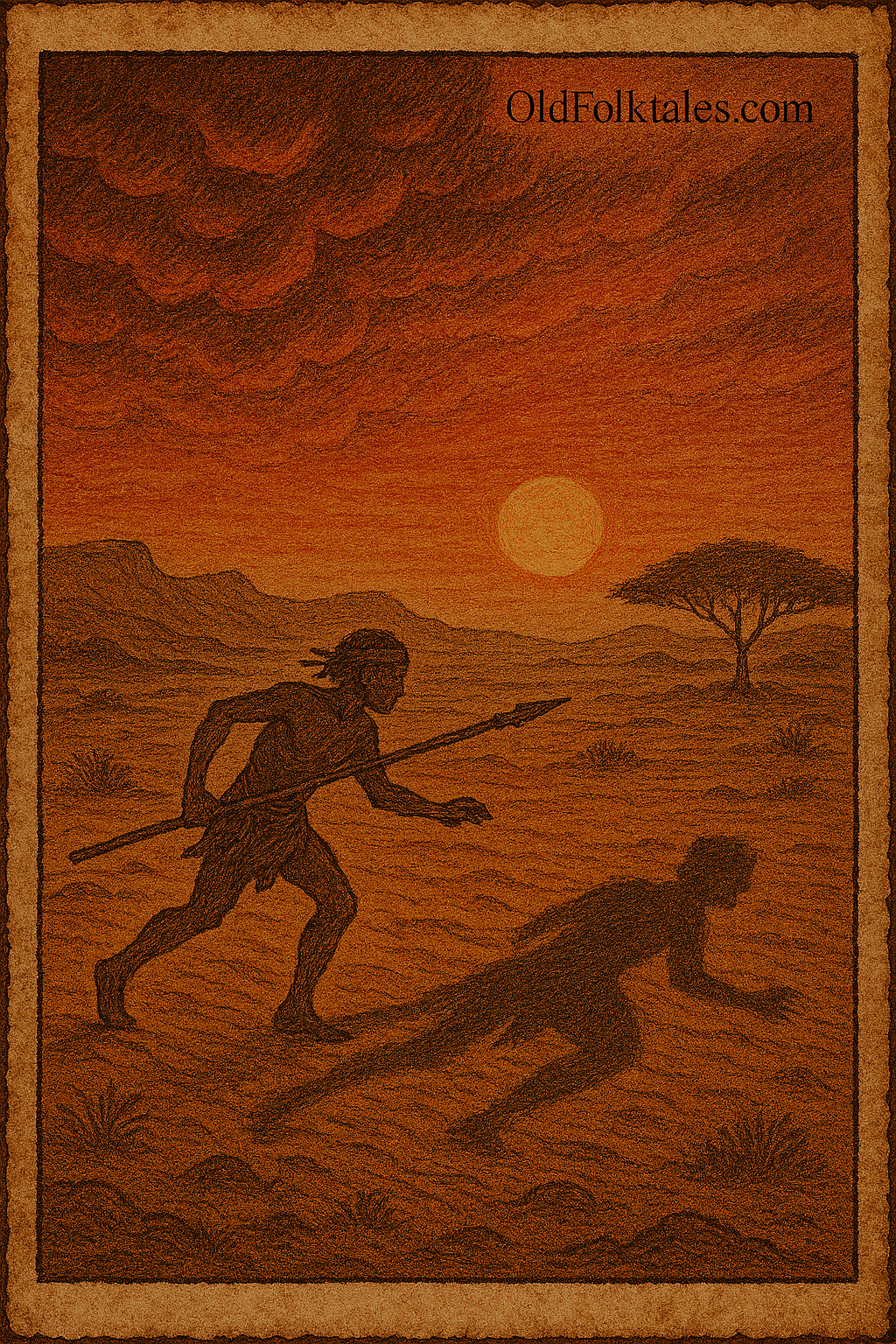
He notched an arrow to his bow and shot at the shadow. The arrow passed through and stuck quivering in the sand. The shadow remained, still copying his every movement.
“Clever creature!” he snarled. “But I will not be defeated!”
And so began the strangest hunt in all the desert’s memory. Xabbu-taa, chased his shadow across the burning sands, shooting arrow after arrow, casting spear after spear. But no matter how fast he ran, how cleverly he moved, the shadow stayed always the same distance ahead or was it behind? just beyond his reach.
The sun wheeled overhead like a great burning eye. The heat waves danced and shimmered, making the world bend and twist like water. Still Xabbu-taa ran, his breath coming in short gasps, his proud stride becoming a stumbling stagger.
“Stand still!” he cried to his shadow. “Face me like a true creature of the desert!”
But the shadow only danced and flickered, sometimes long, sometimes short, sometimes seeming to split into many shadows that scattered like startled birds before coming together again.
Other hunters, searching for Xabbu-taa when he failed to return, found his tracks wandering in great circles and spirals across the desert floor. They found his arrows scattered in the sand, his spears thrown at empty ground. They called his name until their voices were raw as the desert wind but heard no answer.
Some say they saw him still running in the distance, a small figure chasing something they could not see, growing smaller and smaller until he was just a speck against the red horizon. Others say he simply vanished like morning mist when the sun grows strong.
The wise ones, the old grandmothers who read the signs in sand and sky, they knew what had happened. “He chased himself,” they said sadly. “He ran from his own nature until there was nothing left to run from, nothing left to chase.”
Days passed, seasons turned. The desert winds covered Xabbu-taa’s tracks, filled in his footprints, scattered his arrows until they were just splinters of wood and bone returning to the earth. But sometimes, when the sun stands highest and the heat makes the air dance like spirits, travelers say they can still see him—a shadow figure running across the empty places, chasing something that is always just beyond his grasp.
The people learned to speak his name carefully, with respect and warning. “Do not be like Xabbu-taa,” the mothers would tell their sons. “Do not chase what cannot be caught. Do not hunt what lives within yourself.”
And the hunters, when they felt pride swelling in their chests like flood-water in a dry riverbed, would remember the shadow-chaser and humble themselves before the desert’s wisdom. They learned to honor their shadows, to walk in harmony with the dark companions that follow every soul beneath the sun.
For the shadow is not the enemy it is the part of ourselves we must acknowledge, accept, and understand. To run from it is to run from truth. To chase it is to chase emptiness. To fight it is to fight the very ground on which we stand.
Even now, when the wind whispers across the red dunes and the heat makes strange shapes in the shimmering air, the desert remembers Xabbu-taa’s lesson. And those who are wise listen to the whispers, honor their shadows, and walk in the balance between light and dark, between pride and humility, between the hunter and the hunted within us all.
This is the story as the desert told it to me, as it tells it still to those who have ears to hear. May you carry its wisdom like cool water in the burning places of your journey.
Moral lesson
The tale of Xabbu-taa serves as a profound meditation on the dangers of losing touch with our essential nature and the critical importance of self-awareness in navigating life’s challenges. The hunter’s tragic pursuit of his own shadow represents the destructive cycle that begins when pride blinds us to fundamental truths about ourselves and our place in the world.
The story reveals how excessive pride can distort our perception of reality so severely that we fail to recognize even the most basic aspects of our own existence. Xabbu-taa’s inability to identify his shadow something every person encounters daily demonstrates how arrogance can create a disconnect from the natural world and from our own authentic selves. When we become so consumed with our supposed superiority, we lose the capacity for the simple observation and humility that keep us grounded in reality.
The futility of the shadow chase serves as a powerful metaphor for the impossibility of escaping or conquering aspects of ourselves through external action. Just as the shadow is inseparable from the person who casts it, our inner nature including our flaws, limitations, and darker impulses cannot be defeated through aggressive pursuit or denial. The story teaches that attempting to “hunt down” parts of ourselves we dislike, or fear only leads to exhaustion, confusion, and ultimately, self-destruction.
The tale emphasizes the wisdom of acceptance and integration rather than conflict with our complete selves. The shadow in psychology represents not evil, but the unconscious or rejected aspects of personality. Xabbu-taa’s fate warns us that ignoring or fighting these aspects leads to becoming lost in cycles of futile struggle. True maturity comes from acknowledging our shadows, understanding their role in our lives, and finding healthy ways to integrate rather than eliminate them.
Finally, the story underscores the importance of heeding the wisdom of elders and community. The old ones recognized the dangers of Xabbu-taa’s pride and tried to warn him, but his arrogance prevented him from listening. This teaches us that genuine strength includes the humility to accept guidance from those who have traveled the path before us, and that isolation from community wisdom leaves us vulnerable to the very delusions that destroyed the shadow chaser. True self-awareness flourishes not in prideful isolation, but in humble connection with others who can reflect our blind spots back to us with compassion.
Knowledge Check
Q1: How do San folktales use shadows and desert imagery to convey psychological truths? A: San folktales masterfully employ shadows as symbols of the unconscious self and desert imagery to represent psychological landscapes. The vast, disorienting desert mirrors internal confusion, while shadows represent the parts of ourselves we often reject or fail to recognize. Stories like the shadow hunter use the harsh desert environment to externalize internal struggles, teaching that psychological health requires acknowledging and integrating all aspects of the self rather than attempting to escape or destroy them.
Q2: What role does pride play as a cautionary theme in traditional San storytelling? A: Pride appears frequently in San folktales as a dangerous force that separates individuals from community wisdom and natural harmony. Stories typically show how excessive pride leads to isolation, poor judgment, and ultimately self-destruction. The San worldview emphasizes humility as essential for survival in harsh desert conditions, where cooperation and respect for natural limits mean the difference between life and death. Pride tales teach that true strength comes through acknowledging limitations and maintaining connection with others.
Q3: How do San desert mystery stories reflect their understanding of heat mirages and desert psychology? A: San desert mystery stories demonstrate sophisticated understanding of how extreme heat and isolation can affect perception and judgment. Tales often feature characters becoming disoriented by mirages, heat-induced hallucinations, or the psychological strain of desert survival. These stories serve as both entertainment and practical warning, teaching recognition of dangerous mental states that can occur during desert travel and emphasizing the importance of maintaining grounded awareness in challenging conditions.
Q4: What survival wisdom about desert hunting and tracking appears in San folktales? A: San hunting stories encode centuries of practical knowledge about tracking, animal behavior, and desert survival strategies. Tales emphasize reading environmental signs, understanding animal psychology, conserving energy and water, and knowing when to abandon unsuccessful hunts. Stories like the shadow chaser also warn against the dangers of obsessive pursuit that can lead hunters to become lost or exhausted, teaching that successful hunting requires not just skill but wisdom and self-control.
Q5: How do San cautionary tales teach lessons about self-knowledge and community wisdom? A: San cautionary tales consistently emphasize that individual success depends on self-awareness and connection to community knowledge. Stories feature characters who suffer when they ignore elder wisdom, become isolated by pride, or lose touch with their authentic nature. These tales teach that true strength comes from understanding one’s limitations, listening to experienced guidance, and maintaining humble awareness of one’s place within the larger community and natural world.
Q6: What psychological and spiritual meanings do shadows hold in San culture and folklore? A: In San culture, shadows represent the complete self, including aspects that may be hidden or rejected. Unlike Western traditions that often view shadows negatively, San folklore typically treats shadows as natural companions that must be acknowledged and integrated rather than feared or fought. Stories teach that psychological wholeness requires accepting all parts of oneself, including limitations and darker impulses, and that attempting to eliminate rather than understand these aspects leads to internal conflict and spiritual imbalance.