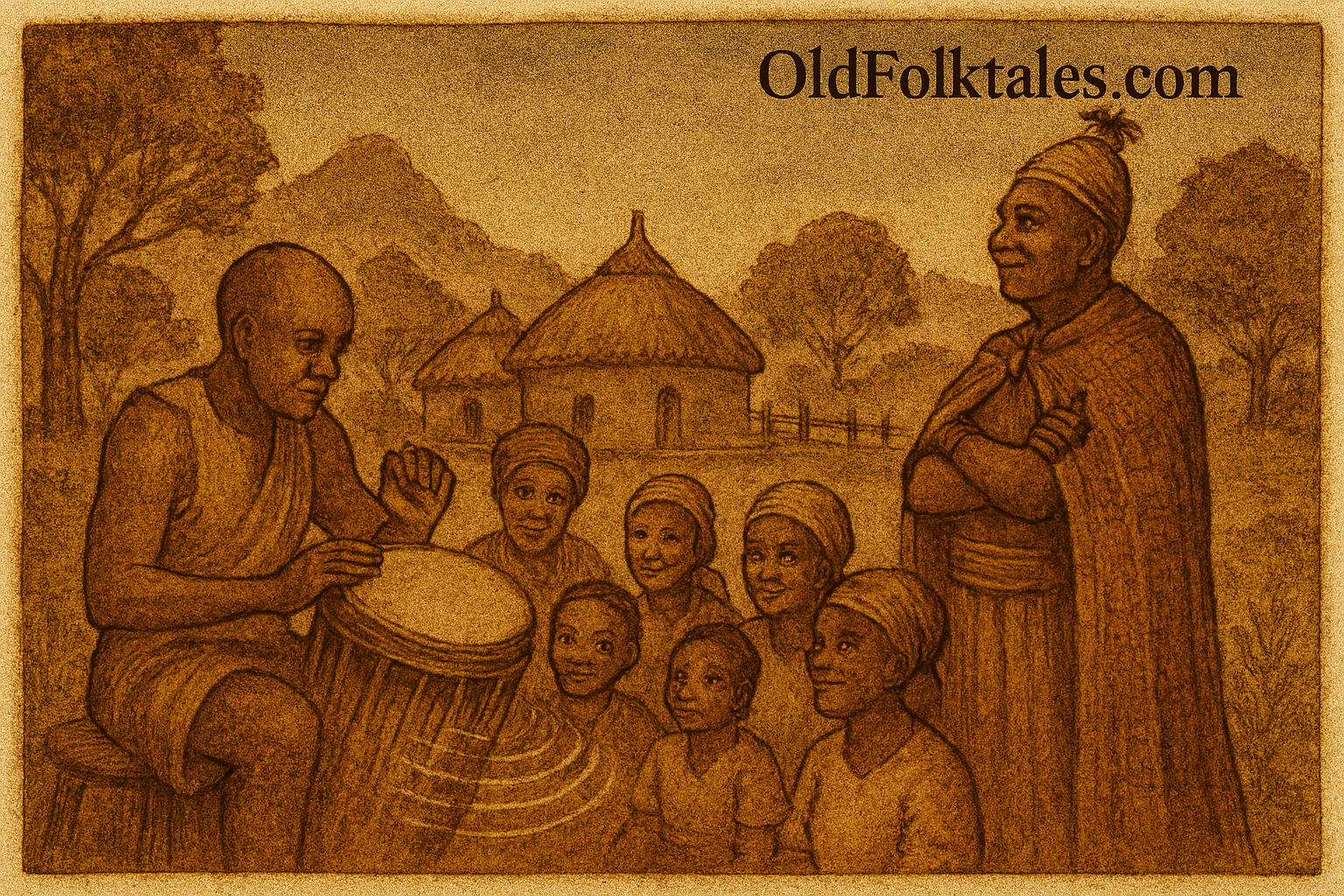
Come close, children of the mountain winds, gather as the evening shadows lengthen across our beloved Maluti. Rest your young hearts like birds upon the branch, for tonight I shall pour into your ears a story that flows from the ancient springs of our people a tale that beats like the heart of the earth itself, steady and true.
Ke nako ea pale, ke nako ea thuto,It is time for the story, it is time for learning, as our fathers’ fathers would say when the cooking fires burned low and wisdom walked among the people.
Long ago, when the world was wrapped in younger shadows and the ancestors’ voices rang clearer in the mountain air, there ruled a chief named Mokhachane in a village where the Caledon River sang its eternal song. This chief was tall as the mountain cedar and strong as the rushing waters, but in his heart grew a tree of pride that cast dark shadows over his people’s joy.
Kgosi e kgolo e sebelisa matla, empa kgosi e bohlale e sebelisa kelello .A great chief uses strength, but a wise chief uses wisdom, whispered the old ones. But Mokhachane’s ears had grown thick with the honey of praise, and he heard only the sweet songs of those who fed his vanity.
In those days, the village possessed three sacred drums, carved from the heartwood of the ancient mohlaka tree and blessed by seven generations of medicine men. These drums, children, were no ordinary instruments, they held within their hollow bellies the spirits of truth itself. When beaten in the sacred rhythms taught by the ancestors, they could speak with voices clearer than mountain streams, revealing secrets hidden in the deepest caves of men’s hearts.
Ngoma e bua ‘nete kamehla The drum speaks truth always, for it knows no fear and holds no favorites among the children of earth.
Now Mokhachane had grown fat on the flattery of his counselors, men whose tongues dripped with false honey while their hearts harbored serpents. They told him he was wise when he was foolish, brave when he was cowardly, and just when he treated his people like cattle to be herded rather than souls to be shepherded.
“My chief,” they would whisper like wind through dry grass, “you are the greatest leader these mountains have ever known. The ancestors themselves must look down from their high places and smile at your wisdom.”
But the people, the people knew differently. They watched their grain stores emptied to feed the chief’s endless feasts while their children’s bellies sang songs of hunger. They saw young men taken from their families to build palaces for a leader who had forgotten that a chief’s strength comes from his people’s love, not their fear.
Motho o jang a le mong, o bolawa ke lengope la hae .One who eats alone is killed by his own greed, muttered the grandmothers as they watched their sons and daughters grow thin while the chief grew round.
One morning, when the sun rose red as warning over the mountain peaks, an old woman named Mathabiso bent with age but straight with courage, came before the chief carrying the three sacred drums. Her voice, though cracked with years, carried the authority of one who had walked with wisdom through many seasons.
“Great Chief,” she said, her words falling like drops of morning dew, “these drums have been silent too long. Let them speak at the next full moon, as was the custom of your noble fathers. Let their voices ring across the village so all may hear the truth they carry.”
Mokhachane, swollen with pride like a river in flood season, laughed with the confidence of one who believes his own lies. “Let the drums speak, old woman. They will surely tell of my greatness, for what truth is there but my wisdom, what justice but my will?”
Lefu le lla pele, empa le se le utloe .Death calls out first, but is not heard, whispered the ancestors, but the chief’s ears were stopped with the wax of his own arrogance.
When the full moon climbed the star-scattered sky like a silver shield, the entire village gathered in the central courtyard. The old woman Mathabiso placed her ancient hands upon the sacred drums and began to beat the rhythm taught by the spirits themselves thum-ba, thum-ba-ba, thum like the heartbeat of the earth mother.
Suddenly, as if lightning had struck the drums, they began to speak with voices that shook the very foundations of the village. Their words rang out clear as mountain streams, impossible to deny or silence:
“This chief take bread from children’s mouths to feed his own belly! This chief sends young fathers to die in wars fought for his glory alone! These chief calls himself father of the people while treating them as his slaves!”
‘Nete e hlaha ka thoko Truth emerges like grass through stone, and so it was that night. The drums spoke of every secret cruelty, every hidden greed, every moment when Mokhachane had chosen his own comfort over his people’s welfare. They told of grain hidden while families starved, of bribes taken while justice was denied, of promises broken like twigs in the wind.
The people listened with hearts both heavy and hopeful, for they heard their own suffering given voice by the spirits themselves. Even Mokhachane’s counselors, those feeders of false praise, hung their heads in shame as their own part in the chief’s tyranny was laid bare.
But the drums were not finished. Their voices rose like the dawn wind, carrying not only condemnation but wisdom:
“A true chief is like the mountain spring he gives life to all who come to him, asking nothing in return but the chance to serve. A true chief is like the sturdy tree he shelters others from the storm while standing firm in the earth of his people’s trust.”
When the drums fell silent, the moon seemed to shine brighter, as if the ancestors themselves smiled at truth finally spoken. Mokhachane sat upon his throne, but now it felt cold as winter stone beneath him. The cheers and flattery he was used to hearing had been replaced by silence deeper than the mountain caves.
From that night forward, everything changed like the seasons turning. The people, emboldened by the drums’ truth-telling, began to speak their own truths. They demanded grain for their children, justice for their grievances, and respect for their dignity as human beings created by the same Modimo who had made their chief.
Mokhachane, stripped of his illusions like a tree losing its leaves in autumn, had to choose: would he remain proud and lose everything, or would he humble himself and learn to truly lead?
Motho yo mo’tona o fela, empa yo mo’nyenyane o phela.The proud person perishes, but the humble one lives, sang the old women as they watched their chief begin the long journey toward wisdom.
And so Mokhachane learned to listen to the drums, to his people, and most importantly, to his own heart. He discovered that true strength comes not from taking what you want, but from giving what others need. He found that real honor comes not from being feared, but from being loved and trusted.
The talking drums still beat in that village when the moon is full, but now they speak words of praise for a chief who learned that the greatest throne is built not from the bones of the conquered, but from the willing service of a grateful people.
The Wisdom of the Ancestors
Thus do the old ones teach us through the voice of story and the beating of sacred drums: Truth cannot be buried forever beneath the soil of lies, no matter how deep we dig or how much earth we pile upon it. Like the first shoots of grass after the long winter, truth will always find a way to push through to the light.
Pride is the great deceiver that whispers sweet poisons in our ears, making us believe we are greater than we are and deserve more than we have earned. But humility is the clear stream that washes our eyes clean, allowing us to see ourselves as we truly are neither gods to be worshipped nor worms to be despised, but human beings with the capacity for both great good and great harm.
The chief who learned to listen to the talking drums discovered what all true leaders must learn: that power is not a treasure to be hoarded but a tool to be used in service of others. When we use our strength to lift up those who have fallen, our wisdom to guide those who are lost, and our resources to feed those who hunger, we become like the mountains themselves strong, enduring, and beloved by all who shelter in our shadow.
Let us therefore listen always for the voice of truth, whether it comes through the beating of drums, the words of honest friends, or the quiet whisper of our own conscience. For in the end, it is better to be humbled by truth and made wise than to be flattered by lies and made foolish.
Knowledge Check
What special power did the sacred drums possess in this Sotho folktale?
The three sacred drums, carved from ancient mohlaka tree wood and blessed by seven generations of medicine men, could speak with voices of truth when beaten in sacred rhythms. They revealed hidden secrets and exposed lies, serving as instruments of divine justice.
How did Chief Mokhachane’s pride manifest in his treatment of his people?
Mokhachane’s pride led him to take grain from starving families to fund lavish feasts, force young fathers into wars for his personal glory, and treat his people like cattle rather than souls to shepherd. He surrounded himself with flattering counselors who fed his ego while his people suffered.
Moral lesson?
Mathabiso, the wise old woman, represents ancestral wisdom and courage. Despite her advanced age, she boldly challenges the corrupt chief by bringing forth the talking drums, demonstrating that truth-telling requires bravery and that wisdom often comes from the most humble sources.
What traditional Sotho proverbs are featured in “The Chief and the Talking Drums”?
The story includes several traditional Sotho proverbs such as “Ngoma e bua ‘nete kamehla” (The drum speaks truth always), “Motho o jang a le mong, o bolawa ke lengope la hae” (One who eats alone is killed by his own greed), and “‘Nete e hlaha ka thoko” (Truth emerges like grass through stone).
How does this folktale teach lessons about leadership and responsibility?
The story teaches that true leadership requires humility, service to others, and listening to one’s people. It contrasts false leadership based on pride and self-serving behavior with authentic leadership that acts like “a mountain spring giving life to all” and “a sturdy tree sheltering others from storms.”
What cultural elements make this an authentic Sotho storytelling experience?
The tale incorporates traditional Sotho elements including mountain imagery from the Maluti range, references to the Caledon River, use of indigenous proverbs, ancestral wisdom, sacred rituals involving drums, and the oral storytelling phrase “Ke nako ea pale, ke nako ea thuto” (It is time for the story, it is time for learning).