Come close, little ones, come gather like tadpoles in the warm shallows! Sit still as the water lily on the calm pond, for tonight I shall tell you why Kwena, the mighty crocodile, no longer basks proudly in the sun but hides his great body in the muddy bottom of our rivers. This is a tale of teeth and tears, of pride that grew too tall and fell too hard.
Kwena e kgolo e nale meno a maholo The big crocodile has big teeth, but as you shall hear, big teeth do not always make for big wisdom!
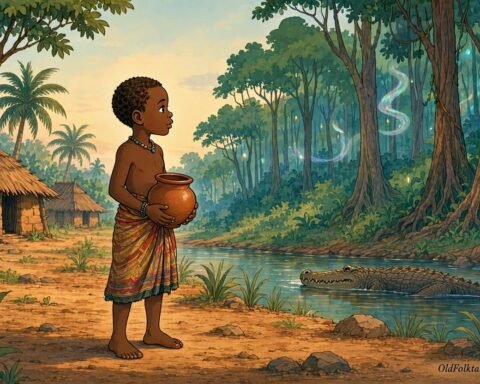
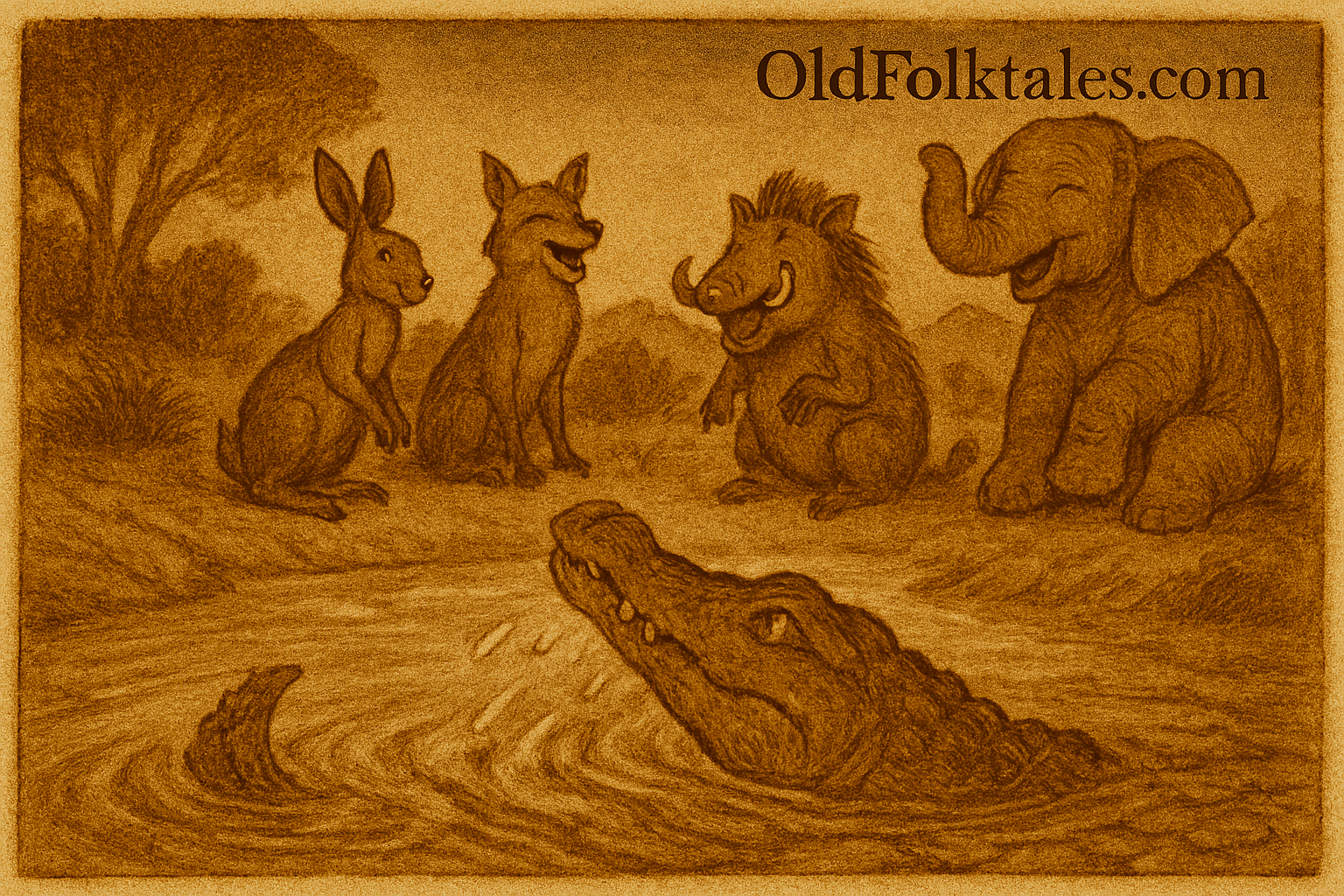
In the time when all animals could speak the same language and the world was still deciding which creatures belonged where, there lived in the great Orange River a crocodile named Kwena who believed himself the most magnificent creature ever created by Modimo’s hands. And indeed, children, he was a sight to behold! His scales gleamed green as new leaves in the morning sun, his teeth flashed white as fresh ivory, and his tail was so powerful it could churn the river into foam with a single sweep.
Botle bo bonolo, empa boinotshi bo boima Beauty is light, but pride is heavy, and Kwena’s pride was growing heavier with each passing season.
Every morning, this vain crocodile would swim to the riverbank and haul his massive body onto the warm rocks where all the animals came to drink. There he would lie, preening and posing, making sure every creature could see his splendid appearance.
“Look upon me, you lesser beasts!” he would call out, his voice booming across the water like thunder. “Have you ever seen such perfect scales? Such magnificent teeth? Such a powerful tail? Surely I am the king of all creatures!”
The other animals would roll their eyes and whisper among themselves, but they dared not speak too loudly, for Kwena’s jaws were indeed fearsome, and his temper was shorter than a dry season.
Motho yo mo galefang o tla galefa One who boasts will eventually be humbled, but Kwena had not yet learned this ancient truth.
Now, among all the creatures who came to drink at the river, there was one who watched Kwena’s daily display with growing irritation. This was Mmutla, the clever hare, whose small size hid a mind sharp as the thorn bush and quick as the desert wind. Mmutla had grown tired of the crocodile’s endless boasting and decided it was time to teach the proud reptile a lesson in humility.
Hlalefi e nyane e ka ruta kgomo e kgolo A small wise one can teach a big fool, and so Mmutla began to plan.
One bright morning, when Kwena was displaying himself as usual on his favorite rock, Mmutla hopped boldly to the water’s edge. This surprised all the animals, for the little hare rarely ventured so close to the dangerous crocodile.
“Great Kwena,” called Mmutla in his sweetest voice, “all the animals are speaking of your beauty, and news of your magnificence has spread even to the distant mountains. But I have heard whispers that there is one creature who claims to be even more beautiful than you!”
Kwena’s yellow eyes flashed with anger and disbelief. “Impossible!” he roared, his tail lashing the water. “No creature in all the world can match my splendor! Who dares to make such a foolish claim?”
Mmutla pretended to hesitate, as if afraid to deliver such terrible news. “Oh, mighty Kwena, I fear to tell you, for it will surely anger you greatly. But there is a creature who lives in the deepest part of the river who says he is more handsome than you. He has scales that shine brighter than yours, teeth whiter than yours, and a tail more powerful than yours. He says,” and here Mmutla’s voice dropped to a dramatic whisper, “he says that you are just an ugly old log pretending to be beautiful!”
Moro o tuka ka sebete sa ona The fool burns by his own strength, and Kwena’s rage burned hotter than the midday sun.
“Where is this impudent creature?” bellowed Kwena, thrashing his great tail so violently that waves splashed all the watching animals. “I will show him who is the most beautiful! I will make him eat his words along with his own teeth!”
“He hides in the deepest pool, just around the bend,” said Mmutla, pointing with his small paw. “But be warned, great one he says he will only reveal himself if you prove your beauty by showing your reflection in the water. He claims your reflection will be so ugly that even you will be ashamed of it!”
This insult was more than proud Kwena could bear. Roaring with fury, he slithered into the water and swam swiftly to the deep pool where the river bent between high banks. There, floating at the surface, he saw what he thought was his rival.
But it was only his own reflection looking back at him from the dark water.
Seipone se bontsha ‘nete The mirror shows the truth, and for the first time, Kwena truly saw himself.
“So!” he snarled at his reflection. “You are the one who dares to challenge my beauty! Look at you with your rough scales and your big ugly teeth! You think you are more handsome than me?”
The reflection, of course, seemed to mouth the same words back at him, which only made Kwena angrier. He snapped his great jaws at the water, trying to bite his supposed rival, but succeeded only in filling his mouth with muddy river water.
Motho yo itsosang o ipuduletsa One who praises himself falls down by himself, and so it was with poor Kwena.
“Fight me, coward!” roared Kwena, thrashing about in the water. “Come out and face me properly! Stop hiding behind your reflection!” He lunged again and again at the image in the water, each time succeeding only in stirring up more mud and making the water cloudier.
Meanwhile, all the animals of the riverbank had followed to watch the spectacle. They saw the mighty crocodile fighting furiously with his own reflection, snapping at empty water, rolling and twisting in the mud he was stirring up. Even the fish swam away to avoid the chaos.
Bohlanya bo bontswa ke litaba Foolishness is revealed by circumstances, and Kwena’s foolishness was on full display.
For hours, the proud crocodile battled his own image, growing more and more exhausted. The clear water became thick brown soup from all his thrashing. His beautiful green scales were now coated with sticky mud. His gleaming teeth were clogged with river weeds and sand.
Finally, old Koko the wise baboon could stand it no longer. “Kwena!” he called from the bank. “What are you doing, you foolish reptile? There is no other crocodile there! You are fighting your own reflection!”
The words hit Kwena like a bolt of lightning. Suddenly he understood the trick that had been played on him. He looked around and saw all the animals watching him some laughing, some shaking their heads in amazement, all seeing him covered in mud and looking ridiculous.
Ditlhong di a bonala, empa bohloko bo ka hara Shame can be seen, but the pain is inside, and Kwena felt both burning within him.
The proud crocodile realized that his vanity had made him the laughingstock of the entire river. His beautiful scales were hidden under thick mud, his magnificent teeth were full of weeds, and his powerful tail was tangled with water plants. Worst of all, every animal had seen him fighting with his own shadow like a mad creature.
Unable to bear the shame and the laughter, Kwena sank beneath the muddy water he had stirred up. “I will never show my face above water again,” he vowed. “Let the mud hide my shame from the world.”
And from that day to this, children, crocodiles have preferred to lie hidden in the mud at the bottom of rivers and pools, showing only their eyes and nostrils above the surface. They learned that pride can make even the mightiest creature look foolish, and that sometimes the safest place is where no one can see you clearly.
Mmutla o ne a re The hare was right when he said that every boaster will eventually meet his match but sometimes, that match is simply their own reflection showing them the truth they refused to see.
The other animals learned their lesson too. They saw that beauty without wisdom is like a flower without roots it looks lovely but cannot last. And they remembered that those who spend all their time praising themselves have little time left for the more important work of living wisely and treating others with respect.
As for clever Mmutla, he went on his way with a satisfied twitch of his whiskers, having taught the river’s most important lesson without lifting a paw in anger. Sometimes, he knew, the best way to defeat pride is simply to let it defeat itself.
The Wisdom of the Ancestors
Thus do the muddy waters teach us, children of the flowing streams, that pride is the quicksand of the spirit it looks solid beneath our feet until we step upon it, and then it swallows us whole. The crocodile who thought himself the most beautiful creature in the world discovered that beauty without humility is like a fire without wood it burns bright for a moment, then turns to cold ash.
When we spend our days looking for praise and admiration, when we believe we are better than others, when we demand that everyone notice how special we are, we become like Kwena fighting his own reflection. We waste our strength battling shadows while real life passes us by. We stir up so much mud with our thrashing that we can no longer see clearly, and we end up hiding from the very world we tried so hard to impress.
True beauty, whether of body or spirit, does not need to shout about itself. Like the mountain that does not boast of its height, like the river that does not brag about its flow, like the stars that do not demand applause for their shining, genuine worth speaks for itself through quiet confidence and kind actions.
Let us remember that the crocodile’s teeth were indeed sharp, his scales truly beautiful, and his strength genuinely impressive. But all these gifts became worthless when wrapped in arrogance and selfishness. Our talents and gifts are meant to serve others and bring joy to the world, not to make us feel superior to our neighbors.
When we feel the dangerous warmth of pride rising in our hearts, let us think of Kwena hiding in his mud, and choose instead the path of gentle humility that keeps us connected to others and grateful for the gifts we have been given.
Knowledge Check
What character flaws led to Kwena the crocodile’s downfall in this Sotho folktale?
Kwena’s excessive pride, vanity, and arrogance caused his downfall. He constantly boasted about his physical beauty, demanded admiration from other animals, and believed himself superior to all other creatures. His inability to see beyond his own ego made him vulnerable to Mmutla’s clever trick and ultimately led to his public humiliation.
How does the clever hare Mmutla use psychology to trick the proud crocodile?
Mmutla exploits Kwena’s vanity by telling him about a supposedly more beautiful rival crocodile. Knowing that Kwena cannot tolerate any challenge to his perceived superiority, the hare manipulates him into fighting his own reflection in the water, turning the crocodile’s pride into the instrument of his own embarrassment.
What does the crocodile’s reaction to fighting his reflection symbolize about self-awareness?
The crocodile fighting his reflection represents how pride blinds us to self-knowledge and truth. Kwena literally cannot recognize himself, symbolizing how arrogant people often lack genuine self-awareness. His battle with his own image shows how pride makes us our own worst enemy, fighting against the very truth we need to accept.
How do traditional Sotho proverbs enhance the moral lessons in this animal tale?
Proverbs like “Botle bo bonolo, empa boinotshi bo boima” (Beauty is light, but pride is heavy) and “Seipone se bontsha ‘nete” (The mirror shows the truth) reinforce the story’s themes through ancestral wisdom. These sayings connect the tale to broader Sotho cultural values about humility and self-knowledge.
What educational value does this folktale provide for teaching children about bullying and social behavior?
The story teaches children that people who constantly boast and put others down often have deep insecurities. It shows how bullying behavior based on feeling superior to others ultimately backfires, and demonstrates that cleverness and patience can be more effective than direct confrontation when dealing with arrogant individuals.
How does this African animal story explain natural behavior while teaching moral lessons?
The tale provides a cultural explanation for why crocodiles hide in muddy river bottoms, using this natural behavior as a metaphor for shame and the consequences of pride. It demonstrates how traditional African storytelling often combines observations of animal behavior with moral instruction, making lessons memorable through connection to the natural world.