In the vast expanse of the African sky, where countless feathered creatures soared and sang their ancient songs, a great debate arose among all the birds of the land. They had observed the world below and above, watching as men lived under the rule of kings and animals followed their chosen leaders. The question burned in their hearts: why should they, the masters of the heavens, remain without a sovereign of their own?
From every corner of the continent, birds of all sizes and colors gathered for this momentous decision. The assembly was magnificent to behold, with wings of every hue catching the golden sunlight as voices rose in animated discussion. Each species put forward their candidate with passionate conviction.
“The Ostrich should be our king!” declared one voice above the chattering crowd. “Look at his magnificent size and stately bearing!”
But immediately came the objection: “No, no! He cannot fly! What use is a king of birds who cannot soar through his own kingdom?”
Another bird called out enthusiastically, “Then surely Eagle, with his tremendous strength and sharp talons, should rule us all!”
“Not Eagle!” came the swift response. “He may be powerful, but he is far too ugly to represent our beautiful kingdom!”
The debate continued with growing fervor. “Vulture can fly higher than any other,” suggested someone from the back of the assembly. “He should be our leader!”
“Vulture?” The crowd recoiled in disgust. “He is filthy beyond measure, and his terrible odor would shame us all!”
“What about Peacock?” piped up another voice. “His plumage is the most beautiful sight in all of creation!”
“But have you seen his feet? And heard his dreadful voice? No, Peacock will not do!”
“Owl, then!” shouted yet another bird. “His great eyes see everything, even in the darkest night!”
“Owl hides from the light like a coward! He cannot be our king!”
The arguments went round and round, each suggestion met with fierce opposition. Hours passed, and still no agreement could be reached. The sun began to sink lower in the sky, and frustration mounted among the assembled multitude.
Finally, one clear voice rose above all the others with a brilliant solution: “Let us settle this matter with a contest! Whoever can fly the highest into the heavens shall be our king!”
The proposal was met with thunderous approval. “Yes! Yes!” they all screamed in unison, their wings beating the air with excitement. This was fair, this was just, this would prove once and for all who deserved to rule the kingdom of the sky.
At the given signal, every bird launched themselves upward with tremendous force. The air filled with the rushing sound of countless wings as they ascended straight toward the blazing sun. It was a spectacular sight, this great migration toward the heavens, with birds of every size and color spiraling upward in their desperate bid for the crown.
One by one, the smaller birds fell back, their strength exhausted. The medium birds followed, gasping in the thin air. Still the mighty Vulture climbed higher and higher, his powerful wings carrying him effortlessly through the atmosphere. For three entire days without pause, he soared straight toward the sun, leaving all others far below.
Finally, his great voice boomed across the sky: “I am the highest! I am king!”
But then, to his amazement, a tiny voice piped up from somewhere above him: “T sie, t sie, t sie! I am the highest! I am king!”
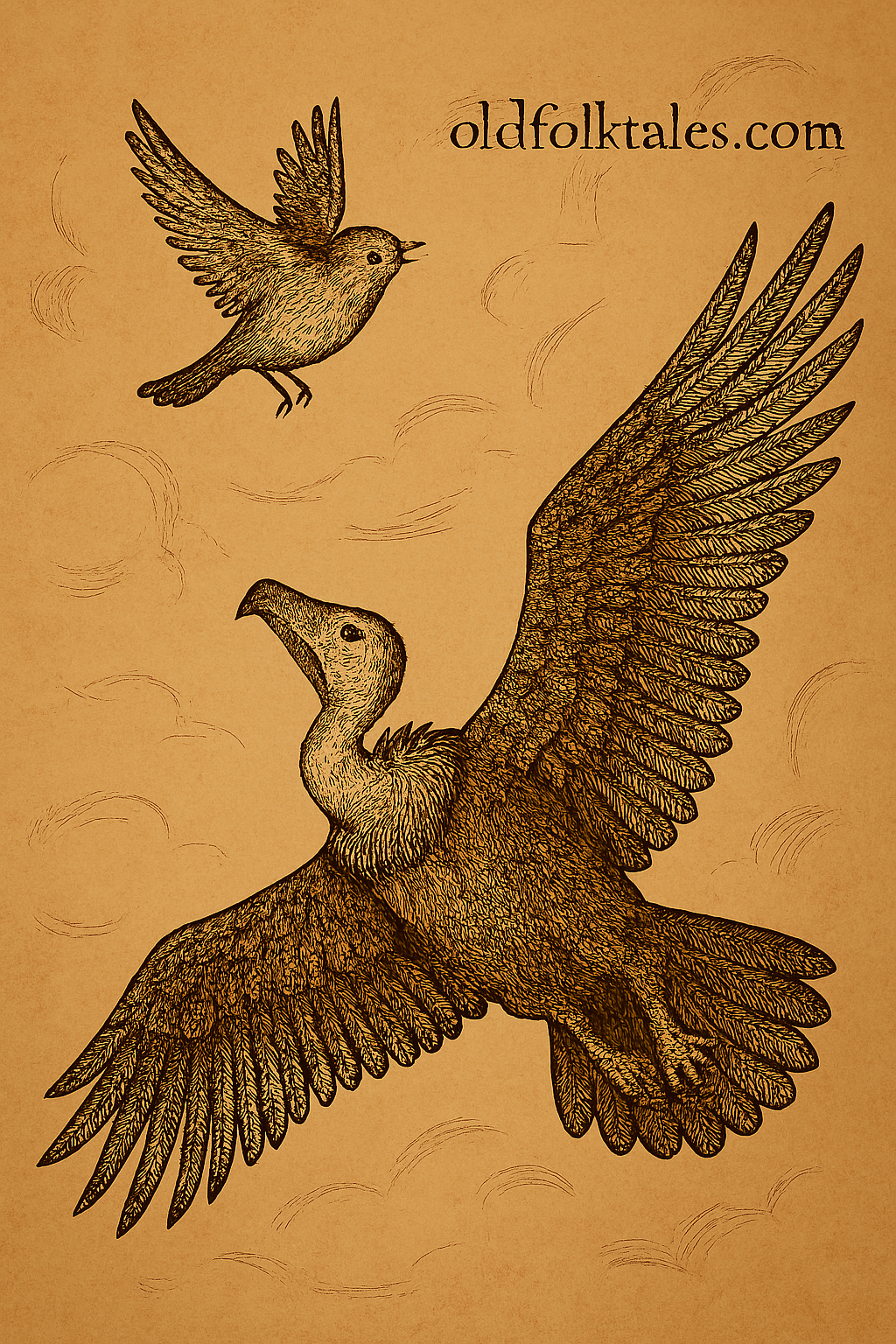
There, fluttering impossibly high above Vulture’s massive form, was little Tink Tinkje. The crafty little bird had secreted himself among the great wing feathers of Vulture at the very start of the contest. So light was he that the mighty bird had never felt his presence, never suspected that he carried a stowaway on his journey to the heavens.
Vulture, determined not to be outdone, summoned his remaining strength and flew even higher for another full day. Again he called out with pride, “I am the highest! I am king!”
And again came that mocking little voice from above: “T sie, t sie, t sie! I am the highest! I am king!”
The tiny Tink Tinkje had simply crept out from under Vulture’s wing and flown a few feet higher, his small size allowing him to soar where the larger bird could not.
On the fifth day, Vulture made one final, desperate attempt, climbing straight up through the thin air until he could barely breathe. “I am the highest! I am king!” he gasped.
But still, that infuriating little voice sang out above him: “T sie, t sie, t sie! I am the highest! I am king!”
Exhausted and defeated, Vulture could climb no more. His great wings carried him in a long, weary glide back toward the earth, where the other birds waited in stunned silence.
When they learned how Tink Tinkje had achieved his victory, their amazement quickly turned to fury. The little bird had cheated! He had used Vulture’s own feathers to gain an unfair advantage! Such trickery could not be allowed to stand!
“Tink Tinkje must die!” they cried in unison, and every bird in the assembly launched themselves after the tiny culprit.
Seeing the angry mob approaching, Tink Tinkje dove toward the ground and squeezed himself into the narrow opening of a mouse hole, where his pursuers could not follow. The birds circled overhead, screeching with frustration.
“How shall we get him out?” they wondered aloud. “We need someone to stand guard and seize him the moment he shows his head!”
“Owl must keep watch,” they decided. “He has the largest eyes of us all, and his sight is keenest. He will not let the little trickster escape!”
Owl puffed himself up with importance and took his position directly in front of the mouse hole, his great yellow eyes fixed on the entrance. But the warm sun beat down on his feathers, and soon he began to feel drowsy. His eyelids grew heavy, and before long, he was fast asleep in the golden afternoon light.
Tink Tinkje cautiously poked his tiny head out of the hole. Seeing his guard slumbering peacefully, he silently slipped out and flew away with barely a whisper of wings.
When the other birds returned to check on their prisoner, they were horrified to find the hole empty and Owl still snoring softly in the sunshine.
“T sie, t sie!” came a familiar mocking call from a nearby tree. There sat the little vagabond, preening his feathers and looking thoroughly pleased with himself.
White Crow, who had been watching this entire shameful episode, was so disgusted with the whole affair that he turned away in absolute silence. “Now I won’t say a single word more!” he declared with finality.
And from that day to this, White Crow has kept his vow of silence. Even if you strike him or threaten him, he makes no sound whatsoever, uttering not the slightest cry. His shame at the birds’ behavior in this great contest has sealed his beak forever.
Moral Lesson
This folktale teaches us that wit and cleverness can triumph over size and strength, but it also warns about the consequences of trickery. While Tink Tinkje’s intelligence helped him win the contest, his deceptive methods ultimately led to conflict and punishment. The story reminds us that true leadership requires not just ability, but also honesty and the respect of those we seek to lead.
Knowledge Check
Q1: Why did the birds want to choose a king in this African folktale? A1: The birds observed that men have kings and animals have leaders, so they decided they should also have a ruler of their own. They wanted to establish a proper hierarchy in their bird kingdom, similar to what they saw in the world of humans and other animals.
Q2: What contest did the birds devise to choose their king? A2: The birds decided that whoever could fly the highest into the sky would become their king. This seemed like a fair test since flying ability was fundamental to being a bird, and height would demonstrate superior strength and capability.
Q3: How did Tink Tinkje manage to fly higher than Vulture? A3: Tink Tinkje secretly hid among Vulture’s wing feathers at the start of the contest. Being so small and light, Vulture never felt his presence. When Vulture reached his maximum height, Tink Tinkje simply flew out from under his wing and soared a bit higher, winning the contest through this clever deception.
Q4: Why did the other birds become angry with Tink Tinkje? A4: The birds were furious because Tink Tinkje had cheated by using Vulture’s feathers to gain an unfair advantage in the flying contest. They felt his victory was illegitimate since he hadn’t actually flown to that height using his own strength and ability.
Q5: What happened to White Crow at the end of the story? A5: White Crow became so disgusted with the entire affair that he declared he would never speak again. From that day forward, he remained completely silent, making no sound even when struck or threatened, maintaining his vow of silence due to his shame over the birds’ behavior.
Q6: What cultural significance does this folktale hold in African storytelling tradition? A6: This African folktale reflects common themes in traditional storytelling about the relationship between cleverness and fairness, the consequences of deception, and how communities deal with leadership challenges. It teaches moral lessons about honesty, the limits of trickery, and the importance of earning respect through legitimate means rather than cunning alone.