In the time when the world was young and the gods still walked closely among mortals, Nyankopon the Almighty found himself weary of the endless responsibilities that came with overseeing all of creation. Day after day, countless prayers and requests reached his divine ears, some for healing, others for prosperity, and many for the life-giving rains that sustained the earth. The burden of managing every small detail of existence had grown heavy upon his shoulders.
In his infinite wisdom, Nyankopon decided to delegate some of his sacred duties to trusted servants. Among these chosen few was Efu, a humble man whose back bore the curved burden of a pronounced hump. To this gentle soul, the Almighty entrusted one of nature’s most vital powers: the ability to summon rain from the heavens. The arrangement was simple yet profound anyone who needed rain need only find Efu and beat upon his hump, and the blessed waters would fall from the sky.
In the rich, fertile lands of an Ashanti kingdom, there lived two farmers whose reputations stretched across the district like the shadows of mighty baobab trees. Kwaku Ananse, the cunning spider, and his dear friend Kwaku Tsin were both blessed with prosperous farms that yielded abundant harvests year after year. The two men shared a friendly rivalry, each striving to earn the coveted title of the finest farmer in all the land. Their fields stretched side by side, creating a patchwork of green that spoke of hard work and divine blessing.
But then came the season of great drought. The sun blazed mercilessly in a cloudless sky, its scorching rays turning once fertile soil into cracked, thirsty earth. Day after day passed without a single drop of rain, and both farmers watched in growing despair as their precious crops began to wither and brown. The leaves that had once stood proud and green now drooped like the wings of dying birds, and the very livelihood of both men hung in the balance.
While Kwaku Ananse paced anxiously through his dying fields, calculating his losses and cursing the stubborn sky, Kwaku Tsin chose a different path. The faithful farmer ventured deep into the sacred forest, where the ancient trees whispered secrets to those who knew how to listen. There, in a quiet grove where dappled sunlight filtered through emerald leaves, he knelt and poured out his heart in fervent prayer to Nyankopon.
His words rose like incense to the heavens, filled with such genuine faith and desperate need that they touched the very heart of the Almighty. Moved by Kwaku Tsin’s sincerity, Nyankopon revealed to him the secret of Efu the hunchback and instructed him to seek out this humble rain maker.
With hope renewed, Kwaku Tsin embarked upon his quest. He searched through village after village, asking every person he met if they had seen the rain maker. Finally, after days of looking, he discovered Efu sitting peacefully on a fallen log in a sun dappled clearing deep in the forest. The hunchback was enjoying a simple meal of sweet pawpaw, the golden fruit dripping with juice as he ate with quiet contentment.
Approaching with the greatest respect, Kwaku Tsin spoke gently: “O Efu the hunchback, Nyankopon the Almighty has revealed to me that within your power lies the blessed gift of rain making. I humbly beg you to allow me to beat upon your back so that my farm might be saved from this terrible drought.”
Efu looked up from his meal with kind eyes and shrugged his curved shoulders. “Since Nyankopon has entrusted me with this sacred task, I cannot refuse your request,” he replied with gentle resignation. “But please, I ask that you do not beat me too harshly, for this work is heavy upon my shoulders, and I have come to this peaceful place to rest my weary bones.”
Kwaku Tsin, grateful beyond measure, gathered two small sticks from the forest floor. In his modesty and consideration for Efu’s comfort, he reasoned that gentle taps would surely bring enough rain for his needs alone. With careful, measured strikes, he tapped Efu’s hump two or three times, offered his heartfelt thanks, and hurried home with anticipation dancing in his heart.
Upon reaching his farm, Kwaku Tsin’s eyes widened in wonder and gratitude. The heavens had indeed opened, blessing his land with a heavy shower that soaked the thirsty soil and brought new life to his drooping plants. The air was sweet with the scent of wet earth, and his crops stood refreshed and green, glistening with precious droplets like emeralds adorned with diamonds. Falling to his knees, he offered prayers of thanksgiving to both Nyankopon and the gentle Efu.
The next morning, as was his custom, Kwaku Ananse set out early for his own fields. His path took him along the border of Kwaku Tsin’s farm, and what he saw there stopped him in his tracks. Where yesterday there had been withering plants and dusty earth, now stretched rows of vibrant, healthy crops that seemed to glow with vitality in the morning light. The contrast was striking and unmistakable, this farm had received abundant rain.
His heart filled with hope, Ananse hurried toward his own land, expecting to find similar blessings. But as he reached the boundary between the two properties, his hopes crumbled like dust. The rain had stopped precisely at the border, leaving his farm as parched and desperate as before. Not a single drop had fallen on his suffering crops.
Puzzled and increasingly anxious, Ananse returned to question his neighbor about this strange phenomenon. At first, Kwaku Tsin hesitated to share his secret, but his kind heart would not allow him to watch his friend’s crops die when help was available. With gentle words, he told Ananse everything, about his prayers to Nyankopon, the revelation of Efu’s power, and his careful, respectful approach to the rainmaker.
Ananse’s eyes gleamed with understanding and something darker, the spark of greed that had always lurked in his spider heart. He thanked his generous friend and immediately set off to find Efu himself. But as he walked, his mind raced with cunning calculations.
“If Kwaku Tsin’s gentle tapping with small sticks brought such abundant rain,” he reasoned to himself, “imagine what I could achieve with truly impressive tools! Why settle for a day’s shower when I could secure weeks of rainfall? My crops will not merely survive, they will flourish beyond all comparison!”
Driven by this greedy vision, Ananse abandoned his original plan to find simple drumsticks. Instead, he sought out two massive clubs, heavy enough to deliver what he considered appropriately powerful blows. Armed with these formidable weapons, he set off in search of Efu with determination burning in his heart.
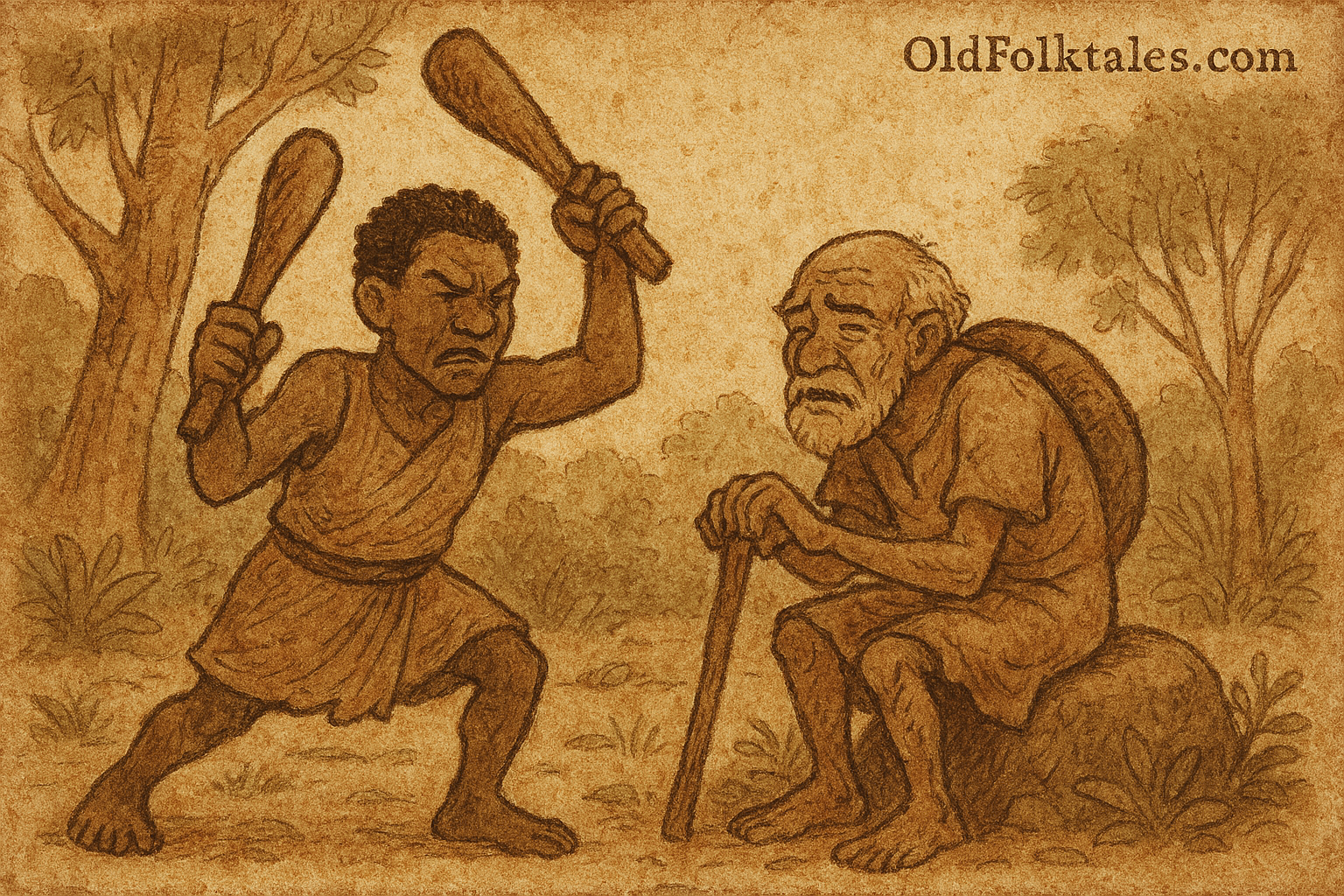
He found the rain-maker walking slowly along a forest path, making his weary way back to his humble dwelling. Without taking time for proper greetings or polite conversation, Ananse rushed forward with his clubs raised high. Before the startled Efu could speak or protest, the spider farmer began raining down powerful blows upon the hunchback’s curved spine.
“Please!” Efu cried out in agony, his voice echoing through the forest. “Have mercy! You’re beating me too hard!”
But Ananse, consumed by his greedy vision of unprecedented rainfall and record-breaking harvests, heard only the promise of greater reward. He continued his brutal assault with increasing violence, the heavy clubs striking again and again until the gentle rain-maker could bear no more.
With a final, heart-wrenching cry, Efu collapsed to the forest floor and lay still. The sacred power that had rested within his humble form departed with his last breath, leaving behind only the tragic consequences of one man’s insatiable greed.
Moral Lesson
This powerful Ashanti folktale serves as a timeless warning about the destructive nature of greed and the importance of moderation. While Kwaku Tsin’s respectful approach and reasonable requests brought him exactly what he needed, Ananse’s excessive greed and violent methods destroyed the very source of the blessing he sought. The story teaches us that divine gifts should be approached with humility and gratitude, and that taking more than we need often results in losing everything.
Knowledge Check
Q1: Why did Nyankopon delegate his rain-making power to Efu in this Ashanti folktale? A1: Nyankopon the Almighty was tired of handling all the day-to-day requests from mankind and his creatures. He decided to delegate some of his divine responsibilities to others, giving Efu the hunchback the specific task of making rain for those who needed it.
Q2: How did Kwaku Tsin learn about Efu’s rain-making ability? A2: Kwaku Tsin went into the forest to pray fervently for rain during the drought. His sincere and heartfelt prayers moved Nyankopon to take pity on him, and the Almighty revealed the secret of Efu the hunchback and instructed him to find and ask for rain.
Q3: What was the difference between how Kwaku Tsin and Kwaku Ananse approached Efu? A3: Kwaku Tsin approached Efu with politeness and respect, used small sticks, and beat the hunchback’s hump gently only two or three times. Kwaku Ananse was impatient and rude, used large heavy clubs, and beat Efu violently and excessively, ultimately killing him.
Q4: What motivated Kwaku Ananse’s violent behavior toward Efu? A4: Ananse was driven by pure greed. He reasoned that if gentle tapping brought Kwaku Tsin one heavy shower, then using large clubs would bring him two or three days of rain, resulting in heavier and better crops. His excessive desire for more led to his destructive actions.
Q5: What role does Nyankopon play in Ashanti spiritual beliefs as shown in this folktale? A5: In this Ashanti folktale, Nyankopon represents the supreme deity who oversees all creation but can delegate divine powers to chosen servants. He responds to sincere prayers and faith, showing both his omnipotence and his compassion for those who approach him with genuine need and respect.
Q6: What does this folktale teach about the consequences of greed in Ashanti culture? A6: The story demonstrates that greed leads to destruction and loss. While moderation and respect brought Kwaku Tsin exactly what he needed, Ananse’s excessive greed not only failed to bring him greater rewards but destroyed the very source of the blessing, leaving everyone worse off than before.