Long ago, when the land was still full of stories, there lived a man named Egya Anansi, known far and wide for his cunning mind. Though he was a skilled farmer, his nature was spoiled by selfishness and greed. He disliked sharing, even with his wife and son, and always sought ways to profit alone from what belonged to all.
One year, Anansi, his wife, and their son decided to plant a farm larger than any they had ever cultivated. Together, they worked tirelessly under the blazing sun, clearing the land, tilling the soil, and planting rows of yams, maize, and beans. Season after season, they weeded and cared for the crops, never neglecting their duties.
When the harvest finally came, their reward was extraordinary. The barns filled to overflowing with golden maize, firm yams, and plump beans. The yield was ten times greater than anything they had known before. His wife and son rejoiced, thanking the spirits of the earth for their good fortune. But Anansi’s eyes gleamed with something darker than gratitude.
Anansi’s Greedy Plan
Though he had worked side by side with his family, Anansi could not bear the thought of sharing the bounty. As he gazed upon the heaps of food, his heart whispered a selfish plan. One evening, he gathered his wife and son. Speaking in a calm, persuasive tone, he said:
“We have all worked exceedingly hard. The fields have given us plenty, and now the harvest is safely stored. Soon we will need rest. I suggest that you and our son return to the village and enjoy two or three weeks of ease. As for me, I must travel to the coast on urgent business. When I return, we shall feast together and enjoy the fruits of our labor.”
His wife, trusting his words, agreed. The son also believed his father’s story. The two packed their things and returned to the village, leaving Anansi behind with his supposed “business.”
But Anansi had no intention of going to the coast. Instead, he built himself a comfortable hut close to the farm, filling it with cooking utensils. From the barn, he carried away large stores of corn, beans, and yams. Every day, he prepared lavish meals for himself, feasting greedily on the harvest that was meant for all three.
The Son’s Discovery
For nearly two weeks, Anansi enjoyed this secret life of gluttony. Meanwhile, back in the village, his son began to grow uneasy. He worried that weeds might overrun the farm if left unattended. Taking his hoe, he set out to weed the fields.
Hours later, while passing by the barn, he peered inside, and froze. Half of their great harvest was gone. His heart pounded. “Robbers must have stolen it!” he thought. Fear and anger gripped him. He rushed back to the village and shared the news.
The villagers were alarmed and eager to help. Together, they devised a clever trap. Using rubber, they crafted the figure of a man. The sticky figure was carried to the farm at nightfall and placed in the middle of the field to scare away thieves. A few of the young men, along with Anansi’s son, hid inside the barn to keep watch.
The Rubber-Man Trap
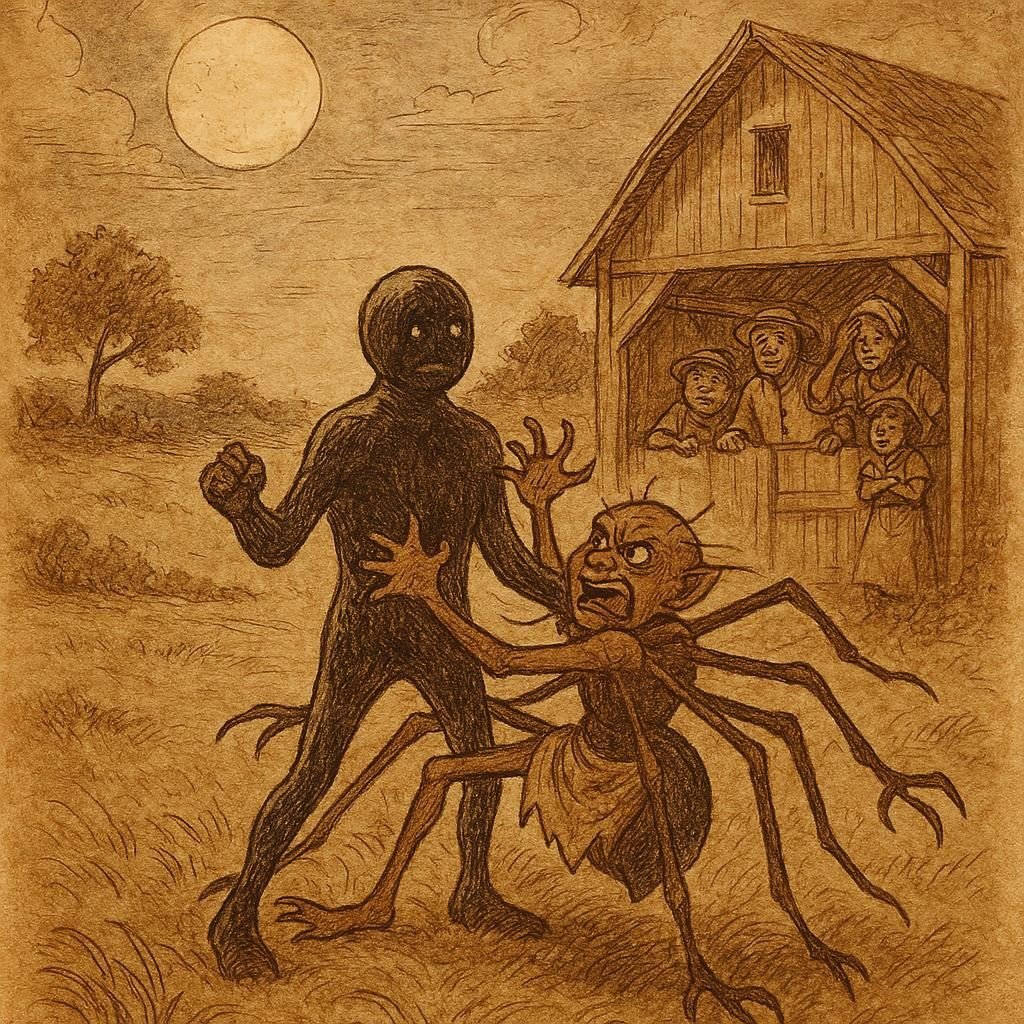
That night, as the moonlight shone faintly on the fields, Egya Anansi crept out of his hut, unaware of the villagers’ plan. Hungry for more, he walked boldly toward the barn. Suddenly, in the shadows, he saw the figure of a man standing silently in the field.
At first, Anansi trembled. “Who dares to block my way?” he muttered. He called out nervously, “What do you want here?” But the figure made no reply.
Growing bolder, he repeated the question. Still no answer.
Anansi’s temper flared. “How dare you ignore me!” he shouted, and in a burst of anger, he struck the figure with his right hand. Instantly, it stuck fast to the sticky surface.
“What? Let go of me at once, or I’ll hit you again!” he cried. He struck with his left hand, only to find it stuck too. Desperate, he tried pushing with his knees, then his body, and finally his head. But the more he struggled, the tighter he clung to the rubber-man. Soon, Anansi was completely trapped, glued in shame to the lifeless figure.
The Morning Shame
At dawn, Anansi’s son and the villagers emerged from the barn. To their shock, the thief was none other than Anansi himself. There he was, stuck helplessly to the rubber-man, his selfish scheme exposed for all to see.
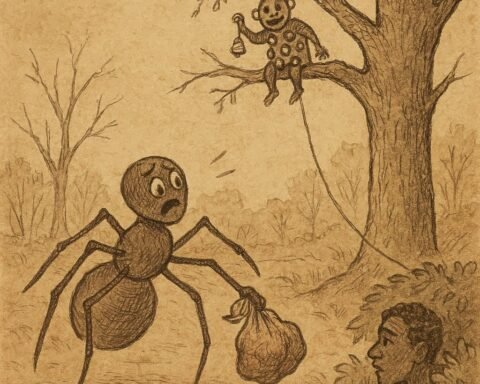
The villagers gasped, and then laughter rang out across the fields. Anansi lowered his head in shame, his pride shattered. Too embarrassed to face his family and neighbors, he felt his body shrink and change. He transformed into a spider and scuttled away, seeking refuge in the darkest, dustiest corner of the ceiling, where no one would notice him again.
And from that day to this, spiders have hidden themselves in ceiling corners, a reminder of Anansi’s shame and greed.
Moral of the Story
Selfishness and greed may bring short-term pleasure, but they always end in shame. Sharing what we have with others brings lasting respect, while hoarding leads to isolation and disgrace.
Knowledge Check
1. Who was Egya Anansi in this folktale?
Egya Anansi was a skilled farmer known for his selfish and greedy nature.
2. What crops did Anansi and his family plant?
They planted yams, maize, and beans, which yielded a rich harvest.
3. How did Anansi trick his wife and son?
He told them he was traveling to the coast on business while secretly feasting near the farm.
4. What was the purpose of the rubber-man in the story?
The rubber-man was a sticky trap created to catch the thief stealing from the barn.
5. Why did Anansi transform into a spider?
He was ashamed of being caught stealing and sought refuge where people would not see him.
6. What is the cultural origin of this folktale?
The story originates from the Ashanti people of Ghana.
Source: Ghanaian Folktale