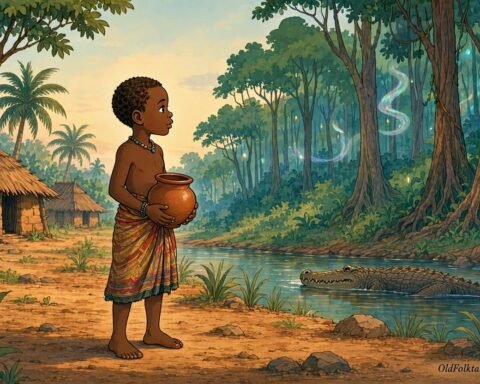
In the fertile highlands of ancient Africa, where the red earth yielded abundant crops and the forests teemed with game, there lived a hardworking farmer who had taken two wives according to the customs of his people. This man was blessed with a son named Kwofi from his first wife, a gentle woman whose heart overflowed with love for her only child. The second wife, though she would later bear many children, remained childless during Kwofi’s early years.
When Kwofi had lived only three short years upon this earth, tragedy struck the household like lightning from a clear sky. His beloved mother fell gravely ill and, despite the efforts of the village healers and their powerful medicines, her spirit departed to join the ancestors. The grieving farmer, left with a young child to raise, made the practical decision to entrust little Kwofi to the care of his second wife, who became his stepmother in both name and duty.
In the years that followed this arrangement, the stepmother’s womb became fruitful, and she bore the farmer many children. Each new arrival brought joy to the household, but also changed the dynamics of the family. Kwofi, as the eldest of all the children, naturally assumed a position of responsibility and leadership among his half siblings, though he remained ever mindful of his place as the stepson rather than the blood child of the woman who now governed the household.
When Kwofi reached the age of ten years, the family faced another devastating loss. His father, the man who had served as the bridge between his old life and his new one, suddenly died, leaving behind a household full of children and a widow struggling to manage alone. With his father’s death, Kwofi found himself completely dependent upon his stepmother’s goodwill, for she was now his only remaining guardian and protector in the world.
As Kwofi grew from childhood into adolescence, his natural talents began to manifest in remarkable ways. He possessed an intelligence that shone like a beacon, grasping lessons and concepts with an ease that amazed the village elders. His physical appearance too was striking, with features so handsome that people would turn to look at him as he passed by. Most impressive of all, he displayed an extraordinary gift for hunting and fishing that surpassed even the skills of men twice his age.
These remarkable qualities, however, became the source of bitter resentment rather than family pride. The stepmother, observing how Kwofi’s abilities far exceeded those of her own biological children, found her heart poisoned by jealousy. Each day, as she watched him return from the forest or river with abundant game or strings of fresh fish, her envy grew deeper and more consuming. Rather than celebrating his success as a blessing for the entire family, she saw it as a threat to her own children’s standing in the community.
This jealousy manifested itself in a cruel daily ritual that became the pattern of their household life. Every evening, when Kwofi returned home with the fruits of his hunting or fishing expeditions, his stepmother would take charge of preparing the meal. She would cook the meat or fish that he had provided with great care, seasoning it with herbs and spices until the aroma filled their compound and drew the family together in hungry anticipation.
When the time came to serve the meal, the stepmother would begin distributing generous portions to each family member. Her own biological children received heaping plates piled high with meat, vegetables, and grain. Even the smallest child among them was given more food than they could possibly consume. But when she reached Kwofi, who had provided the very sustenance they were all enjoying, her manner would change completely.
“Oh, my son Kwofi,” she would say with false regret, though her eyes held no trace of genuine sorrow, “I am so sorry, but there is none left for you! You must go to the field and get some ripe pawpaw for your supper.”
Day after day, this same scene played out with heartbreaking regularity. Kwofi, who had spent long hours tracking game through dense forests or standing patiently by rivers waiting for fish to take his bait, would watch as others feasted on the results of his labor while he was sent away to forage for wild fruit. Not once did he taste the meat or fish he had so skillfully procured. Not once did he receive his fair share of the family meal.
What made this injustice even more remarkable was Kwofi’s response to it. Despite the obvious cruelty and unfairness of his treatment, he never complained or protested. He never raised his voice in anger or demanded the justice that any reasonable person would have expected. Instead, he accepted his stepmother’s words with quiet dignity and made his way to the fields to search for pawpaw fruits, as if this were the natural order of things.
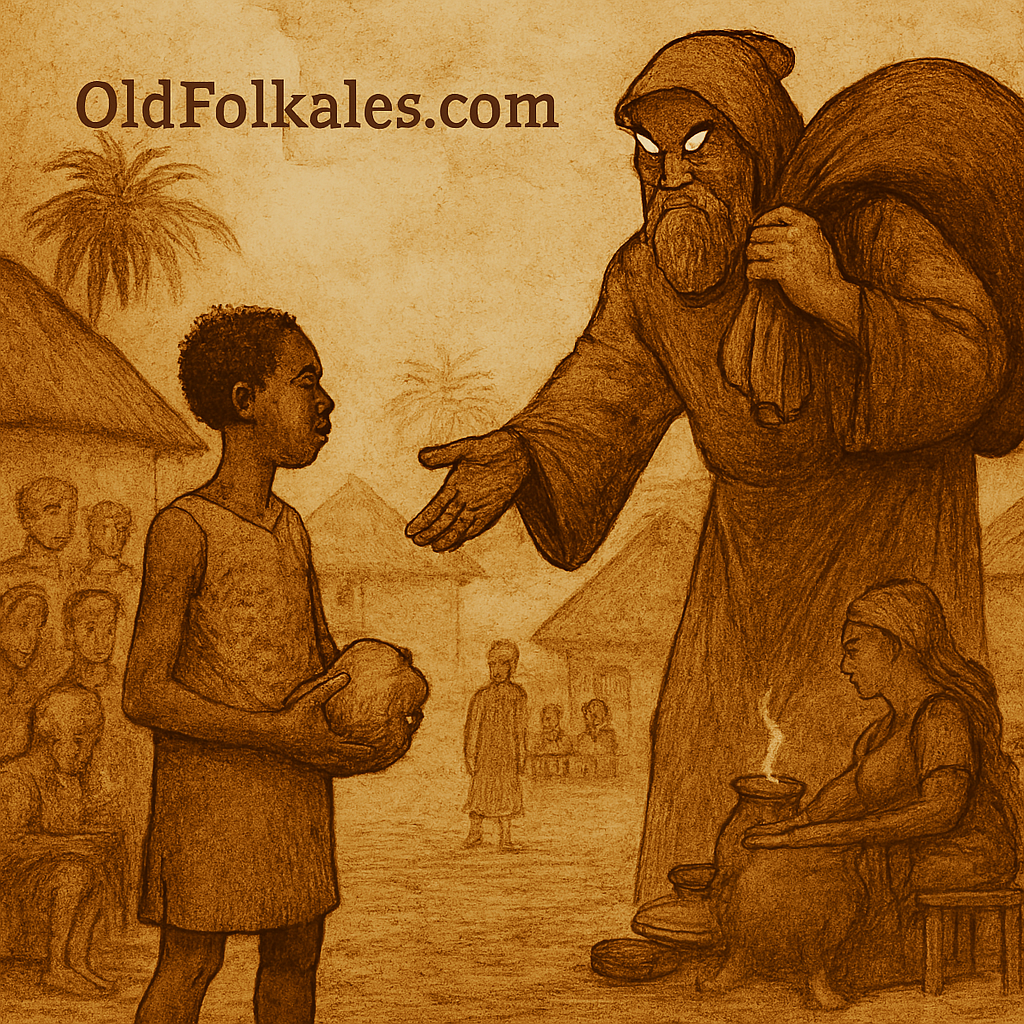
One evening, as this familiar tragedy was unfolding once again and Kwofi was preparing to make his usual journey to forage for fruit, the ordinary rhythm of village life was suddenly interrupted by an extraordinary apparition. A figure appeared in their midst with an presence so commanding that all activity ceased immediately. This was clearly one of the gods, recognizable by the divine aura that surrounded him and the otherworldly power that radiated from his being.
The god carried upon his shoulder an enormous bag, its contents unknown but somehow ominous in their mystery. His voice, when he spoke, carried the authority of divine decree as it echoed through the village compound: “Oh, my villagers, I come with a bag of death for you!”
Terror gripped the hearts of all who heard these words, but before anyone could flee or protest, the god began his work. He reached into his mysterious bag and began distributing its contents among the villagers, moving from person to person with deliberate purpose. No one could escape his attention, no one could hide from his divine judgment.
When the god reached Kwofi, who stood quietly waiting like all the others, his manner suddenly changed. Instead of reaching into his bag of death, he paused and looked directly into the young man’s eyes. His voice, when he spoke, carried not threat but recognition and justice:
“Oh, my son Kwofi, there was never sufficient meat for you, neither is there any death.”
In that moment, divine justice was served in the most complete and final way possible. As the god’s words echoed through the air, every person in the village except Kwofi collapsed and died instantly. The stepmother who had denied him food, the half siblings who had eaten while he went hungry, every villager who had witnessed his mistreatment without intervening, all were claimed by the death that the god had brought.
Only Kwofi remained standing, alive and unharmed, in the sudden silence that had replaced the bustle of village life. The compound that had been filled with the voices and activities of many people now belonged entirely to him. The fields that had fed others while he foraged for scraps were now his to harvest. The position of leadership that should have been his by right as the eldest son was now his by divine decree.
From that day forward, Kwofi ruled over his domain with wisdom and kindness, enjoying the peace and prosperity that had been so long denied to him. His patient endurance of injustice had been witnessed by the gods themselves, and they had delivered a justice more complete and final than any earthly court could have provided.
Moral Lesson
This profound African folktale teaches us that divine justice, though sometimes delayed, is always perfect and complete. Kwofi’s story demonstrates the power of maintaining dignity and kindness in the face of cruel treatment, showing that patient endurance of injustice does not go unnoticed by higher powers. The tale reminds us that those who abuse their positions of power and treat others unfairly will ultimately face consequences, while those who suffer injustice with grace will be rewarded beyond their wildest dreams.
Knowledge Check
Q1: What does Kwofi represent in this African divine justice folktale? A: Kwofi represents the virtuous sufferer who maintains dignity and kindness despite cruel treatment. His character demonstrates how patient endurance of injustice, without bitterness or complaint, attracts divine attention and ultimate reward.
Q2: What role does the stepmother play in this African moral tale? A: The stepmother embodies jealousy, favoritism, and the abuse of power over vulnerable dependents. Her character represents how envy can corrupt natural family bonds and lead to cruel injustice that ultimately brings divine punishment.
Q3: What is the significance of the god’s bag of death in African storytelling traditions? A: The bag of death represents divine judgment and the power of the gods to deliver ultimate justice. In African folklore, such divine interventions often occur when earthly justice fails, showing that higher powers observe human behavior and act accordingly.
Q4: How does this folktale reflect African values about family obligations? A: The story emphasizes that family guardians have sacred duties to treat all children fairly, regardless of blood relationships. The stepmother’s failure to fulfill these obligations represents a violation of cultural values that demands divine correction.
Q5: What does Kwofi’s hunting success symbolize in this African wisdom tale? A: Kwofi’s exceptional hunting and fishing abilities symbolize divine blessing and natural virtue. His success in providing for others, despite receiving no benefit himself, demonstrates the principle that good character attracts prosperity even under adverse circumstances.
Q6: How does this folktale explain the relationship between earthly suffering and divine justice? A: The tale teaches that the gods observe all human interactions and will intervene when injustice becomes unbearable. It shows that patient suffering, when endured with dignity, serves as a call for divine intervention that brings perfect and final justice.