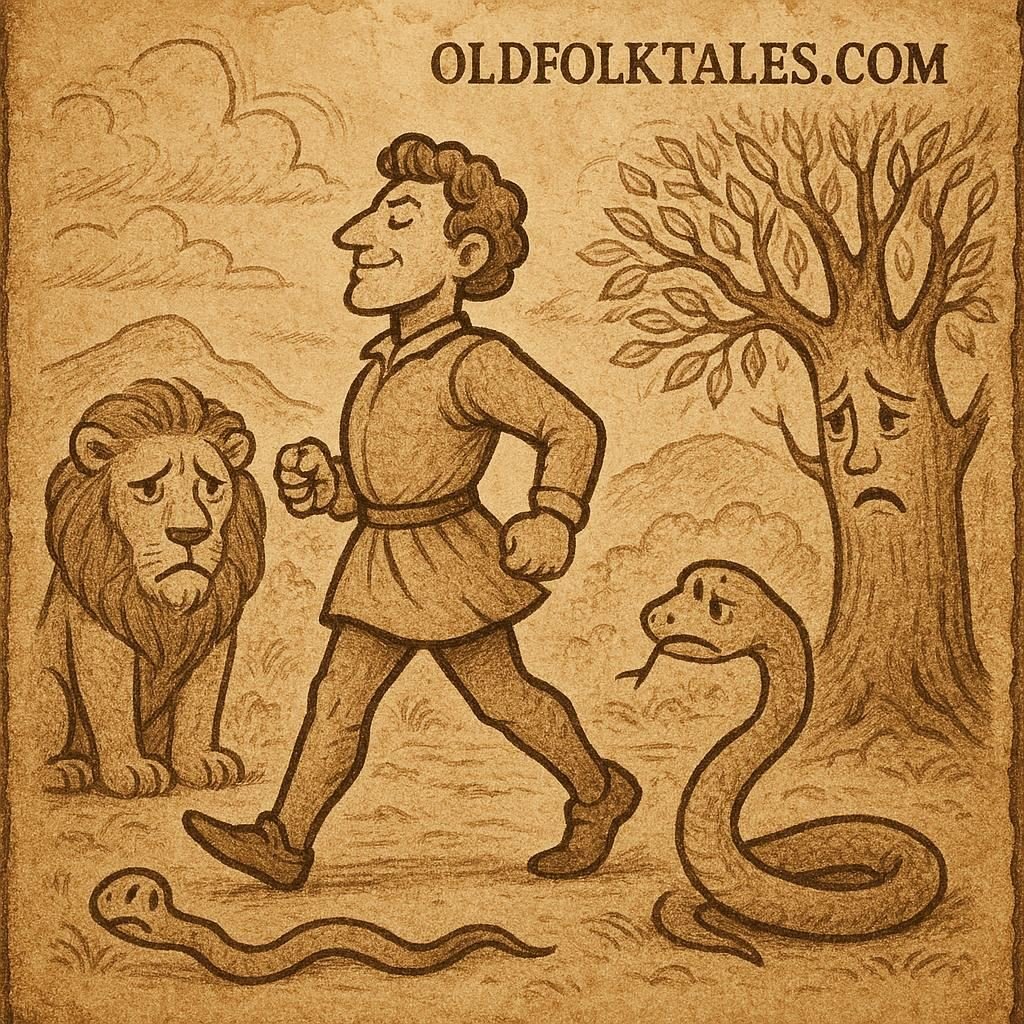
Long ago in the land of the Wolof people of Senegal, there lived a poor hunter who spent most of his days roaming the forest. His bow was worn and his clothes were patched, yet he never lost hope that one day fortune would smile on him. One hot afternoon, when the sun beat down upon the trees and silence hung heavy in the air, the hunter wandered deeper into the forest in search of food. His stomach growled with hunger, but what he found that day was not prey. It was a lesson that would change his life forever.
As he walked carefully through the undergrowth, he came upon a wide pit hidden beneath fallen leaves. From within rose desperate cries for help. The hunter peered inside and saw four trapped creatures: a leopard with eyes like fire, a serpent coiled and hissing, a rat trembling in the corner, and a weary man covered in dust.
“Brother hunter,” the leopard called out, “have mercy and pull me out of this prison. I will never forget your kindness.”
The hunter frowned. “Why should I save you? Leopards have killed my goats and terrorized my village. If I free you, you may turn and tear me apart.”
The serpent lifted his head and spoke with a soft hiss. “Free me, hunter. I too will reward you.”
But the hunter shook his head. “Serpents bite and kill men. I see no wisdom in setting you free.”
The rat squeaked desperately. “Kind hunter, help me! I am small, but I will find a way to repay you.”
The hunter laughed bitterly. “What use is a rat to a man? You gnaw food and ruin clothes. I should leave you here.”
Finally, the man in the pit spoke. “Save me, good hunter. I am a man like you. I can share your burdens.”
The hunter sighed. His heart was tender despite his poverty. At first, he only thought of saving the man, but as the animals pleaded with such desperation, his compassion grew stronger. “Very well,” he said at last, “I will help you all, though I do not trust you.” With great effort, he pulled them out one by one.
The leopard stretched his sleek body and gave a respectful bow. “You will not regret this. I shall feed you with my hunts.” The serpent slid gracefully across the ground and left behind a small bundle of herbs and powders. “This is an antidote against snake poison,” he explained. “Guard it well. If you use it, remember it must be mixed with the blood of a traitor.” The rat scurried away and later returned with a bundle tied in leaves. Inside lay fine woven cloth, pieces of ivory, and gold dust. The hunter was astonished and thanked them all.
Only the man gave nothing. “I am poor,” he said, “but I will stay with you.” The hunter, being generous, allowed him into his home.
With the leopard bringing fresh meat, the serpent’s gift of medicine, and the rat’s treasures, the hunter soon rose from poverty. He built a new house with strong walls and filled it with goods. His neighbors looked on in wonder, for fortune seemed to follow him. Yet the man he had saved grew jealous. Envy festered in his heart until he could bear it no longer.
One day a proclamation echoed across the land. Robbers had stolen jewels and treasures from the king’s palace. Whoever revealed the thief would be richly rewarded. The ungrateful man ran swiftly to the palace. Bowing before the king, he declared, “My master, the hunter, is the thief. I can show you his riches as proof.”
The king, enraged, ordered the hunter arrested. Guards dragged him from his home, ignoring his cries of innocence. In court, the hunter explained, “My wealth came from the gifts of the creatures I saved. I have stolen nothing.” But the judges scoffed. Who would believe such a tale? He was condemned to die at noon the next day.
That morning, as the scaffold was prepared, a messenger burst into the court. The king’s eldest son had been bitten by a serpent and lay dying. Physicians had failed, and the palace was in despair. The hunter stepped forward. “I can cure him, but I will need the antidote I carry, and it must be mixed with the blood of a traitor.”
The king’s eyes narrowed. “There is no greater traitor than the man who betrayed the very host who saved him.” He pointed at the ungrateful man. Without delay, the man was executed, and his blood was given for the remedy. The hunter mixed the powder and applied it to the prince’s wound. Within moments, the young man opened his eyes and breathed freely once more.
The king was overcome with joy. He embraced the hunter, showered him with riches, and declared him a man of honor. From that day forward, the hunter lived not in poverty but in dignity, respected by all. As for the ungrateful man, his memory remained only as a warning to others.
Moral Lesson of The Ungrateful Man
The Wolof folktale of The Ungrateful Man teaches that gratitude is the mark of true character. Kindness, when returned with betrayal, never prospers, for deceit always brings destruction. Yet honest deeds and compassion, even when doubted, are never forgotten by fate. Gratitude builds trust and blessings, while envy and treachery destroy even the closest bonds.
Knowledge Check: The Ungrateful Man
What creatures did the hunter find trapped in the pit in the Wolof story of The Ungrateful Man?
He found a leopard, a serpent, a rat, and a man.Why was the hunter hesitant to free the leopard, serpent, and rat in The Ungrateful Man?
Because he feared the leopard would kill him, the serpent would bite him, and the rat seemed useless.What special gift did the serpent give the hunter in The Ungrateful Man?
The serpent gave him a powerful antidote against snake poison, to be mixed with the blood of a traitor.How did the rat reward the hunter in The Ungrateful Man?
The rat brought him fine cloths, ivory, and gold dust.Why did the ungrateful man betray the hunter in The Ungrateful Man?
He was jealous of the hunter’s wealth and accused him falsely of stealing the king’s treasures.How was the hunter saved from execution in The Ungrateful Man?
He cured the king’s son using the serpent’s antidote mixed with the blood of the traitor, the ungrateful man.Cultural Origin
This folktale comes from the Wolof people of Senegal, West Africa.