In Senegal, the Wolof people have a rich tradition of storytelling that preserves the wisdom of generations. Their folktales are not merely for entertainment; they teach valuable lessons about morality, cunning, and the inevitable consequences of one’s actions. Two of the most compelling Wolof stories, The Wolf and Abdou Dhiabare and The Wolf, the Ox, and the Elephant, reveal the delicate balance between fate, deceit, and justice through vivid animal characters and spiritual forces.
The Wolf and Abdou Dhiabare (Spirit of Death)
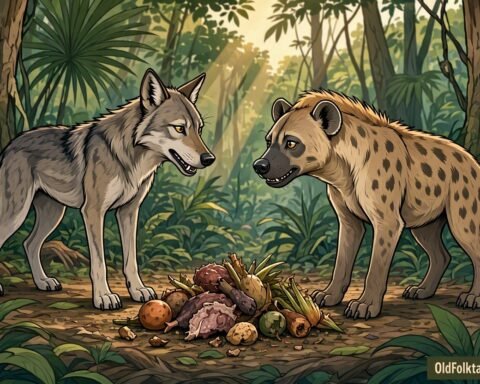
In the quiet, shadowed plains of Senegal, a wolf wandered, weakened by hunger. He had hunted tirelessly but found nothing to eat. His stomach growled, and his body trembled with exhaustion. Then, in a stroke of fortune, he discovered the carcass of a fallen ox. Desperation overcame hesitation, and he tore into the meat, feasting ravenously on the remains of the dead animal.
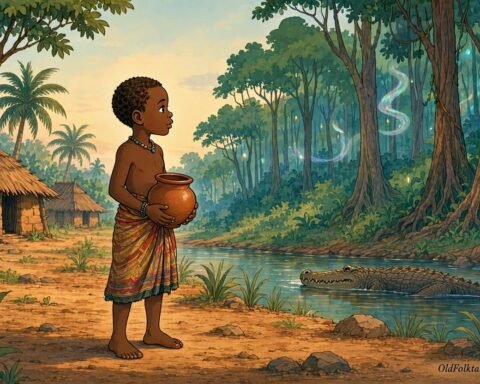
Suddenly, a presence unlike any other appeared. It was Abdou Dhiabare, the Spirit of Death, his form glowing with an otherworldly light. His voice cut through the night like thunder:
“By what right do you steal my property?”
The wolf, terrified, trembled in every limb. Tears streamed down his face as he bowed before the spirit. “Forgive me, great master!” he pleaded.
The Spirit studied him, then spoke with solemn authority:
“I will pardon you, but on one condition. For two years, you may feast on carrion freely. When that time ends, you must come to my kingdom.”
The wolf, relieved, agreed hastily. He thought, Two years is a long time. Perhaps I can escape. Perhaps death will forget me.
Seasons changed. The wolf grew strong again, full of life and cunning, yet he remained unaware that fate cannot be cheated. When the two years passed, he slept peacefully in his den, dreaming of endless hunting. Suddenly, Abdou Dhiabare appeared, shaking the earth with his command:
“Rise, wretch! Gather your things and follow me. Delay, and you will pay dearly.”
The wolf tried to deceive the spirit. “Please, allow me to embrace my wife and children first,” he pleaded, pretending to return to his den. But instead, he bolted into the wilderness, hoping to escape his fate.
The Spirit, however, was more cunning. Transforming into a tiny fly, he pursued the wolf relentlessly. The wolf ran through forests and plains, exhausted by the unyielding sting. Finally, drained beyond strength, he collapsed. His breath ceased, and Abdou Dhiabare claimed him proving that no one can outrun death.
The Wolf, the Ox, and the Elephant
Another story tells of the same wolf, wandering in search of food one dark night, when he fell into a deep pit. He clawed and howled, but escape seemed impossible.
At dawn, an ox passing nearby heard his cries. “In God’s name, help me out!” the wolf begged. “Give me the tip of your tail, so I may climb.”
The ox hesitated. “If I help you, you may betray me and devour me,” he said.
“I swear,” the wolf implored, “I will be grateful forever.”
Trusting the wolf, the ox lowered his tail. The wolf scrambled up and, the moment his paws touched the ground, attempted to attack the ox. At that instant, an elephant appeared, drawn by their commotion.
“Return each of you to your former places, and I will judge fairly,” the elephant commanded.
The wolf, confident in his cunning, leapt back into the pit. The ox walked away, free from danger. The elephant, embodying wisdom and justice, left the wolf to perish where he had fallen, teaching that deceit and treachery will always meet their rightful consequences.
Moral Lesson
These Wolof folktales impart crucial lessons. The first teaches that no creature can escape fate; deceit and delay cannot outrun destiny. The second emphasizes honesty, trust, and the consequences of betrayal. Both stories highlight the Wolof values of justice, wisdom, and respect for spiritual and moral order. Cunning may offer temporary advantage, but ultimately, fairness and integrity prevail.
Knowledge Check
1. Who is Abdou Dhiabare in Wolof folklore?
Abdou Dhiabare is the Spirit of Death, representing the inevitability of mortality in Wolof tradition.
2. What lesson does the wolf’s fate in the first story teach?
It shows that no being can escape death, regardless of cunning or deception.
3. Why did the elephant ask the wolf to return to the pit in the second story?
The elephant wanted to ensure fairness and judge based on the wolf’s honesty and actions.
4. How do these folktales reflect Wolof cultural values?
They emphasize justice, honesty, responsibility, and the consequences of wrongdoing.
5. What traits of the wolf are highlighted?
The wolf is greedy, deceitful, and ungrateful, leading to his downfall.
6. Why are animals used as characters in Wolof folktales?
Animals symbolize human qualities, allowing moral lessons to be taught through engaging storytelling.
Cultural Origin: Wolof people, Senegal