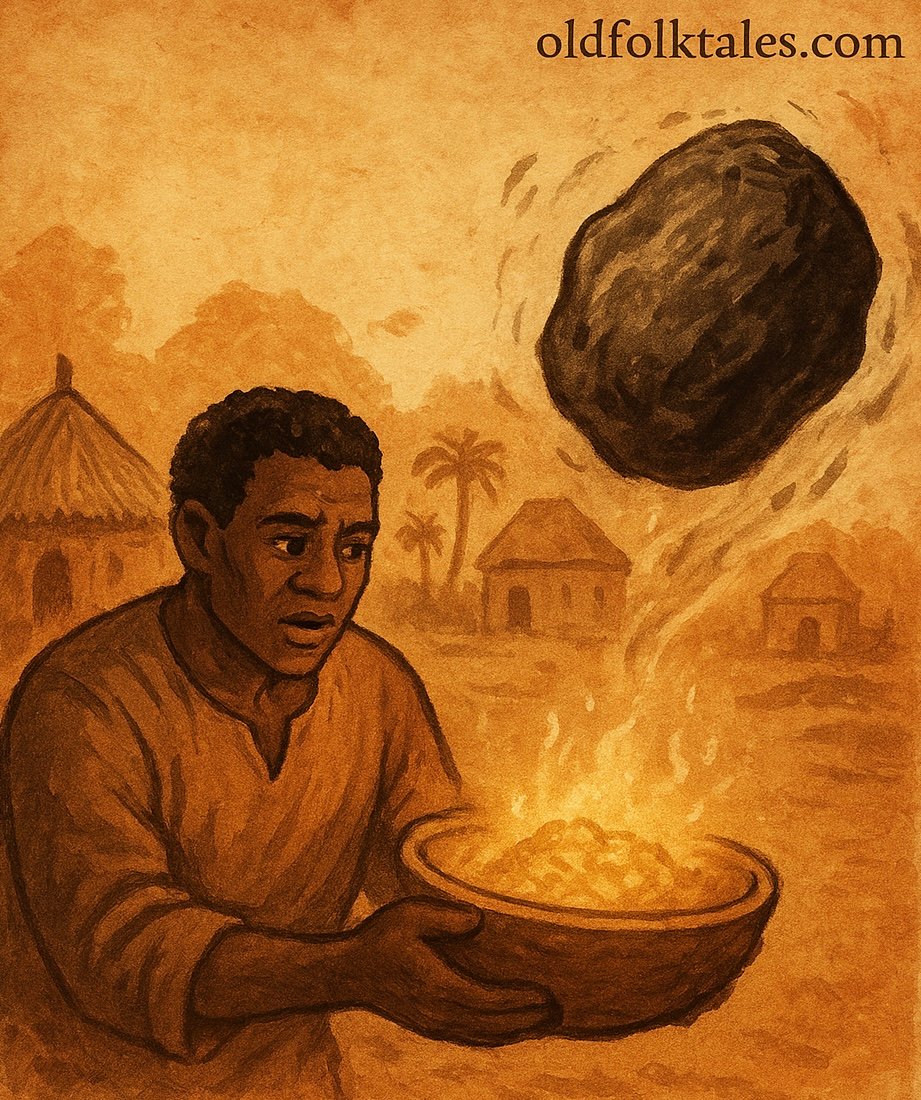
In a small Wolof village in Senegal, hunger once spread like a shadow. The dry season stretched longer than expected, and famine ruled every household. Families grew weaker by the day. Among them was a man named Samba, who could no longer bear to see his wife and children waste away from hunger. One morning, determined to do something, Samba set out for the bush in search of roots, berries, or anything that might keep his family alive.
As he wandered through thorny thickets, his stomach growling with emptiness, he suddenly heard a strange whisper. At first he thought it was the wind rustling in the dry leaves, but then the voice grew clearer. He pushed aside some branches and found, hidden among the thorns, an old wooden bowl.
“Who speaks?” Samba asked, startled.
The bowl shimmered faintly in the sunlight and answered in a voice both gentle and firm. “You are hungry, Samba. I can fill myself with whatever food you desire. All you must do is speak the words.”
Samba’s eyes widened in disbelief. But with nothing to lose, he whispered, “Bowl, be full of bran!”
At once, the bowl filled itself with steaming, fragrant bran mash. Samba dipped his hand in and ate with joy, tears filling his eyes. When he finished, he spoke again. “Bowl, be full of couscous!” And couscous appeared. “Bowl, be full of rice!” And rice came forth, white and plentiful.
Samba fell to his knees in gratitude. This miraculous bowl was a gift from the unseen world, a blessing that could save his family. Carefully, he carried it home, his heart full of relief and hope.
From that day forward, Samba’s household knew no hunger. The bowl provided endlessly, day after day. His children laughed again, his wife sang as she cooked, and their compound overflowed with food and joy. Yet the bowl came with one condition. Samba warned his wife: “This must remain our secret. No one must know, or envy and greed will bring misfortune.”
But as time passed, Samba grew careless. Pride swelled in him like the rains filling the rivers. At first he boasted quietly to his friends, and soon his words reached the ears of the king.
The king, a man known for his love of wealth, summoned Samba to the palace. “I hear you possess a vessel that never runs dry,” he said.
Samba bowed nervously. “Yes, my king.”
“Bring it to me,” commanded the king.
Reluctantly, Samba obeyed. Before the royal court, the king set the bowl down and declared, “Bowl, be full of gold!”
The bowl obeyed. Gold coins spilled over its rim, clinking on the palace floor. The courtiers gasped in awe. The king’s eyes gleamed with greed. Without a word, he ordered his guards to seize the bowl and beat Samba for daring to keep such a treasure from him. Bruised and humiliated, Samba was cast out of the palace and returned home empty-handed.
Once again hunger loomed over his family. Ashamed and broken, Samba returned to the bush where he had first found the bowl, hoping against hope that another gift might appear. There, hidden beneath the same thicket, he discovered not the bowl but a heavy, shapeless mass of iron. It sat silent and dark, yet Samba sensed it was no ordinary stone.
He touched it and whispered its name, as if the word had been planted in his mind. “Bolde.”
At once, the iron mass quivered and rose into the air. With a terrifying speed, it shot down and struck Samba on the head. Dazed, he stumbled back. Though the blow did not kill him, he realized this iron carried both danger and power.
Gathering his strength, Samba decided to bring the Bolde to the king. Perhaps it would earn his forgiveness, perhaps even return his bowl. He carried the heavy object with great effort and presented it at the palace.
“My king,” Samba said, “I have found another wonder. This is the Bolde.”
The king sneered. “What use is this ugly iron? Does it also give gold?”
Before anyone could laugh, Samba spoke softly. “Bolde.”
The iron leapt into the air and slammed against the king’s crown. The courtiers screamed. The king staggered and fell, his robe stained with dust.
“It is alive!” cried the guards.
“Bolde!” Samba called again, and the iron rose once more, whirling through the palace like a furious storm. It struck guard after guard, scattering them in terror. No spear nor shield could withstand it.
Amid the chaos, Samba seized his stolen wooden bowl and fled the palace. The Bolde continued its wild dance until the king himself crawled into hiding, his court in ruins.
When Samba returned home, the bowl once again filled his family’s calabashes with food. They rejoiced, and Samba learned a bitter lesson: blessings are meant to be cherished quietly, not flaunted with pride.
Moral Lesson of Bolde
The story of Bolde teaches that pride and boasting can destroy even the greatest blessings. Samba’s miraculous bowl could have sustained his family forever, yet his pride in revealing it to the king led to suffering. The Bolde, a symbol of destructive power, reminded him and the village that greed and arrogance invite disaster, while humility preserves peace and abundance.
Knowledge Check: Bolde
What caused Samba to search the bush in the first place in the story of Bolde?
Samba went into the bush because famine had struck his village, and his family was starving.How did Samba discover the magical bowl in the tale of Bolde?
He heard a mysterious voice near a thicket, and upon looking closer, he found a wooden bowl hidden among thorns.What command did Samba give the bowl in the Wolof folktale Bolde?
He commanded the bowl to be full of bran, couscous, and rice, and it instantly filled with food.Why did the king take Samba’s bowl in the story of Bolde?
The king seized the bowl after Samba boasted about it, commanding it to produce gold for his own wealth.What happened when Samba discovered the Bolde?
When Samba spoke its name, the mass of iron rose into the air and struck him on the head, showing its dangerous power.What lesson does the Wolof folktale Bolde teach about pride and humility?
The story shows that pride and boasting can turn blessings into curses, while humility ensures lasting peace and prosperity.Cultural Origin
This tale comes from the Wolof people of Senegal, where oral storytelling traditions carry moral lessons through symbolic figures such as magical bowls and mysterious spirits.