In the beginning of time, when the world was still soft and malleable like wet clay in a potter’s hands, the great goddess Mawu labored tirelessly in her divine workshop, breathing life into countless creatures that would populate the earth. Her skilled hands shaped beasts both great and small, each one unique and wonderful in its own way. Lions with their magnificent manes, elephants with their mighty tusks, hyenas with their cunning eyes, and countless others emerged from her creative touch.
Yet despite all her divine artistry, these newly formed beings remained unnamed and incomplete. They wandered about Mawu’s celestial realm in a state of eager anticipation, knowing that something fundamental was still missing from their existence. They could feel it in their very essence, they were waiting for their true identities to be revealed, for their purposes in the grand design to be made clear.
Mawu surveyed her menagerie of creatures with the satisfaction of a master craftsperson, but she was not yet finished. Her creative vision extended far beyond what she had already accomplished. More beings needed to be shaped, more life needed to be breathed into existence, and for this monumental task, she would need assistance.
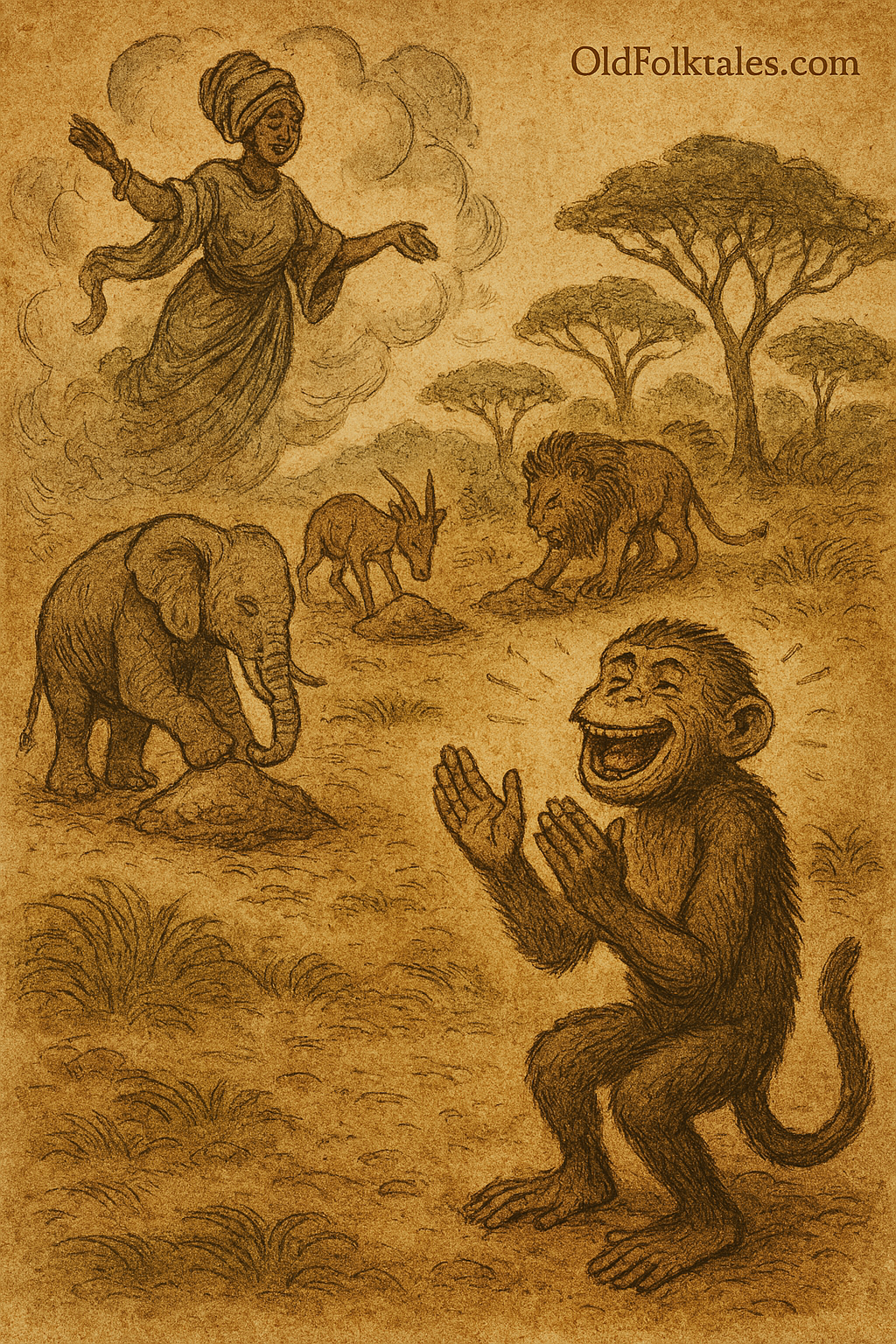
Gathering all her newly created animals around her in a great circle, Mawu’s voice rang out across the divine workshop like the sound of distant thunder. “My children,” she announced, her words carrying the weight of cosmic authority, “you remain unnamed because your true nature has yet to be revealed. Soon I will bestow upon each of you a name that will define your place in the world I am creating. But first, you must prove yourselves worthy through your actions.”
The animals listened with rapt attention as their creator continued. “I have not yet finished shaping all the creatures I envision for this world. There is still much work to be done, and I will need your help. You must work the clay for me, knead it, prepare it, make it ready for my divine touch. Through your labor, you will demonstrate your character, and through your character, you will earn your names and your destinies.”
Among all the gathered creatures, one particular animal caught Mawu’s special attention. This being possessed something extraordinary that set him apart from all the others, five perfectly formed fingers on each hand, just like the goddess herself. His dexterity and manual skill were remarkable, and Mawu saw in him tremendous potential.
Drawing this special creature aside, Mawu spoke to him in a voice filled with promise and possibility. “You, with your five fingers on each hand,” she said, her eyes gleaming with divine intent, “you have been blessed with exceptional abilities. If you work well and prove yourself diligent and worthy, I will grant you the highest honor imaginable. I will place you among men, rather than among the animals. You will walk upright, speak with wisdom, and share in the divine spark that separates humanity from all other creatures.”
The moment these words left Mawu’s lips, the animal who would later be known as Monkey felt his heart swell with an intoxicating mixture of pride and anticipation. The goddess herself had singled him out! She had recognized his superior qualities and promised him elevation above all his fellow creatures! This was beyond his wildest dreams, to become human, to transcend his animal nature, to stand at the pinnacle of creation.
Unable to contain his overwhelming excitement, Monkey immediately began to boast about his privileged status. His chest puffed out with pride as he swaggered among his fellow animals, no longer seeing them as equals but as inferior beings he would soon leave behind.
First, he approached the mighty Lion, the king of beasts himself. “Listen to what Mawu has promised me!” Monkey declared, his voice ringing with self-importance. “Tomorrow, I won’t be among you animals anymore. I’m going to become a man! Can you imagine? A man!”
Lion’s golden eyes regarded him with a mixture of curiosity and mild annoyance, but Monkey was already moving on to his next audience. He found Hyena and repeated his announcement with even greater enthusiasm, gesticulating wildly with those blessed five-fingered hands. “You won’t believe what’s going to happen to me! Mawu herself told me I’ll be transformed into a human being!”
Next came Elephant, whose ancient wisdom might have cautioned against such prideful display, but Monkey was too intoxicated by his own importance to notice any disapproving looks. He shared his secret with the great gray giant, his voice growing more boastful with each telling.
But Monkey’s excitement knew no bounds. One by one, he called each animal aside, claiming he had a special secret to share. When they approached, curious about what important news he might have, he would lean in conspiratorially and then burst forth with the same proud announcement: “Mawu is going to make me into a man! I’ll be elevated above all of you! I’ll walk upright and be like the gods themselves!”
With each telling of his tale, Monkey’s joy became more exuberant. He clapped his hands together in rhythm, creating his own celebratory music as he danced from animal to animal. “Tomorrow I change into a man!” he sang out loud, his voice carrying across the divine workspace. “Mawu herself told me that! Can you believe it? Me, a man!”
So consumed was Monkey with his boastful celebrations and his visions of his elevated future that he completely forgot about the task that Mawu had assigned to all of them. While every other animal diligently worked the clay kneading it with paws, hooves, and whatever appendages they possessed, Monkey continued his joyful parade, singing and clapping and telling anyone who would listen about his upcoming transformation.
The other animals bent their backs to the labor, understanding that their futures depended on proving their worth through dedicated work. Lions used their powerful paws to shape the clay, elephants employed their versatile trunks, and even the smallest creatures contributed what they could. The divine workshop hummed with productive activity as each being focused on the task at hand.
But not Monkey. His five-fingered hands, the very gifts that had earned him Mawu’s special attention, remained idle as he basked in his anticipated glory. The clay that was meant to be shaped by his dexterous digits lay untouched while he pursued his endless circuit of self-congratulation.
After some time had passed, Mawu decided to inspect the progress of her workers. She moved through her divine workshop with the careful attention of a master observing her apprentices, noting which animals applied themselves diligently to their assigned tasks and which ones showed signs of laziness or distraction.
As she made her rounds, Mawu’s keen divine senses immediately detected something amiss. Above the steady sounds of productive labor, the squishing of clay being kneaded, the soft grunts of effort from various animals, she could hear something else entirely. It was the sound of singing, of joyful clapping, of celebration.
Following the sound to its source, Mawu discovered the animal she had singled out for potential elevation. There he was, happier and more carefree than any other creature in the workshop, completely oblivious to the work happening around him. His hands clapped together in rhythmic joy as he continued his endless song: “Tomorrow I change into a man! Mawu herself told me that! Tomorrow I change into a man!”
The sight filled Mawu with profound disappointment and righteous anger. Here was the creature she had blessed with the greatest potential, the one she had offered the most precious gift imaginable, and he had proven himself completely unworthy of such grace. Instead of demonstrating the diligence and responsibility that would justify elevation to human status, he had shown only pride, boastfulness, and laziness.
Her voice cut through his celebration like a divine blade. “Come to me,” she commanded, and the authority in her tone immediately silenced his singing and stopped his dancing. The joy drained from his face as he realized that his creator was not pleased.
When he stood before her, trembling now instead of celebrating, Mawu delivered her final judgment. With a swift kick that carried the force of cosmic justice, she sealed his fate forever. “You will always be Monkey,” she declared, her words echoing with the finality of divine decree. “You will never walk erect. Your pride and laziness have cost you the greatest gift I could have bestowed. You had the chance to become more than an animal, but you chose to act like less than one.”
And so it was that Monkey, through his own pride and failure to fulfill his responsibilities, condemned himself and all his descendants to remain forever in the trees, always reaching upward but never achieving the elevated status that had once been within his grasp.
Moral Lesson
This West African creation tale teaches us that opportunity without effort leads to failure, while boastfulness without action breeds disappointment. Monkey’s five-fingered hands represented divine potential, but his pride and laziness squandered the chance for transformation. The story reminds us that true elevation comes not from what we’re promised, but from how we prove ourselves worthy of those promises through dedicated work and humble service.
Knowledge Check
Q1: Who is the creator goddess in this West African folktale and what is her role? A: Mawu is the creator goddess who shapes all animals from clay. She serves as both divine craftsperson and judge, offering opportunities for elevation while testing character through assigned tasks.
Q2: What made Monkey special among all the animals Mawu created? A: Monkey possessed five fingers on each hand, just like Mawu herself, which gave him exceptional dexterity and manual abilities that set him apart from other animals and caught the goddess’s attention.
Q3: What was the condition Mawu set for Monkey to become human? A: Mawu told Monkey that if he worked well at preparing clay for her continued creation work, she would elevate him to human status and place him among men rather than animals.
Q4: How did Monkey’s behavior demonstrate his unworthiness for transformation? A: Instead of working the clay as instructed, Monkey spent all his time boasting to other animals about his promised elevation, singing, clapping, and celebrating while neglecting his assigned responsibilities.
Q5: What does Monkey’s punishment symbolize in West African culture? A: Monkey’s eternal inability to walk erect represents the consequences of wasted potential and serves as a cautionary tale about how pride and laziness can cost us our greatest opportunities for advancement.
Q6: What is the deeper meaning behind this Mawu creation story? A: This folktale explains both the origin of different species and teaches moral lessons about work ethic, humility, and responsibility. It demonstrates that divine gifts must be accompanied by worthy actions to be fully realized.