In the ancient days when the gods walked closely with mortals and divine wisdom governed the affairs of earth, the great goddess Mawu maintained perfect order over all creation through her mysterious ways. Each dawn brought with it a sacred ritual that had continued unchanged for countless years: Mawu would dispatch her divine messenger to travel across the world from the moment the sun kissed the eastern horizon until it disappeared beyond the western edge of creation.
This messenger was no ordinary being, though he appeared in human form to those who encountered him along his endless journeys. Day after day, year after year, he carried out his divine mission with unwavering dedication, his true nature hidden beneath the guise of a simple traveler walking the dusty roads that connected village to village across the vast landscape.
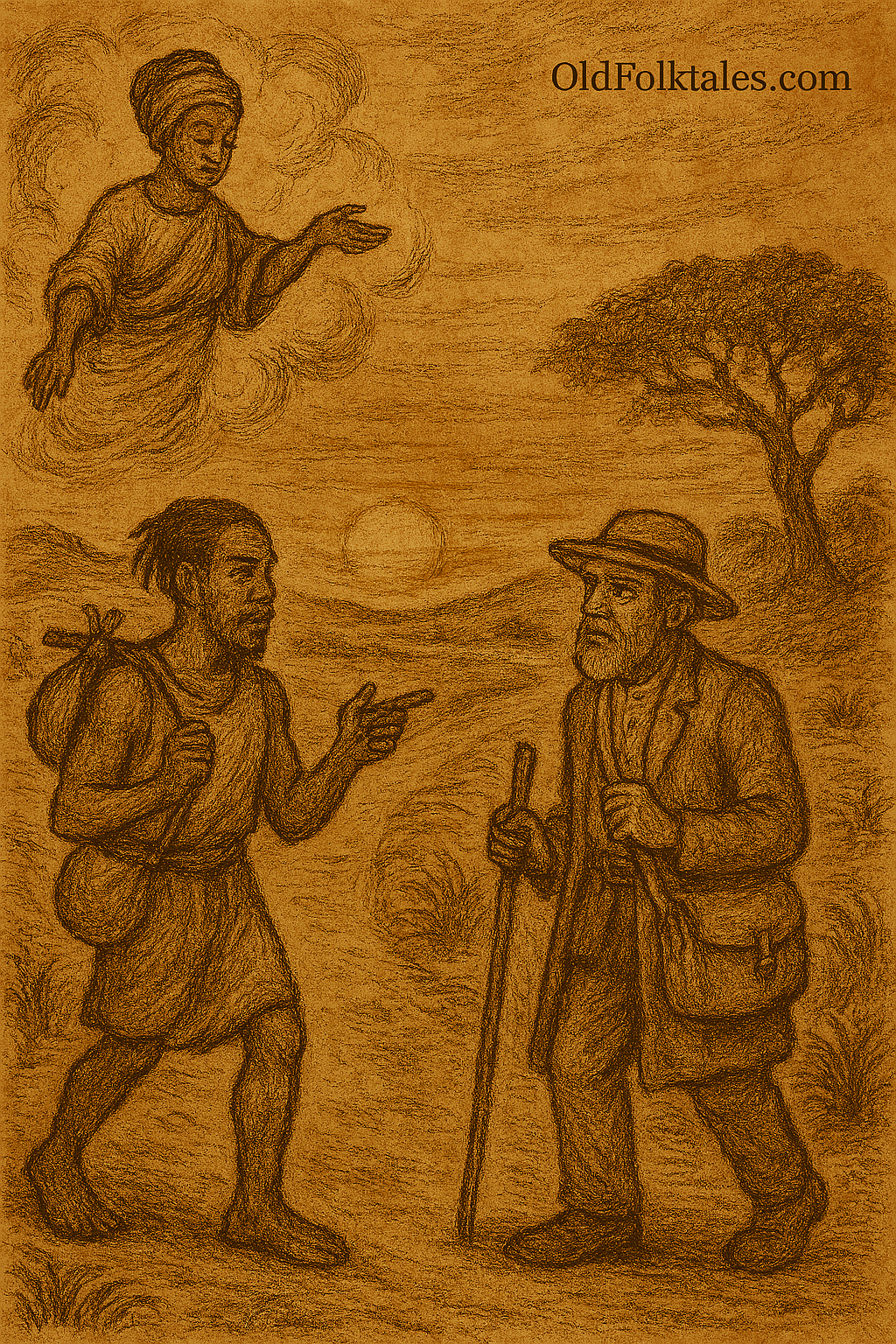
One particular evening, as the golden light of sunset painted the sky in shades of amber and crimson, the divine messenger found himself approaching the town of Adjala. The shadows had grown long, and night was beginning to settle over the land like a dark blanket. Knowing that his divine duties required rest even as mortals did, he sought shelter in a house by the roadside, following the ancient custom of hospitality that bound all travelers together.
As fate would have it, another weary traveler had also arrived at the same dwelling as darkness fell. This man was purely human, journeying on his own business through the same territories. The generous hosts, following the sacred laws of welcome, provided lodging for both strangers under the same roof, creating an unexpected companionship between the divine and the mortal.
As they settled in for the night, the divine messenger struck up conversation with his fellow traveler. “Tell me, friend,” he asked with the casual interest of one wayfarer to another, “where does your journey take you?”
The human replied with simple honesty, “I am traveling to where the sun sets, to the lands beyond the western horizon.”
“How fortunate!” exclaimed Mawu’s messenger, his eyes gleaming with what seemed like mere pleasure at finding a companion. “It is indeed life that provides us with traveling partners when we least expect them. I myself am bound for that very same destination.”
The coincidence seemed remarkable to the human traveler, and he felt blessed to have found such agreeable company for what promised to be a long and potentially lonely journey.
As the first light of dawn crept across the sky and the roosters began their morning calls, both men were awakened by a sound that pierced the peaceful morning air, the heartbroken wailing of parents in distress. The anguished cries came from the house directly beside their lodging, where the unmistakable sounds of grief and desperation had echoed through the night.
Unable to ignore such profound suffering, Mawu’s messenger approached the distressed family to inquire about the source of their sorrow. “Good people,” he asked with apparent concern, “why have you not slept all night? What troubles have kept you awake?”
Through their tears, the exhausted parents explained their torment. “We have a child here who is very, very sick,” they said, their voices breaking with fear and sleeplessness. “The little one has been suffering terribly, and we dare not rest.”
The divine messenger listened with seeming sympathy, then reached into a leather sack he carried with him, a container that held mysterious powders whose properties were known only to divine beings. He carefully measured out a portion of one particular powder and gave it to one of the men present. “Give this to the sick child,” he instructed. “This will help the situation.”
Without waiting to observe the results of his intervention, the messenger quickly returned to his companion. “We must leave this place immediately!” he urged with sudden urgency.
They had taken only a few steps away from the house when the morning air was suddenly filled with desperate shouts from behind them. “Where is the stranger? Where is the stranger?” The voices carried an urgent, searching quality, but the two travelers continued walking without looking back, soon disappearing down the road.
Their journey continued until they reached the town of Savalou, where once again they sought shelter for the night in a roadside house. The pattern of hospitality repeated itself, with generous hosts providing them with a warm place to rest.
In the deep hours before dawn, when the world lay wrapped in peaceful slumber, Mawu’s messenger quietly rose from his sleeping place. With practiced stealth, he struck flint and kindled a small flame. But instead of using this fire for warmth or light, he deliberately touched it to the dry straw of the house where they had been so graciously welcomed.
“Wake up, wake up!” he called to his companion with the same urgent tone as before. “We must leave this place immediately!”
Confused but trusting, the human traveler gathered his belongings and followed his mysterious companion out into the pre-dawn darkness. They had barely cleared the village outskirts when the night behind them erupted in chaos. The house had burst into flames, and panicked voices filled the air: “Where are the strangers? Where are the strangers who stayed here tonight?”
But the two travelers were already far down the road, their figures disappearing into the shadows of early morning. The human traveler was deeply disturbed by what he had witnessed, but something in his companion’s demeanor discouraged questions, and they continued their journey in troubled silence.
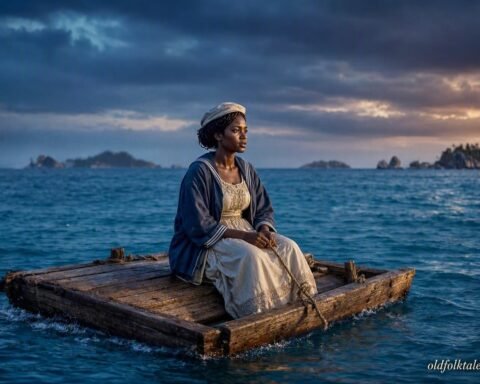
Finally, after many days of travel, they approached their destination: Badahwedji, the legendary place where the sun sets. Between them and their goal flowed a wide river, its waters reflecting the changing colors of the sky. The only way to cross was by raft, guided by those who knew the treacherous currents and hidden rocks.
An elderly man from Badahwedji had made this crossing many times, coming regularly to the riverbank to gather medicinal leaves and herbs. On this particular day, he was making his second crossing, moving slowly and carefully as befitted his advanced years and the precious cargo of healing plants he carried.
Mawu’s messenger watched the old man’s careful progress with intense attention. When the moment seemed right, he followed the elder onto the raft. The old man proceeded with cautious deliberation, testing each step and movement. But suddenly, without warning, the divine messenger stepped forward and deliberately pushed the unsuspecting elder, sending him tumbling into the rushing waters below.
This act of apparent cruelty was too much for the human traveler to bear. All the strange and disturbing incidents of their journey suddenly crystallized into a moment of horror and revulsion. He turned and began to run, fleeing from a companion who had revealed himself capable of such callous violence.
“Come back! Come back here!” called Mawu’s messenger, his voice carrying clearly across the distance. “You’re running in the wrong direction! This is where you need to be!”
But the terrified human continued to flee, calling over his shoulder, “What I have witnessed on this journey is far too much for any decent person to bear! I want no part of such cruelty and destruction!”
It was then that the divine messenger decided the time had come for truth. His voice took on a different quality, one that resonated with authority and ancient wisdom. “Stop running, friend, and listen to me carefully. I am not a man as you are. I understand your shock and horror at all you have witnessed, but I am not a human being bound by human understanding or morality.”
The fleeing traveler slowed, then stopped, compelled by something in that voice that spoke of powers beyond mortal comprehension.
“In that first house,” the messenger continued, “where you saw me give powder to the sick child, if that child had not died, both its mother and father would have perished when it took its first steps into the world. It was Mawu herself who commanded me to end that young life. You see, this couple had been blessed with many children, but this particular child carried within it a curse that would have destroyed the entire family. My action, though it appeared cruel, saved two lives by taking one.”
The human traveler listened in stunned silence as the divine being continued his explanation.
“The family whose house I set ablaze, they possess wealthy relatives who could ease their poverty, but those relatives had buried their treasure and left the family to struggle in need. When they rebuild their home and dig new foundations, they will discover the hidden wealth that was always theirs by right. My fire will lead them to prosperity.”
The messenger’s voice grew even more solemn as he explained the final act. “The old man I sent into the river, his death, though it seems cruel, prevents a great catastrophe. The king of Badahwedji has died, and the people need a new ruler. They planned to crown this old man as their king, but if he had taken the throne, disaster would have followed. Under his rule, there would be no livestock, no crops, no children born in the kingdom. The deity Sagbata would bring plague and destruction, because Mawu had decreed that this man must not rule. With a young king on the throne instead, the people will prosper with abundant herds, successful harvests, and growing families.”
As the divine messenger’s words sank in, the human began to understand the vast complexity of divine justice, how actions that appeared cruel or destructive to limited mortal perception served greater purposes in the cosmic order.
“I see into the hearts of all people,” the messenger concluded, “and Mawu sends me to observe and to act according to her perfect wisdom. You must not be troubled by what seems harsh or unfair. Throughout the years, I take many forms to carry out divine will. Sometimes I remain as you see me now. Other times I become illness and disease to remove those whose time has come. I transform into serpents to burn houses that need burning, or into any form necessary to accomplish divine purpose. When you encounter such mysteries in the course of your life, remember this journey and know that it is Mawu who sends them, and her ways are always just, even when they surpass human understanding.”
Moral Lesson
This profound West African folktale teaches us that divine justice operates on levels far beyond human comprehension. What appears to be cruelty or injustice from our limited perspective may serve greater purposes in the cosmic order. The story reminds us to trust in divine wisdom even when we cannot understand the reasons behind suffering or loss, and that sometimes apparent tragedies are actually mercies that prevent greater disasters. It calls for humility in the face of life’s mysteries and faith that ultimate justice prevails even through seemingly harsh circumstances.
Knowledge Check
Q1: Who is Mawu’s messenger and what was his daily mission in this West African folktale? A: Mawu’s messenger is a divine being who appears human but serves the goddess Mawu. His mission was to travel daily from sunrise to sunset across the earth, carrying out divine justice and observing human affairs according to Mawu’s will.
Q2: Why did the messenger give powder to the sick child in Adjala? A: The messenger gave powder to kill the sick child because Mawu had ordained that if the child lived and took its first steps, both its parents would die. By ending one life, he saved two lives and prevented the destruction of a family with many children.
Q3: What was the divine purpose behind burning the house in Savalou? A: The messenger burned the house so that when the family rebuilt and dug new foundations, they would discover buried treasure left by wealthy relatives. The fire was meant to lead them from poverty to prosperity by revealing hidden wealth.
Q4: Why did Mawu’s messenger push the old man into the river at Badahwedji? A: The old man was destined to become king, but under his rule, the kingdom would suffer complete devastation, no livestock, crops, or children. The deity Sagbata would bring plague because Mawu decreed this man must not rule. His death allowed a young king to take the throne and bring prosperity.
Q5: What does this folktale teach about the nature of divine justice in West African spirituality? A: The story teaches that divine justice operates beyond human understanding and that actions appearing cruel or unfair may serve greater purposes. Mawu’s wisdom encompasses the bigger picture, preventing greater tragedies through seemingly harsh interventions.
Q6: What cultural significance does Sagbata have in this Dahomey folktale? A: Sagbata is a deity associated with plague and destruction in West African tradition. The mention of Sagbata threatening the kingdom represents divine punishment that would follow if the wrong king ruled, emphasizing the cosmic consequences of defying divine will.