Long ago, when the world was still being shaped and the gods walked close to humankind, there lived a son of Ananunamed Azo. He was restless, strong willed, and known everywhere for his refusal to obey. No authority could bend him, and no command could restrain him. His parents tried to guide him, but his spirit remained untamed. At last, weary of his endless disobedience, they sold him away.
Yet wherever Azo went, his stubbornness followed. Those who bought him soon grew tired of his defiance and passed him on. In time, he was sold to none other than Death himself.
When Death claimed Azo, he said with cold authority, “In my house there is no room for insults or rebellion. You will learn obedience here.”
To test him, Death planted a field of millet and ordered, “Guard this field. When the birds come, you must drive them away.”
But Azo laughed and replied, “I will not chase birds from a field. That is not my work.”
Death grew stern. “You are my servant. You must do as I command.”
Still, Azo mocked him. “Look at this man with long eyelashes who thinks he can command me.”
Fury filled Death, and he warned, “Do you not know what happens to one who insults me?”
But Azo answered with bold defiance. “You will do nothing.”
That night, Death locked Azo in a dark room without food. “You will perish here,” he declared. Yet Azo was cunning. He knew Death’s plan and resolved never to sleep, for he understood that Death would strike the moment his eyes closed. For seven nights and seven days he remained awake, fighting exhaustion with sheer stubbornness.
On the seventh day, Death came expecting to find him lifeless. Instead, Azo was still alive, though weary and weak. Furious, Death cried out, “You have mocked me, but you cannot escape me forever.”
It was then that Sagbata, the god of the earth, and Hevioso, the god of the sky and thunder, appeared. They had long been observing the quarrels and stubbornness of Azo, and they saw how his defiance upset the balance of the world. The time had come to establish clear boundaries between the realms.
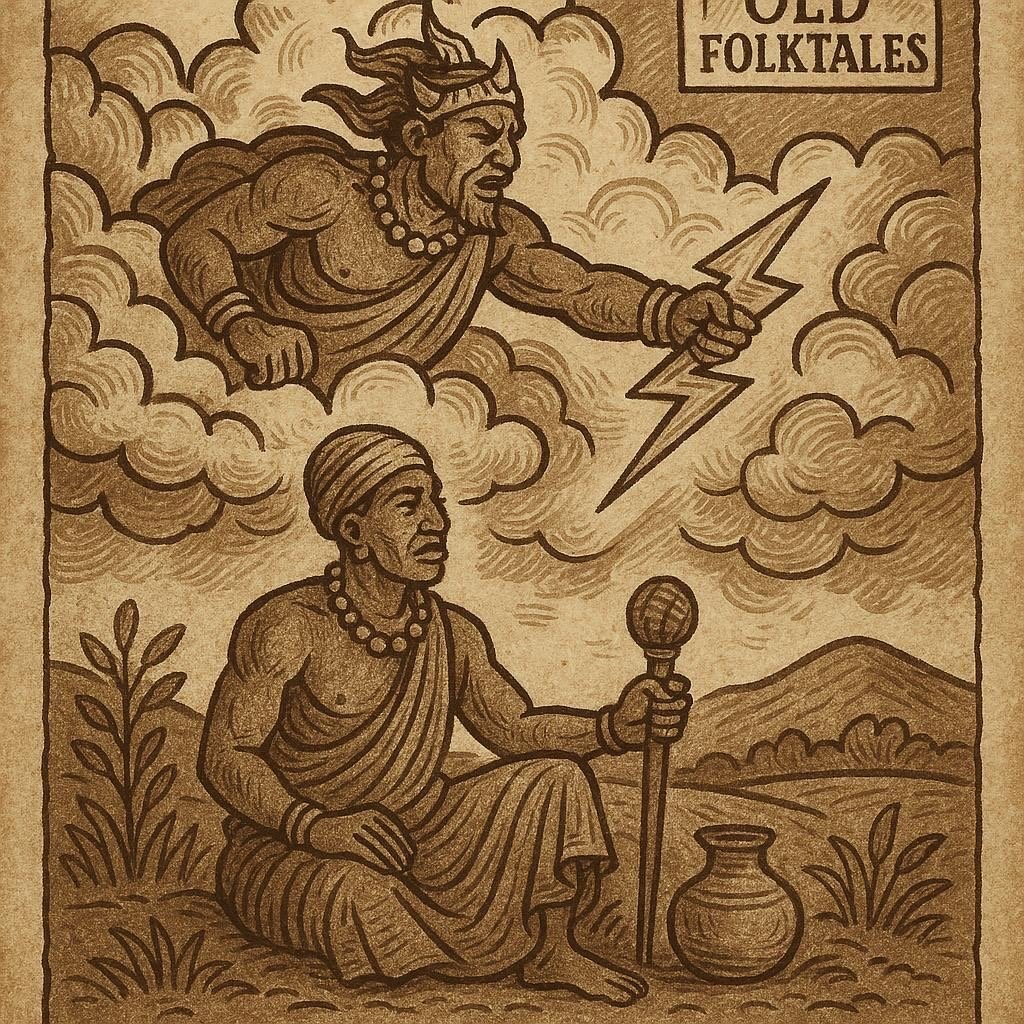
Sagbata spoke first with a voice that carried the weight of mountains. “The earth belongs to me. I will command the soil, the harvest, and the life that grows from it.”
Hevioso answered with a voice that rumbled like thunder. “The sky is mine. I will command the rains, the storms, and the fire of lightning.”
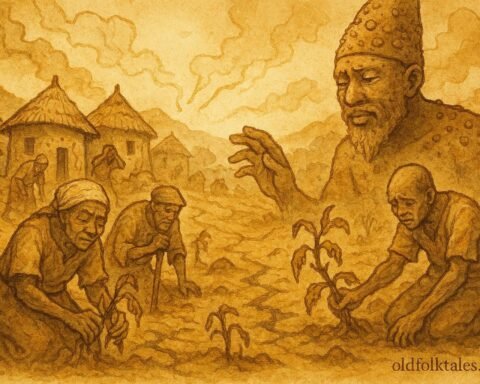
Thus, before the eyes of all, the brothers set their boundaries. Sagbata stretched his hands over the ground, and the earth trembled as if bowing to his rule. Hevioso raised his arms to the heavens, and clouds gathered while lightning flashed in acknowledgment of his authority.
The people understood from that day that there must always be order between earth and sky. Each god had his realm, and harmony depended on respecting those divisions. Azo, who had mocked both men and gods, learned that his defiance would never prevail against divine law.
From then on, Sagbata was honored whenever the harvest was plentiful, for his power made the land fertile. Hevioso was revered when the rains came or when thunder warned of his might, for he controlled the sky above. The world flourished because the boundaries were set, and balance was restored.
Moral Lesson
The story teaches that balance and respect for boundaries are essential for harmony. The defiance of Azo showed that stubborn pride leads only to conflict and downfall. True order was established when Sagbata and Hevioso defined their realms. The moral is clear: peace is found in respecting limits, whether between people or between the forces of nature.
Knowledge Check
Who was Azo in The Rule of Sky and Earth Delimited: Sagbata and Hevioso’s Boundaries?
Azo was the son of Ananu, known for his stubborn disobedience and defiance against all authority.Why did Death grow angry with Azo?
Because Azo refused to guard the millet field and mocked Death with insults.How did Azo try to survive after being locked up by Death?
He refused to sleep for seven days, knowing that Death would kill him if he closed his eyes.What role did Sagbata play in the story?
Sagbata declared authority over the earth, the soil, and the harvest.What did Hevioso claim as his realm?
Hevioso claimed the sky, controlling rain, storms, and lightning.What is the main moral lesson of the tale?
The story teaches the importance of respecting boundaries and maintaining balance to ensure peace and harmony.Cultural Origin: Dahomean (Fon), Beninese