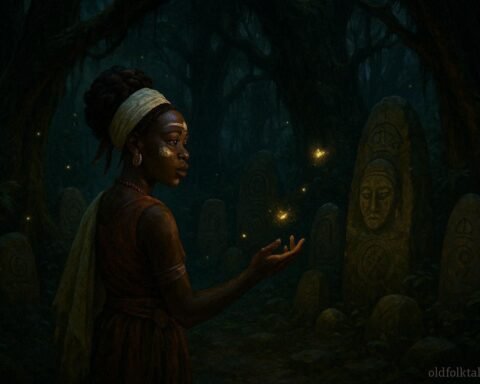
Long ago, in the kingdom of Dahomey, the world was without vodun. Life moved in strange cycles, pregnant women sometimes bore goats, and goats could give birth to men. Amid this confusion, a woman named Hwandjelè arrived from the distant land of Adja. She carried with her knowledge that would transform Dahomey forever.
Hwandjelè, a trader of indigo, had long observed the mysteries of life in her homeland. She saw men walking behind goats and goats trailing after women. Curious, she asked the people, “Who bears these creatures?” And they answered, “A woman bears men, and an animal bears animals.”
At this time, Agadja, the king of Dahomey, lived with his wife Naè Adono. Their marriage had yet to bring them true happiness. One market day, Naè came to her husband and said, “I saw a woman from Adja who knows the rites to make men bear men and goats bear goats.” Intrigued, Agadja sent messengers to summon Hwandjelè.
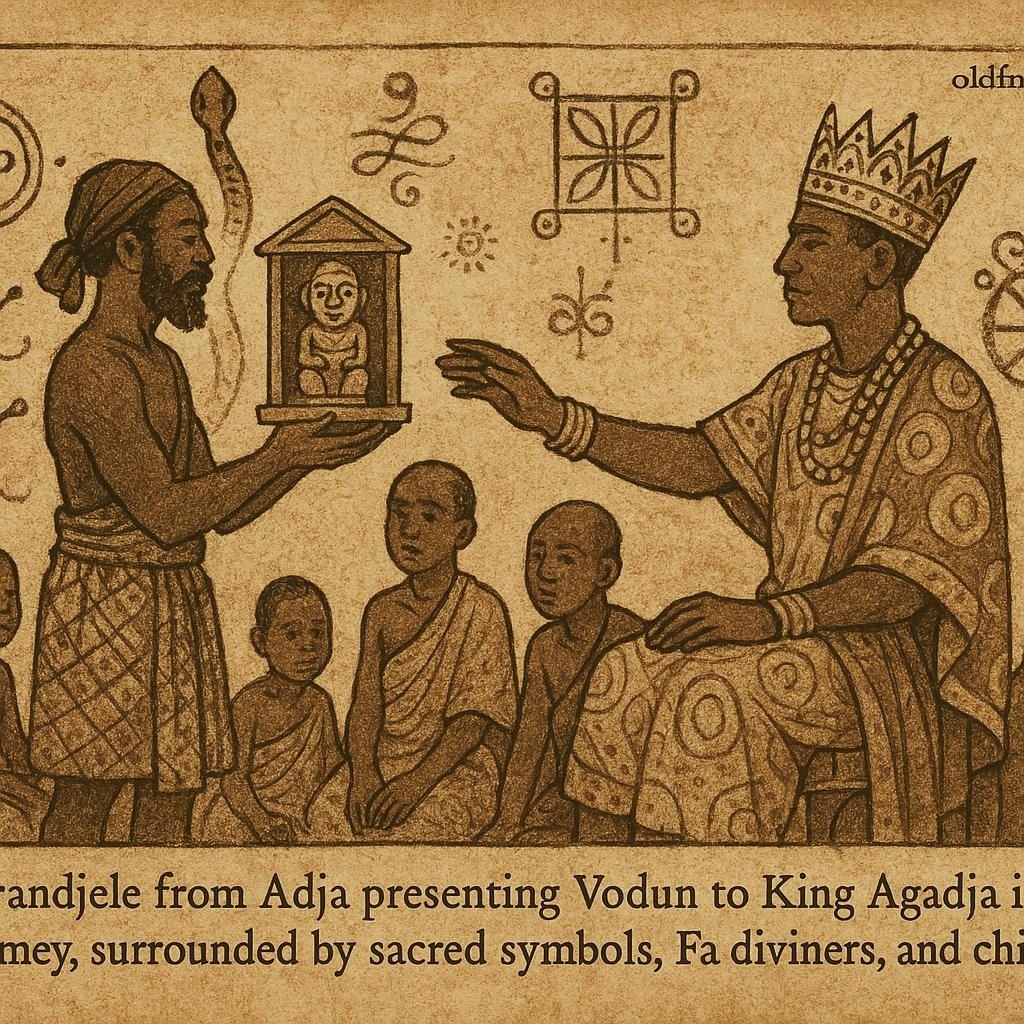
Hwandjelè had a husband and a son in Adja, yet she obeyed the king’s call. Arriving in Dahomey, she explained, “In my village, women give birth to humans, and animals bear animals. This is because we honor the vodun. You have none here, so nature is unbalanced.”
Agadja was fascinated. “Bring these vodun to our land,” he commanded. Hwandjelè asked for all necessary instruments, and soon she brought forth Sagabata, Hevioso, Ogu, Lisa, Da, Aido-Hwedo, Nesuhwe, Tovodun, Fa, Minona, and Boko Legba, the powerful spirits that would guide the people and sanctify their lives.
Seeing her wisdom, Agadja asked Hwandjelè to join his household as a wife. She consented and bore him a son named Tegbesu. In those days, Dahomey, like later dealings with foreigners, had a tradition of sending sons to the neighboring kingdom of Oyo as tribute. Each chief had to provide his own son, along with other men of his village. Even the king himself had to send one of his sons.
When Tegbesu grew old enough, it became time to send him as part of this tribute. Agadja’s other wives, eager to protect their own sons, begged the king not to send Tegbesu. Agadja initially agreed, but Hwandjelè intervened. “Your son must go,” she said. “The kingdom cannot falter. Do not let personal desire endanger our people.”
Thus, Tegbesu departed with the other young men for Oyo. There, he served as a messenger for the king, earning respect for his intelligence and integrity. On one journey, he met a diviner with the striking appearance of a white-bull-headed figure. The diviner asked Tegbesu, “Where do you, who I meet on the road so often, come from?” Tegbesu promised to take the diviner to his father, Agadja.
When they arrived, the diviner, named Djiso, and a second, called Gongon, were welcomed by the king. Both carried their own Fa, sacred tools for divination and guidance. Agadja provided them with a place to establish the rituals of Fa, ensuring that the knowledge of the vodun would endure for generations.
As Agadja’s death approached, he reflected on the importance of these sacred practices. “Why have you shown such interest in my son Tegbesu?” he asked the diviners. Their presence ensured that the kingdom would continue to respect the balance between humans, animals, and the divine, an order introduced by Hwandjelè herself.
Thanks to Hwandjelè’s wisdom and courage, the vodun became rooted in Dahomey. Sagbata, Hevioso, and the other spirits guided the people, establishing sacred rites, moral codes, and divine oversight. Through Tegbesu, the kingdom maintained strong connections with neighboring powers, blending human governance with divine order.
Moral Lesson
This folktale teaches that divine wisdom and adherence to sacred law are essential for social order and the prosperity of a kingdom. One person’s courage and knowledge can shape the destiny of an entire people.
Knowledge Check
Who brought the vodun to Dahomey?
– Hwandjelè from Adja.
Why was Dahomey initially without vodun?
– Lack of divine ritual caused confusion in birth and life.
Name three vodun brought by Hwandjelè.
– Sagabata, Hevioso, Lisa.
Who was Tegbesu?
– Son of Agadja and Hwandjelè, sent to Oyo as tribute.
What is Fa?
– A sacred tool for divination and guidance in Dahomey.
Why is Hwandjelè’s role significant?
– She introduced order, ritual, and divine knowledge to Dahomey.
Source: Beninese Folktale